

12.5 Oxygen Supply in Marine Animals
389
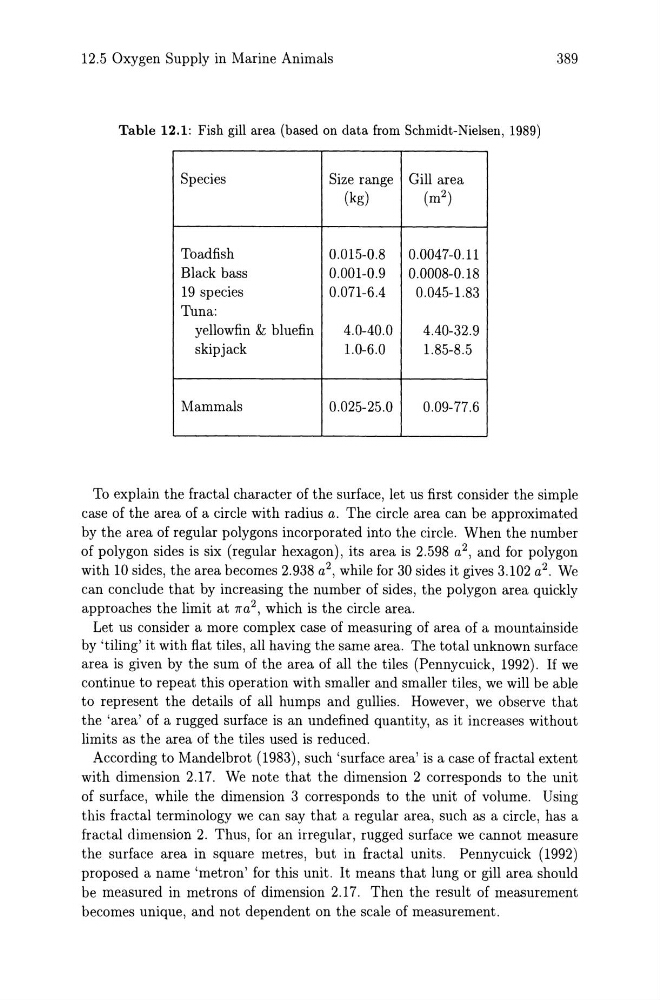
Table 12.1: Fish gill area (based on data from Schmidt-Nielsen, 1989)
Species
Size range Gill area
(kg)
(m 2 )
Toadfish
0.015-0.8
0.0047-0.11
Black bass
0.001-0.9
0.0008-0.18
19 species
0.071-6.4
0.045-l.83
Tuna:
yellowfin & bluefin
4.0-40.0
4.40-32.9
skipjack
l.0-6.0
l.85-8.5
Mammals
0.025-25.0
0.09-77.6
To explain the fractal character of the surface, let us first consider the simple
case of the area of a circle with radius a. The circle area can be approximated
by the area of regular polygons incorporated into the circle. When the number
of polygon sides is six (regular hexagon), its area is 2.598 a 2 , and for polygon
with 10 sides, the area becomes 2.938 a 2 , while for 30 sides it gives 3.102 a 2 . We
can conclude that by increasing the number of sides, the polygon area quickly
approaches the limit at '/ra 2 , which is the circle area.
Let us consider a more complex case of measuring of area of a mountainside
by 'tiling' it with flat tiles, all having the same area. The total unknown surface
area is given by the sum of the area of all the tiles (Pennycuick, 1992). If we
continue to repeat this operation with smaller and smaller tiles, we will be able
to represent the details of all humps and gullies. However, we observe that
the 'area' of a rugged surface is an undefined quantity, as it increases without
limits as the area of the tiles used is reduced.
According to Mandelbrot (1983), such 'surface area' is a case of fractal extent
with dimension 2.17. We note that the dimension 2 corresponds to the unit
of surface, while the dimension 3 corresponds to the unit of volume. Using
this fractal terminology we can say that a regular area, such as a circle, has a
fractal dimension 2. Thus, for an irregular, rugged surface we cannot measure
the surface area in square metres, but in fractal units. Pennycuick (1992)
proposed a name 'metron' for this unit. It means that lung or gill area should
be measured in metrons of dimension 2.17. Then the result of measurement
becomes unique, and not dependent on the scale of measurement.
389
Table 12.1: Fish gill area (based on data from Schmidt-Nielsen, 1989)
Species
Size range Gill area
(kg)
(m 2 )
Toadfish
0.015-0.8
0.0047-0.11
Black bass
0.001-0.9
0.0008-0.18
19 species
0.071-6.4
0.045-l.83
Tuna:
yellowfin & bluefin
4.0-40.0
4.40-32.9
skipjack
l.0-6.0
l.85-8.5
Mammals
0.025-25.0
0.09-77.6
To explain the fractal character of the surface, let us first consider the simple
case of the area of a circle with radius a. The circle area can be approximated
by the area of regular polygons incorporated into the circle. When the number
of polygon sides is six (regular hexagon), its area is 2.598 a 2 , and for polygon
with 10 sides, the area becomes 2.938 a 2 , while for 30 sides it gives 3.102 a 2 . We
can conclude that by increasing the number of sides, the polygon area quickly
approaches the limit at '/ra 2 , which is the circle area.
Let us consider a more complex case of measuring of area of a mountainside
by 'tiling' it with flat tiles, all having the same area. The total unknown surface
area is given by the sum of the area of all the tiles (Pennycuick, 1992). If we
continue to repeat this operation with smaller and smaller tiles, we will be able
to represent the details of all humps and gullies. However, we observe that
the 'area' of a rugged surface is an undefined quantity, as it increases without
limits as the area of the tiles used is reduced.
According to Mandelbrot (1983), such 'surface area' is a case of fractal extent
with dimension 2.17. We note that the dimension 2 corresponds to the unit
of surface, while the dimension 3 corresponds to the unit of volume. Using
this fractal terminology we can say that a regular area, such as a circle, has a
fractal dimension 2. Thus, for an irregular, rugged surface we cannot measure
the surface area in square metres, but in fractal units. Pennycuick (1992)
proposed a name 'metron' for this unit. It means that lung or gill area should
be measured in metrons of dimension 2.17. Then the result of measurement
becomes unique, and not dependent on the scale of measurement.