

12.2 Flow in Pipes Revisited
381
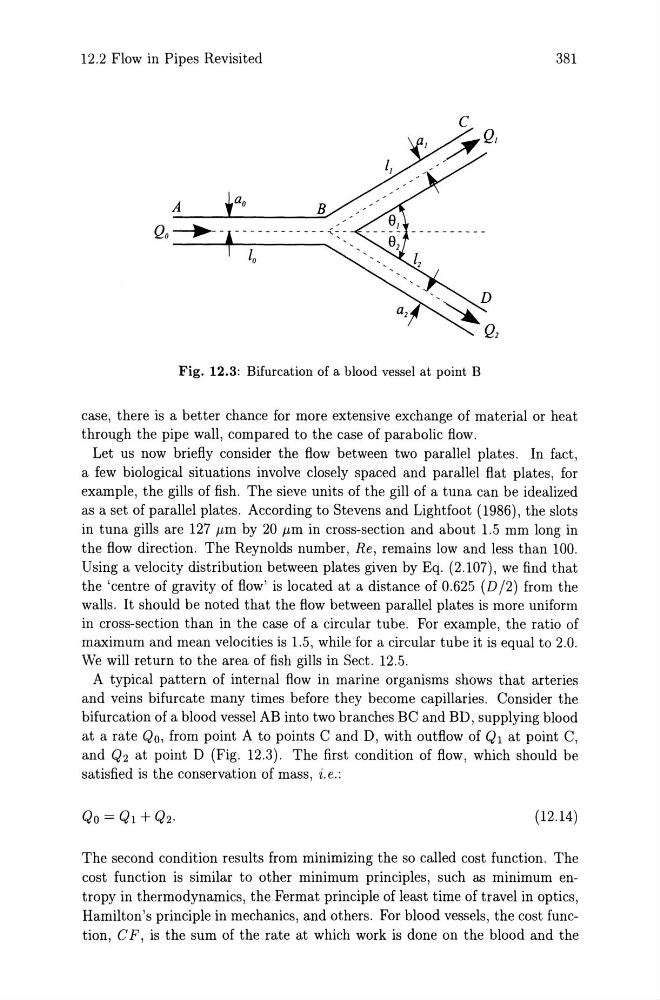
Fig. 12.3: Bifurcation of a blood vessel at point B
case, there is a better chance for more extensive exchange of material or heat
through the pipe wall, compared to the case of parabolic flow.
Let us now briefly consider the flow between two parallel plates. In fact,
a few biological situations involve closely spaced and parallel flat plates, for
example, the gills of fish. The sieve units of the gill of a tuna can be idealized
as a set of parallel plates. According to Stevens and Lightfoot (1986), the slots
in tuna gills are 127 f.Lm by 20 f.Lm in cross-section and about 1.5 mm long in
the flow direction. The Reynolds number, Re, remains low and less than 100.
Using a velocity distribution between plates given by Eq. (2.107), we find that
the 'centre of gravity of flow' is located at a distance of 0.625 (D /2) from the
walls. It should be noted that the flow between parallel plates is more uniform
in cross-section than in the case of a circular tube. For example, the ratio of
maximum and mean velocities is 1.5, while for a circular tube it is equal to 2.0.
We will return to the area of fish gills in Sect. 12.5.
A typical pattern of internal flow in marine organisms shows that arteries
and veins bifurcate many times before they become capillaries. Consider the
bifurcation of a blood vessel AB into two branches BC and BD, supplying blood
at a rate Qo, from point A to points C and D, with outflow of Ql at point C,
and Q2 at point D (Fig. 12.3). The first condition of flow, which should be
satisfied is the conservation of mass, i.e.:
(12.14)
The second condition results from minimizing the so called cost function. The
cost function is similar to other minimum principles, such as minimum entropy in thermodynamics, the Fermat principle of least time of travel in optics,
Hamilton's principle in mechanics, and others. For blood vessels, the cost function, C F, is the sum of the rate at which work is done on the blood and the
381
Fig. 12.3: Bifurcation of a blood vessel at point B
case, there is a better chance for more extensive exchange of material or heat
through the pipe wall, compared to the case of parabolic flow.
Let us now briefly consider the flow between two parallel plates. In fact,
a few biological situations involve closely spaced and parallel flat plates, for
example, the gills of fish. The sieve units of the gill of a tuna can be idealized
as a set of parallel plates. According to Stevens and Lightfoot (1986), the slots
in tuna gills are 127 f.Lm by 20 f.Lm in cross-section and about 1.5 mm long in
the flow direction. The Reynolds number, Re, remains low and less than 100.
Using a velocity distribution between plates given by Eq. (2.107), we find that
the 'centre of gravity of flow' is located at a distance of 0.625 (D /2) from the
walls. It should be noted that the flow between parallel plates is more uniform
in cross-section than in the case of a circular tube. For example, the ratio of
maximum and mean velocities is 1.5, while for a circular tube it is equal to 2.0.
We will return to the area of fish gills in Sect. 12.5.
A typical pattern of internal flow in marine organisms shows that arteries
and veins bifurcate many times before they become capillaries. Consider the
bifurcation of a blood vessel AB into two branches BC and BD, supplying blood
at a rate Qo, from point A to points C and D, with outflow of Ql at point C,
and Q2 at point D (Fig. 12.3). The first condition of flow, which should be
satisfied is the conservation of mass, i.e.:
(12.14)
The second condition results from minimizing the so called cost function. The
cost function is similar to other minimum principles, such as minimum entropy in thermodynamics, the Fermat principle of least time of travel in optics,
Hamilton's principle in mechanics, and others. For blood vessels, the cost function, C F, is the sum of the rate at which work is done on the blood and the