

382
12 Internal Flows in Marine Organisms
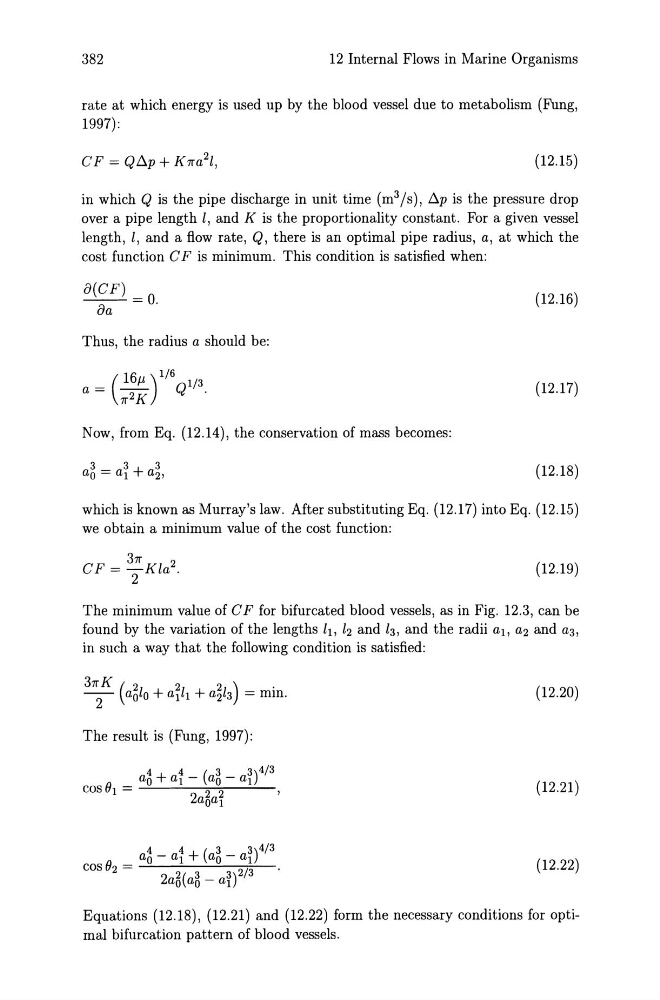
rate at which energy is used up by the blood vessel due to metabolism (Fung,
1997):
(12.15)
in which Q is the pipe discharge in unit time (m 3 /s), 6.p is the pressure drop
over a pipe length l, and K is the proportionality constant. For a given vessel
length, l, and a flow rate, Q, there is an optimal pipe radius, a, at which the
cost function C F is minimum. This condition is satisfied when:
a(CF) = O.
aa
Thus, the radius a should be:
(
1611 ) 1/6
_ _ t'"_
Ql/3
a -
2
.
7rK
Now, from Eq. (12.14), the conservation of mass becomes:
(12.16)
(12.17)
(12.18)
which is known as Murray's law. After substituting Eq. (12.17) into Eq. (12.15)
we obtain a minimum value of the cost function:
(12.19)
The minimum value of C F for bifurcated blood vessels, as in Fig. 12.3, can be
found by the variation of the lengths h, hand l3, and the radii aI, a2 and a3,
in such a way that the following condition is satisfied:
(12.20)
The result is (Fung, 1997):
(12.21)
(12.22)
Equations (12.18), (12.21) and (12.22) form the necessary conditions for optimal bifurcation pattern of blood vessels.
12 Internal Flows in Marine Organisms
rate at which energy is used up by the blood vessel due to metabolism (Fung,
1997):
(12.15)
in which Q is the pipe discharge in unit time (m 3 /s), 6.p is the pressure drop
over a pipe length l, and K is the proportionality constant. For a given vessel
length, l, and a flow rate, Q, there is an optimal pipe radius, a, at which the
cost function C F is minimum. This condition is satisfied when:
a(CF) = O.
aa
Thus, the radius a should be:
(
1611 ) 1/6
_ _ t'"_
Ql/3
a -
2
.
7rK
Now, from Eq. (12.14), the conservation of mass becomes:
(12.16)
(12.17)
(12.18)
which is known as Murray's law. After substituting Eq. (12.17) into Eq. (12.15)
we obtain a minimum value of the cost function:
(12.19)
The minimum value of C F for bifurcated blood vessels, as in Fig. 12.3, can be
found by the variation of the lengths h, hand l3, and the radii aI, a2 and a3,
in such a way that the following condition is satisfied:
(12.20)
The result is (Fung, 1997):
(12.21)
(12.22)
Equations (12.18), (12.21) and (12.22) form the necessary conditions for optimal bifurcation pattern of blood vessels.