

380
12 Internal Flows in Marine Organisms
The formula (12.9) is valid for laminar flow only, and is not valid for large
diameter tubes or large velocities.
From Fig. 12.2, it is clear that discharge through an elementary annulus,
21l'ru(r)~r, depends on the distance of the annulus from pipe wall (or axis).
Although close to the pipe axis the velocity u(r) is very high, the area of the
annulus is very small. On the other hand, close to the pipe wall the velocity is
very small but the annulus area is large. Therefore, in both limiting cases, the
elementary discharge is small.
In general, using the velocity Eq. (12.1) we can represent the discharge
through the elementary annulus situated at a distance r from the pipe axis
as follows:
dQ = 21l'ru(r )dr,
(12.10)
or:
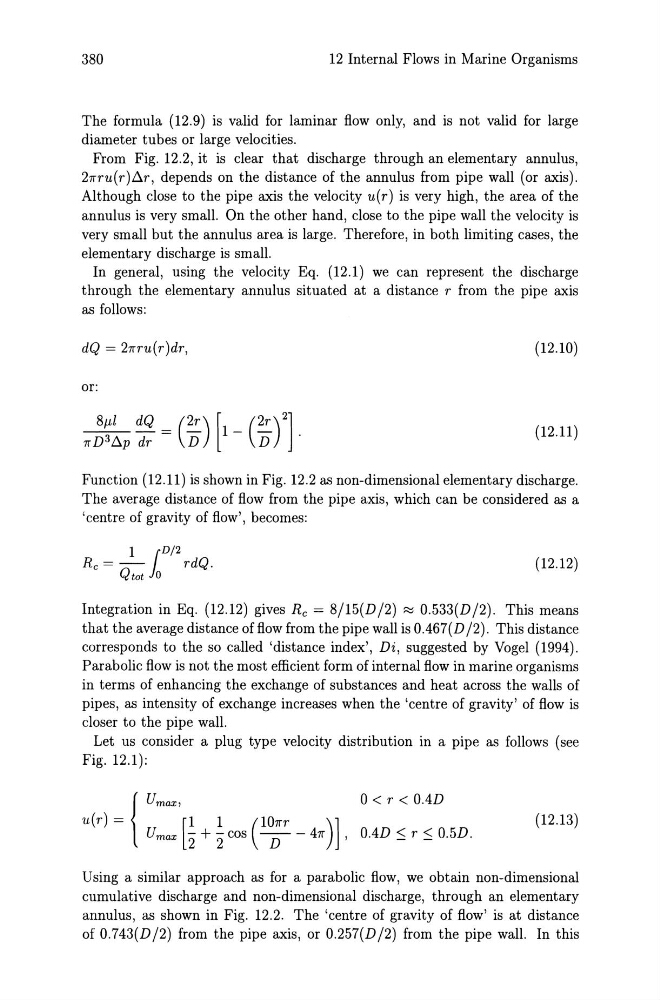
8p,1 dQ = (2r) [1- (2r)2] .
1l'D3~p dr
D
D
(12.11)
Function (12.11) is shown in Fig. 12.2 as non-dimensional elementary discharge.
The average distance of flow from the pipe axis, which can be considered as a
'centre of gravity of flow', becomes:
1 lD/2
Rc=rdQ.
Qtot 0
(12.12)
Integration in Eq. (12.12) gives Rc = 8/15(D /2) ~ 0.533(D /2). This means
that the average distance of flow from the pipe wall is 0.467(D /2). This distance
corresponds to the so called 'distance index', Di, suggested by Vogel (1994).
Parabolic flow is not the most efficient form of internal flow in marine organisms
in terms of enhancing the exchange of substances and heat across the walls of
pipes, as intensity of exchange increases when the 'centre of gravity' of flow is
closer to the pipe wall.
Let us consider a plug type velocity distribution in a pipe as follows (see
Fig. 12.1):
u(r) = {U
max '[l 1
(101l'r
)]
U
- + - cos - - - 41l'
max 2 2
D
'
0< r < O.4D
O.4D ~ r ~ 0.5D.
(12.13)
Using a similar approach as for a parabolic flow, we obtain non-dimensional
cumulative discharge and non-dimensional discharge, through an elementary
annulus, as shown in Fig. 12.2. The 'centre of gravity of flow' is at distance
of 0.743(D/2) from the pipe axis, or 0.257(D/2) from the pipe wall. In this
12 Internal Flows in Marine Organisms
The formula (12.9) is valid for laminar flow only, and is not valid for large
diameter tubes or large velocities.
From Fig. 12.2, it is clear that discharge through an elementary annulus,
21l'ru(r)~r, depends on the distance of the annulus from pipe wall (or axis).
Although close to the pipe axis the velocity u(r) is very high, the area of the
annulus is very small. On the other hand, close to the pipe wall the velocity is
very small but the annulus area is large. Therefore, in both limiting cases, the
elementary discharge is small.
In general, using the velocity Eq. (12.1) we can represent the discharge
through the elementary annulus situated at a distance r from the pipe axis
as follows:
dQ = 21l'ru(r )dr,
(12.10)
or:
8p,1 dQ = (2r) [1- (2r)2] .
1l'D3~p dr
D
D
(12.11)
Function (12.11) is shown in Fig. 12.2 as non-dimensional elementary discharge.
The average distance of flow from the pipe axis, which can be considered as a
'centre of gravity of flow', becomes:
1 lD/2
Rc=rdQ.
Qtot 0
(12.12)
Integration in Eq. (12.12) gives Rc = 8/15(D /2) ~ 0.533(D /2). This means
that the average distance of flow from the pipe wall is 0.467(D /2). This distance
corresponds to the so called 'distance index', Di, suggested by Vogel (1994).
Parabolic flow is not the most efficient form of internal flow in marine organisms
in terms of enhancing the exchange of substances and heat across the walls of
pipes, as intensity of exchange increases when the 'centre of gravity' of flow is
closer to the pipe wall.
Let us consider a plug type velocity distribution in a pipe as follows (see
Fig. 12.1):
u(r) = {U
max '[l 1
(101l'r
)]
U
- + - cos - - - 41l'
max 2 2
D
'
0< r < O.4D
O.4D ~ r ~ 0.5D.
(12.13)
Using a similar approach as for a parabolic flow, we obtain non-dimensional
cumulative discharge and non-dimensional discharge, through an elementary
annulus, as shown in Fig. 12.2. The 'centre of gravity of flow' is at distance
of 0.743(D/2) from the pipe axis, or 0.257(D/2) from the pipe wall. In this