

11.4 Swimming Strategy
375
observations in the field showed that intermittent swimming is used for feeding
purposes. Cod of 26 cm and 30 cm length used the intermittent swimming mode
to save energy, with the ratio, R, as low as 0.42 and 0.36, respectively. Saithe
of 35 cm length swim at a mean velocity of U / L = 5 s-l but can accelerate
during the burst phase to about a/ L = 10 s-2, wherle a is the acceleration. As
a result, intermittent swimming in this case is 2.5 times cheaper than constant
swimming.
The proximity of the sea surface induces extra drag on swimming animals.
This is especially true for air-breathing aquatic mammals, such as whales and
dolphins, which experience higher drag when touching the sea surface (Hertel,
1969; Newman, 1977). The energy generated by a swimming animal is partly
used to produce surface waves. If the height of surface waves is equal to H,
then the energy wasted on wave formation (per unit area) is equal to 1/8 pgH2.
Webb et al. (1991) found that about 70% of the mechanical energy used for
propulsion by trout in deep water was dispersed in the form of waves when the
fish was just below the surface.
At the end of this section we will consider another mode of swimming, used
by dolphins, which is very interesting from a fluid mechanics point of view.
Dolphins exhibit at least three modes of swimming (Au and Weihs, 1980).
In unhurried motion, they break the surface gently, often showing little more
than the blowhole. At cruising speed of the order of 3-3.5 mis, they swim just
beneath the surface with a little splashing. However in the fastest 'running'
mode, the dolphins clear the water in sequential, parabolic leaps. Leaps are
accompanied by considerable splashing and interspersed with brief subsurface
swimming. Let us compare, following Au and Weihs (1980), the efficiency of
dolphin swimming with and without leaping.
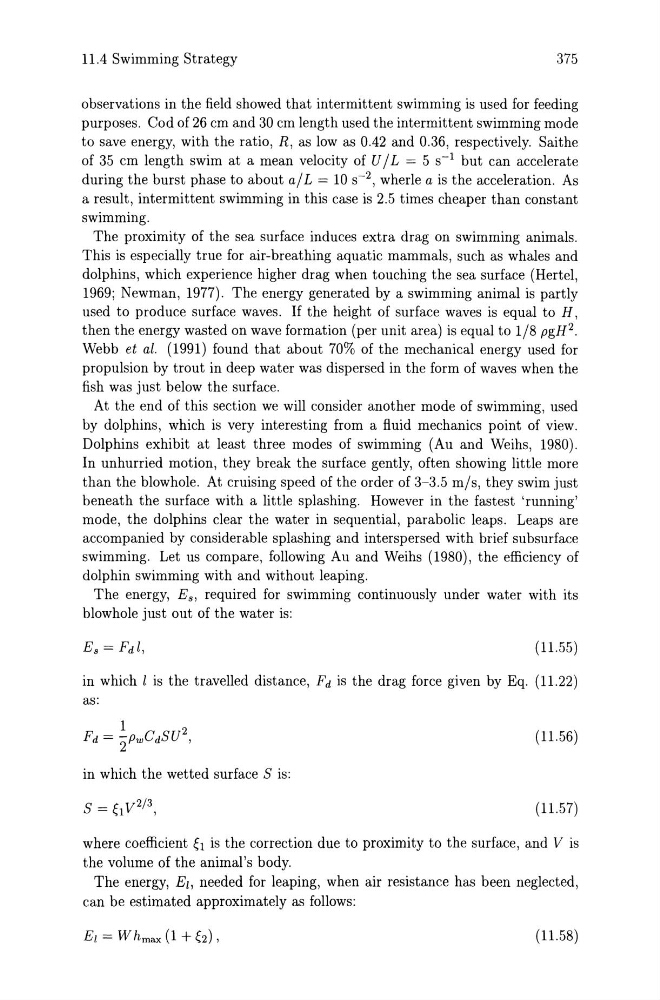
The energy, E s , required for swimming continuously under water with its
blowhole just out of the water is:
(11.55)
in which I is the travelled distance, Fd is the drag force given by Eq. (11.22)
as:
(11.56)
in which the wetted surface Sis:
(11.57)
where coefficient 6 is the correction due to proximity to the surface, and V is
the volume of the animal's body.
The energy, El, needed for leaping, when air resistance has been neglected,
can be estimated approximately as follows:
El = W hmax (1 + 6) ,
(11.58)
375
observations in the field showed that intermittent swimming is used for feeding
purposes. Cod of 26 cm and 30 cm length used the intermittent swimming mode
to save energy, with the ratio, R, as low as 0.42 and 0.36, respectively. Saithe
of 35 cm length swim at a mean velocity of U / L = 5 s-l but can accelerate
during the burst phase to about a/ L = 10 s-2, wherle a is the acceleration. As
a result, intermittent swimming in this case is 2.5 times cheaper than constant
swimming.
The proximity of the sea surface induces extra drag on swimming animals.
This is especially true for air-breathing aquatic mammals, such as whales and
dolphins, which experience higher drag when touching the sea surface (Hertel,
1969; Newman, 1977). The energy generated by a swimming animal is partly
used to produce surface waves. If the height of surface waves is equal to H,
then the energy wasted on wave formation (per unit area) is equal to 1/8 pgH2.
Webb et al. (1991) found that about 70% of the mechanical energy used for
propulsion by trout in deep water was dispersed in the form of waves when the
fish was just below the surface.
At the end of this section we will consider another mode of swimming, used
by dolphins, which is very interesting from a fluid mechanics point of view.
Dolphins exhibit at least three modes of swimming (Au and Weihs, 1980).
In unhurried motion, they break the surface gently, often showing little more
than the blowhole. At cruising speed of the order of 3-3.5 mis, they swim just
beneath the surface with a little splashing. However in the fastest 'running'
mode, the dolphins clear the water in sequential, parabolic leaps. Leaps are
accompanied by considerable splashing and interspersed with brief subsurface
swimming. Let us compare, following Au and Weihs (1980), the efficiency of
dolphin swimming with and without leaping.
The energy, E s , required for swimming continuously under water with its
blowhole just out of the water is:
(11.55)
in which I is the travelled distance, Fd is the drag force given by Eq. (11.22)
as:
(11.56)
in which the wetted surface Sis:
(11.57)
where coefficient 6 is the correction due to proximity to the surface, and V is
the volume of the animal's body.
The energy, El, needed for leaping, when air resistance has been neglected,
can be estimated approximately as follows:
El = W hmax (1 + 6) ,
(11.58)