

376
11 Locomotion of Marine Animals
in which W is the dolphin's weight, hmax is the maximum height of the centre
of gravity of the dolphin's body above still water level, and 6 is the correction
coefficient due to spray when the dolphin emerges from the water.
From ballistic theory we find that distance, I, and maximum height, h, are
dependent on emergence angle, 0: (measured from the still water level):
u 2
I = - sin 20:,
9
and
u 2 sin 2 0:
h = - - -
29
(11.59)
(11.60)
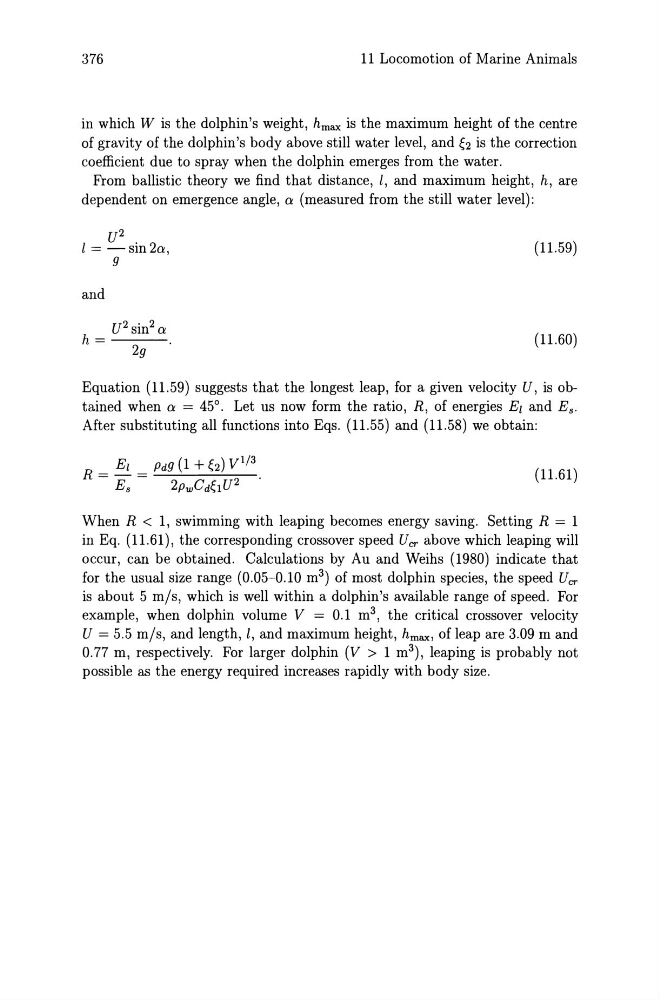
Equation (11.59) suggests that the longest leap, for a given velocity U, is obtained when 0: = 45°. Let us now form the ratio, R, of energies El and Es.
After substituting all functions into Eqs. (11.55) and (11.58) we obtain:
(11.61)
When R < 1, swimming with leaping becomes energy saving. Setting R = 1
in Eq. (11.61), the corresponding crossover speed Ucr above which leaping will
occur, can be obtained. Calculations by Au and Weihs (1980) indicate that
for the usual size range (0.05-0.10 m 3 ) of most dolphin species, the speed Ucr
is about 5 mis, which is well within a dolphin's available range of speed. For
example, when dolphin volume V = 0.1 m 3 , the critical crossover velocity
U = 5.5 mis, and length, I, and maximum height, hmax , of leap are 3.09 m and
0.77 m, respectively. For larger dolphin (V > 1 m 3 ), leaping is probably not
possible as the energy required increases rapidly with body size.
11 Locomotion of Marine Animals
in which W is the dolphin's weight, hmax is the maximum height of the centre
of gravity of the dolphin's body above still water level, and 6 is the correction
coefficient due to spray when the dolphin emerges from the water.
From ballistic theory we find that distance, I, and maximum height, h, are
dependent on emergence angle, 0: (measured from the still water level):
u 2
I = - sin 20:,
9
and
u 2 sin 2 0:
h = - - -
29
(11.59)
(11.60)
Equation (11.59) suggests that the longest leap, for a given velocity U, is obtained when 0: = 45°. Let us now form the ratio, R, of energies El and Es.
After substituting all functions into Eqs. (11.55) and (11.58) we obtain:
(11.61)
When R < 1, swimming with leaping becomes energy saving. Setting R = 1
in Eq. (11.61), the corresponding crossover speed Ucr above which leaping will
occur, can be obtained. Calculations by Au and Weihs (1980) indicate that
for the usual size range (0.05-0.10 m 3 ) of most dolphin species, the speed Ucr
is about 5 mis, which is well within a dolphin's available range of speed. For
example, when dolphin volume V = 0.1 m 3 , the critical crossover velocity
U = 5.5 mis, and length, I, and maximum height, hmax , of leap are 3.09 m and
0.77 m, respectively. For larger dolphin (V > 1 m 3 ), leaping is probably not
possible as the energy required increases rapidly with body size.