

374
~ 0.8
.§
'" Q
S
:a I
Q
o
Z
0.6
0.4
0.2
0.0
11 Locomotion of Marine Animals
o
2
3
4
Non-dimensional velocity
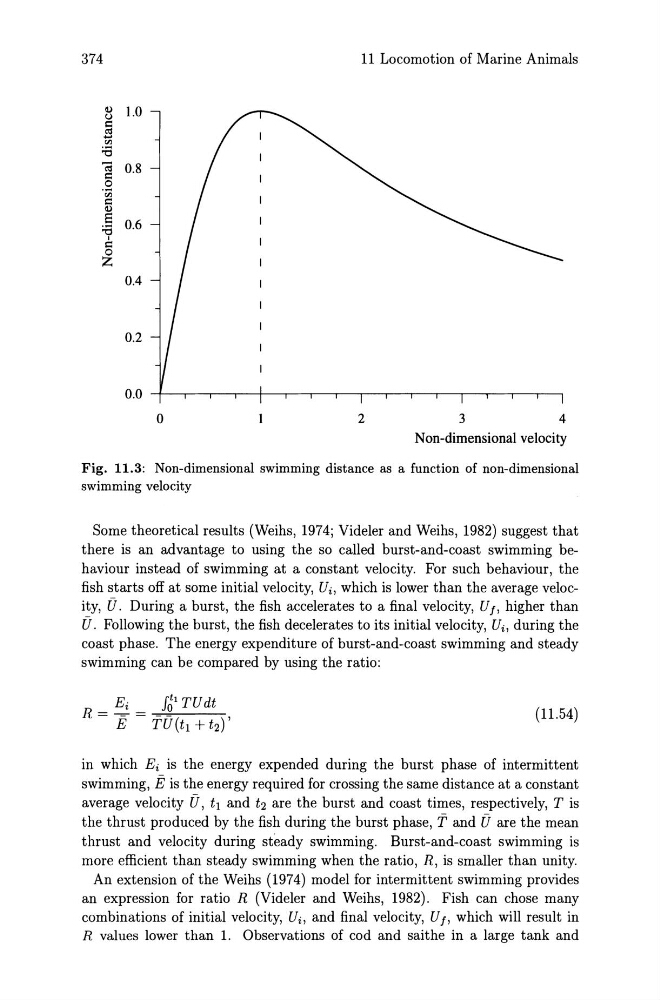
Fig. 11.3: Non-dimensional swimming distance as a function of non-dimensional
swimming velocity
Some theoretical results (Weihs, 1974; Videler and Weihs, 1982) suggest that
there is an advantage to using the so called burst-and-coast swimming behaviour instead of swimming at a constant velocity. For such behaviour, the
fish starts off at some initial velocity, U;, which is lower than the average velocity, (j. During a burst, the fish accelerates to a final velocity, Uj, higher than
(j. Following the burst, the fish decelerates to its initial velocity, U;, during the
coast phase. The energy expenditure of burst-and-coast swimming and steady
swimming can be compared by using the ratio:
(11.54)
in which Ei is the energy expended during the burst phase of intermittent
swimming, E is the energy required for crossing the same distance at a constant
average velocity (j, tl and t2 are the burst and coast times, respectively, T is
the thrust produced by the fish during the burst phase, T and (j are the mean
thrust and velocity during steady swimming. Burst-and-coast swimming is
more efficient than steady swimming when the ratio, R, is smaller than unity.
An extension of the Weihs (1974) model for intermittent swimming provides
an expression for ratio R (Videler and Weihs, 1982). Fish can chose many
combinations of initial velocity, U;, and final velocity, Uj, which will result in
R values lower than 1. Observations of cod and saithe in a large tank and
~ 0.8
.§
'" Q
S
:a I
Q
o
Z
0.6
0.4
0.2
0.0
11 Locomotion of Marine Animals
o
2
3
4
Non-dimensional velocity
Fig. 11.3: Non-dimensional swimming distance as a function of non-dimensional
swimming velocity
Some theoretical results (Weihs, 1974; Videler and Weihs, 1982) suggest that
there is an advantage to using the so called burst-and-coast swimming behaviour instead of swimming at a constant velocity. For such behaviour, the
fish starts off at some initial velocity, U;, which is lower than the average velocity, (j. During a burst, the fish accelerates to a final velocity, Uj, higher than
(j. Following the burst, the fish decelerates to its initial velocity, U;, during the
coast phase. The energy expenditure of burst-and-coast swimming and steady
swimming can be compared by using the ratio:
(11.54)
in which Ei is the energy expended during the burst phase of intermittent
swimming, E is the energy required for crossing the same distance at a constant
average velocity (j, tl and t2 are the burst and coast times, respectively, T is
the thrust produced by the fish during the burst phase, T and (j are the mean
thrust and velocity during steady swimming. Burst-and-coast swimming is
more efficient than steady swimming when the ratio, R, is smaller than unity.
An extension of the Weihs (1974) model for intermittent swimming provides
an expression for ratio R (Videler and Weihs, 1982). Fish can chose many
combinations of initial velocity, U;, and final velocity, Uj, which will result in
R values lower than 1. Observations of cod and saithe in a large tank and