

368
11 Locomotion of Marine Animals
swimming mechanisms of soft bodied animals have been described in books by
Trueman (1975) and Alexander (1982). Here, we will concentrate only on some
examples of the use of jet propulsion.
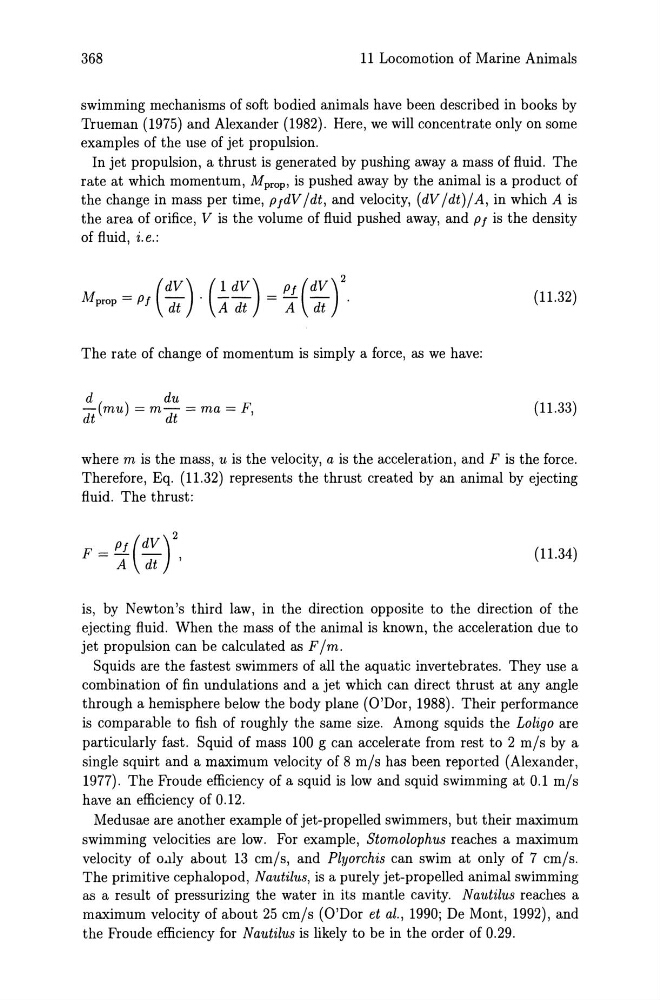
In jet propulsion, a thrust is generated by pushing away a mass of fluid. The
rate at which momentum, M prop , is pushed away by the animal is a product of
the change in mass per time, PldV /dt, and velocity, (dV /dt)/A, in which A is
the area of orifice, V is the volume of fluid pushed away, and PI is the density
of fluid, i. e.:
dV
1 dV
PI dV
(
)
(
)
(
)
2
Mprop = PI dt . Adt = A dt
The rate of change of momentum is simply a force, as we have:
d
du
-(mu) = m- = ma = F
dt
dt
'
(11.32)
(11.33)
where m is the mass, u is the velocity, a is the acceleration, and F is the force.
Therefore, Eq. (11.32) represents the thrust created by an animal by ejecting
fluid. The thrust:
F = PI (dV)2
A dt
'
(11.34)
is, by Newton's third law, in the direction opposite to the direction of the
ejecting fluid. When the mass of the animal is known, the acceleration due to
jet propulsion can be calculated as F /m.
Squids are the fastest swimmers of all the aquatic invertebrates. They use a
combination of fin undulations and a jet which can direct thrust at any angle
through a hemisphere below the body plane (O'Dor, 1988). Their performance
is comparable to fish of roughly the same size. Among squids the Loligo are
particularly fast. Squid of mass 100 g can accelerate from rest to 2 m/s by a
single squirt and a maximum velocity of 8 m/s has been reported (Alexander,
1977). The Froude efficiency of a squid is low and squid swimming at 0.1 m/s
have an efficiency of 0.12.
Medusae are another example of jet-propelled swimmers, but their maximum
swimming velocities are low. For example, Stomolophus reaches a maximum
velocity of 0.11y about 13 cm/s, and Plyorchis can swim at only of 7 cm/s.
The primitive cephalopod, Nautilus, is a purely jet-propelled animal swimming
as a result of pressurizing the water in its mantle cavity. Nautilus reaches a
maximum velocity of about 25 cm/s (O'Dor et al., 1990; De Mont, 1992), and
the Froude efficiency for Nautilus is likely to be in the order of 0.29.
11 Locomotion of Marine Animals
swimming mechanisms of soft bodied animals have been described in books by
Trueman (1975) and Alexander (1982). Here, we will concentrate only on some
examples of the use of jet propulsion.
In jet propulsion, a thrust is generated by pushing away a mass of fluid. The
rate at which momentum, M prop , is pushed away by the animal is a product of
the change in mass per time, PldV /dt, and velocity, (dV /dt)/A, in which A is
the area of orifice, V is the volume of fluid pushed away, and PI is the density
of fluid, i. e.:
dV
1 dV
PI dV
(
)
(
)
(
)
2
Mprop = PI dt . Adt = A dt
The rate of change of momentum is simply a force, as we have:
d
du
-(mu) = m- = ma = F
dt
dt
'
(11.32)
(11.33)
where m is the mass, u is the velocity, a is the acceleration, and F is the force.
Therefore, Eq. (11.32) represents the thrust created by an animal by ejecting
fluid. The thrust:
F = PI (dV)2
A dt
'
(11.34)
is, by Newton's third law, in the direction opposite to the direction of the
ejecting fluid. When the mass of the animal is known, the acceleration due to
jet propulsion can be calculated as F /m.
Squids are the fastest swimmers of all the aquatic invertebrates. They use a
combination of fin undulations and a jet which can direct thrust at any angle
through a hemisphere below the body plane (O'Dor, 1988). Their performance
is comparable to fish of roughly the same size. Among squids the Loligo are
particularly fast. Squid of mass 100 g can accelerate from rest to 2 m/s by a
single squirt and a maximum velocity of 8 m/s has been reported (Alexander,
1977). The Froude efficiency of a squid is low and squid swimming at 0.1 m/s
have an efficiency of 0.12.
Medusae are another example of jet-propelled swimmers, but their maximum
swimming velocities are low. For example, Stomolophus reaches a maximum
velocity of 0.11y about 13 cm/s, and Plyorchis can swim at only of 7 cm/s.
The primitive cephalopod, Nautilus, is a purely jet-propelled animal swimming
as a result of pressurizing the water in its mantle cavity. Nautilus reaches a
maximum velocity of about 25 cm/s (O'Dor et al., 1990; De Mont, 1992), and
the Froude efficiency for Nautilus is likely to be in the order of 0.29.