

11.3 Mechanics of Animal Swimming
367
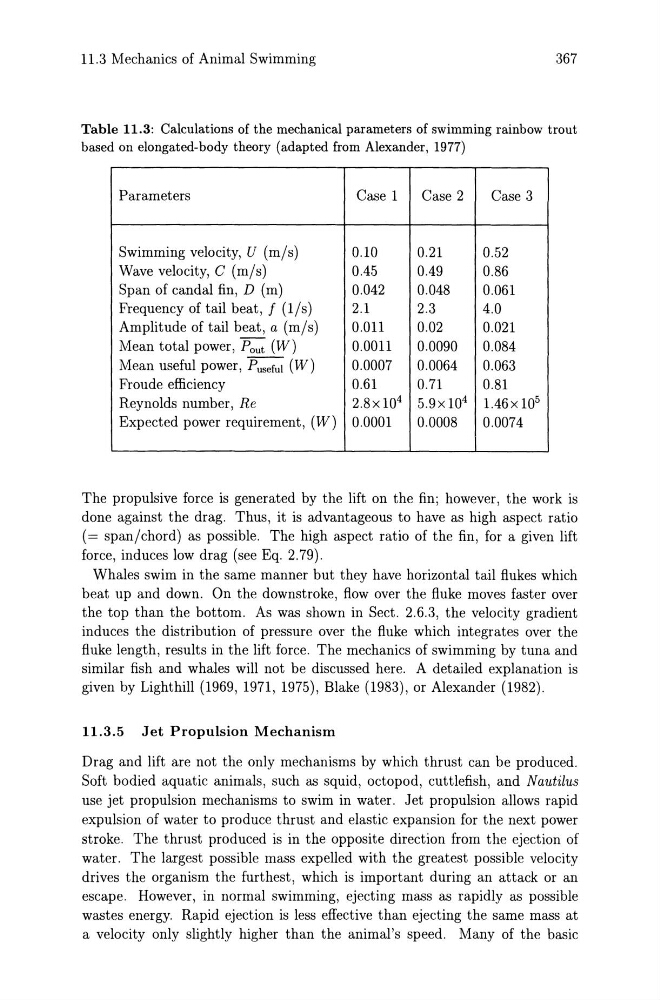
Table 11.3: Calculations of the mechanical parameters of swimming rainbow trout
based on elongated-body theory (adapted from Alexander, 1977)
Parameters
Case 1
Case 2
Case 3
Swimming velocity, U (m/s)
0.10
0.21
0.52
Wave velocity, C (m/s)
0.45
0.49
0.86
Span of candal fin, D (m)
0.042
0.048
0.061
Frequency of tail beat, f (l/s)
2.1
2.3
4.0
Amplitude of tail beat, a (m/s)
0.011
0.02
0.021
Mean total power, Pout (W)
0.0011
0.0090
0.084
Mean useful power, Puseful (W)
0.0007
0.0064
0.063
Froude efficiency
0.61
0.71
0.81
Reynolds number, Re
2.8x 10 4 5.9x10⁴ 1.46 x 10 5
Expected power requirement, (W) 0.0001
0.0008
0.0074
The propulsive force is generated by the lift on the fin; however, the work is
done against the drag. Thus, it is advantageous to have as high aspect ratio
(= span/chord) as possible. The high aspect ratio of the fin, for a given lift
force, induces low drag (see Eq. 2.79).
Whales swim in the same manner but they have horizontal tail flukes which
beat up and down. On the downstroke, flow over the fluke moves faster over
the top than the bottom. As was shown in Sect. 2.6.3, the velocity gradient
induces the distribution of pressure over the fluke which integrates over the
fluke length, results in the lift force. The mechanics of swimming by tuna and
similar fish and whales will not be discussed here. A detailed explanation is
given by Lighthill (1969, 1971, 1975), Blake (1983), or Alexander (1982).
11.3.5 Jet Propulsion Mechanism
Drag and lift are not the only mechanisms by which thrust can be produced.
Soft bodied aquatic animals, such as squid, octopod, cuttlefish, and Nautilus
use jet propulsion mechanisms to swim in water. Jet propulsion allows rapid
expulsion of water to produce thrust and elastic expansion for the next power
stroke. The thrust produced is in the opposite direction from the ejection of
water. The largest possible mass expelled with the greatest possible velocity
drives the organism the furthest, which is important during an attack or an
escape. However, in normal swimming, ejecting mass as rapidly as possible
wastes energy. Rapid ejection is less effective than ejecting the same mass at
a velocity only slightly higher than the animal's speed. Many of the basic
367
Table 11.3: Calculations of the mechanical parameters of swimming rainbow trout
based on elongated-body theory (adapted from Alexander, 1977)
Parameters
Case 1
Case 2
Case 3
Swimming velocity, U (m/s)
0.10
0.21
0.52
Wave velocity, C (m/s)
0.45
0.49
0.86
Span of candal fin, D (m)
0.042
0.048
0.061
Frequency of tail beat, f (l/s)
2.1
2.3
4.0
Amplitude of tail beat, a (m/s)
0.011
0.02
0.021
Mean total power, Pout (W)
0.0011
0.0090
0.084
Mean useful power, Puseful (W)
0.0007
0.0064
0.063
Froude efficiency
0.61
0.71
0.81
Reynolds number, Re
2.8x 10 4 5.9x10⁴ 1.46 x 10 5
Expected power requirement, (W) 0.0001
0.0008
0.0074
The propulsive force is generated by the lift on the fin; however, the work is
done against the drag. Thus, it is advantageous to have as high aspect ratio
(= span/chord) as possible. The high aspect ratio of the fin, for a given lift
force, induces low drag (see Eq. 2.79).
Whales swim in the same manner but they have horizontal tail flukes which
beat up and down. On the downstroke, flow over the fluke moves faster over
the top than the bottom. As was shown in Sect. 2.6.3, the velocity gradient
induces the distribution of pressure over the fluke which integrates over the
fluke length, results in the lift force. The mechanics of swimming by tuna and
similar fish and whales will not be discussed here. A detailed explanation is
given by Lighthill (1969, 1971, 1975), Blake (1983), or Alexander (1982).
11.3.5 Jet Propulsion Mechanism
Drag and lift are not the only mechanisms by which thrust can be produced.
Soft bodied aquatic animals, such as squid, octopod, cuttlefish, and Nautilus
use jet propulsion mechanisms to swim in water. Jet propulsion allows rapid
expulsion of water to produce thrust and elastic expansion for the next power
stroke. The thrust produced is in the opposite direction from the ejection of
water. The largest possible mass expelled with the greatest possible velocity
drives the organism the furthest, which is important during an attack or an
escape. However, in normal swimming, ejecting mass as rapidly as possible
wastes energy. Rapid ejection is less effective than ejecting the same mass at
a velocity only slightly higher than the animal's speed. Many of the basic