

366
11 Locomotion of Marine Animals
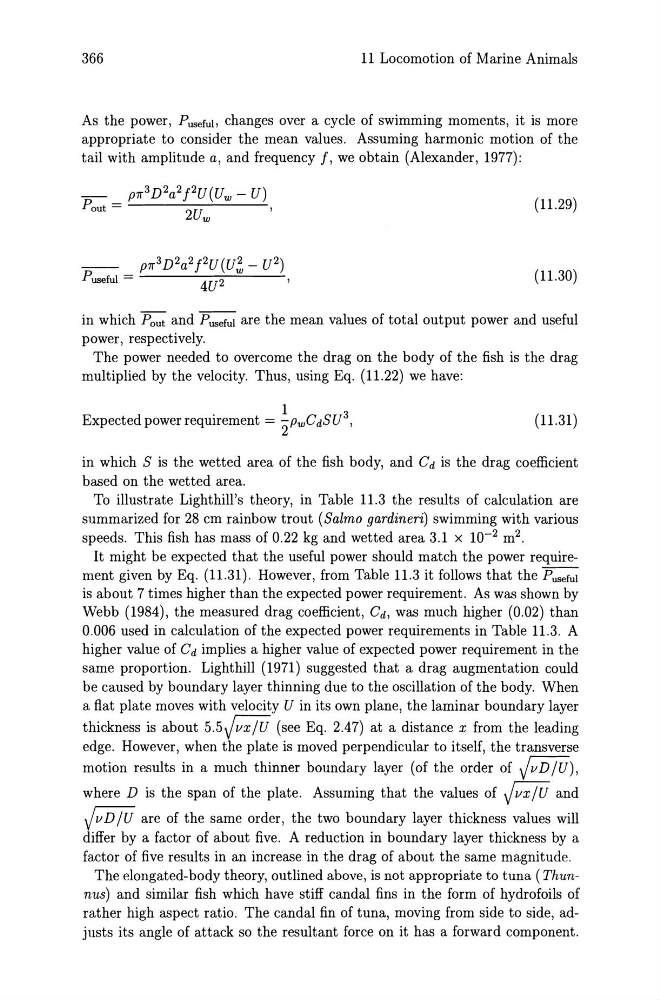
As the power, Pusefu[' changes over a cycle of swimming moments, it is more
appropriate to consider the mean values. Assuming harmonic motion of the
tail with amplitude a, and frequency j, we obtain (Alexander, 1977):
(11.29)
(11.30)
in which Pout and Puseful are the mean values of total output power and useful
power, respectively.
The power needed to overcome the drag on the body of the fish is the drag
multiplied by the velocity. Thus, using Eq. (11.22) we have:
.
1
Expected power reqUlrement = "2PwCdSU3,
(11.31)
in which S is the wetted area of the fish body, and Cd is the drag coefficient
based on the wetted area.
To illustrate Lighthill's theory, in Table 11.3 the results of calculation are
summarized for 28 cm rainbow trout (Salmo gardineri) swimming with various
speeds. This fish has mass of 0.22 kg and wetted area 3.1 x 10- 2 m 2 .
It might be expected that the useful power should match the power requirement given by Eq. (11.31). However, from Table 11.3 it follows that the Puseful
is about 7 times higher than the expected power requirement. As was shown by
Webb (1984), the measured drag coefficient, Cd, was much higher (0.02) than
0.006 used in calculation of the expected power requirements in Table 11.3. A
higher value of Cd implies a higher value of expected power requirement in the
same proportion. Lighthill (1971) suggested that a drag augmentation could
be caused by boundary layer thinning due to the oscillation of the body. When
a fiat plate moves with velocity U in its own plane, the laminar boundary layer
thickness is about S.SJvx/U (see Eq. 2.47) at a distance x from the leading
edge. However, when the plate is moved perpendicular to itself, the transverse
motion results in a much thinner boundary layer (of the order of JvD/U),
where D is the span of the plate. Assuming that the values of Jvx/U and
J v D /U are of the same order, the two boundary layer thickness values will
differ by a factor of about five. A reduction in boundary layer thickness by a
factor of five results in an increase in the drag of about the same magnitude.
The elongated-body theory, outlined above, is not appropriate to tuna (Thunnus) and similar fish which have stiff candal fins in the form of hydrofoils of
rather high aspect ratio. The candal fin of tuna, moving from side to side, adjusts its angle of attack so the resultant force on it has a forward component.
11 Locomotion of Marine Animals
As the power, Pusefu[' changes over a cycle of swimming moments, it is more
appropriate to consider the mean values. Assuming harmonic motion of the
tail with amplitude a, and frequency j, we obtain (Alexander, 1977):
(11.29)
(11.30)
in which Pout and Puseful are the mean values of total output power and useful
power, respectively.
The power needed to overcome the drag on the body of the fish is the drag
multiplied by the velocity. Thus, using Eq. (11.22) we have:
.
1
Expected power reqUlrement = "2PwCdSU3,
(11.31)
in which S is the wetted area of the fish body, and Cd is the drag coefficient
based on the wetted area.
To illustrate Lighthill's theory, in Table 11.3 the results of calculation are
summarized for 28 cm rainbow trout (Salmo gardineri) swimming with various
speeds. This fish has mass of 0.22 kg and wetted area 3.1 x 10- 2 m 2 .
It might be expected that the useful power should match the power requirement given by Eq. (11.31). However, from Table 11.3 it follows that the Puseful
is about 7 times higher than the expected power requirement. As was shown by
Webb (1984), the measured drag coefficient, Cd, was much higher (0.02) than
0.006 used in calculation of the expected power requirements in Table 11.3. A
higher value of Cd implies a higher value of expected power requirement in the
same proportion. Lighthill (1971) suggested that a drag augmentation could
be caused by boundary layer thinning due to the oscillation of the body. When
a fiat plate moves with velocity U in its own plane, the laminar boundary layer
thickness is about S.SJvx/U (see Eq. 2.47) at a distance x from the leading
edge. However, when the plate is moved perpendicular to itself, the transverse
motion results in a much thinner boundary layer (of the order of JvD/U),
where D is the span of the plate. Assuming that the values of Jvx/U and
J v D /U are of the same order, the two boundary layer thickness values will
differ by a factor of about five. A reduction in boundary layer thickness by a
factor of five results in an increase in the drag of about the same magnitude.
The elongated-body theory, outlined above, is not appropriate to tuna (Thunnus) and similar fish which have stiff candal fins in the form of hydrofoils of
rather high aspect ratio. The candal fin of tuna, moving from side to side, adjusts its angle of attack so the resultant force on it has a forward component.