

11.3 Mechanics of Animal Swimming
365
speed of the moving portions of the animal body and the density of the fluid.
Lighthill (1969) developed a theory applicable to small amplitude motion of fish
swimming in the anguilliform mode (see Fig. lU). In a further study, Lighthill
extended the theory to include large amplitude motions. This theory is known
as large-amplitude elongated body theory. Following Alexander (1977), we will
briefly describe the basic outcomes of Lighthill's theory in application to typical fish with fairly large candal fins, such as trout Salmo. We assume that a
fish swims with velocity U, passing waves bending posteriorly along its body
with velocity Uw' The transverse component of velocity of the posterior end of
the fish body is W, and the water being left behind has transverse velocity W'.
lt is also assumed that this velocity is associated with all the water passing
through the circle drawn (in a transverse plane) around the candal fin. Thus,
water mass which passes through it in unit time is Pw7r D 2 U /4, and D is equal
to the span of the candal fin.
On the other hand, the momentum given to the water in unit time
becomes
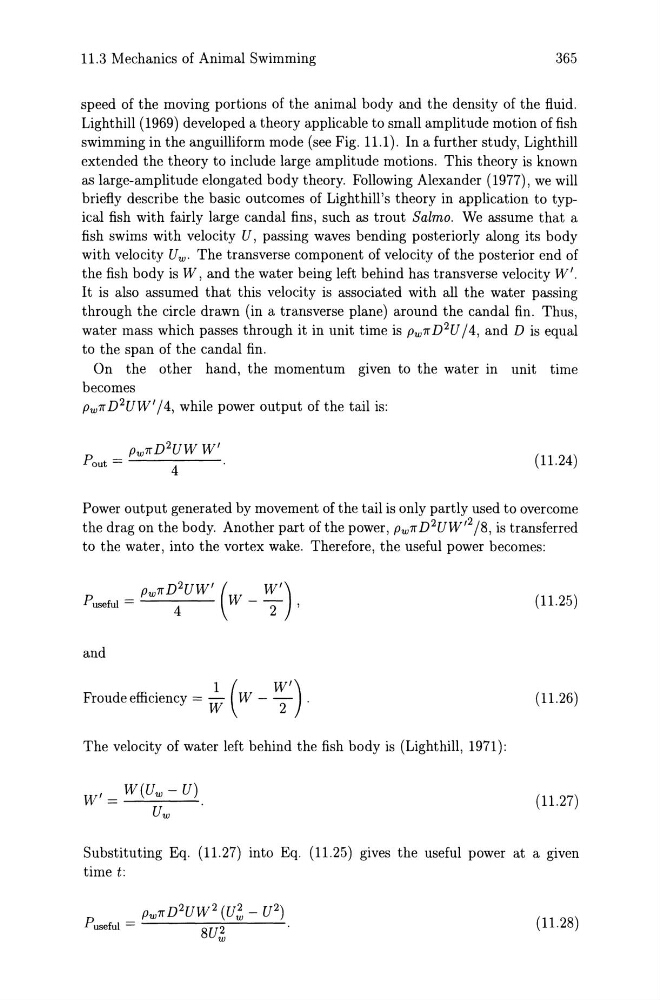
Pw7r D 2 UW' / 4, while power output of the tail is:
(11.24 )
Power output generated by movement of the tail is only partly used to overcome
the drag on the body. Another part of the power, Pw7r D 2 UW,2 /8, is transferred
to the water, into the vortex wake. Therefore, the useful power becomes:
Pw7rD2UW' (
WI)
Puseful =
4
W - 2 '
(11.25)
and
1 (
WI)
Froude efficiency = W W - 2 .
(11.26)
The velocity of water left behind the fish body is (Lighthill, 1971):
I W(Uw - U)
W=
.
Uw
( 11.27)
Substituting Eq. (11.27) into Eq. (11.25) gives the useful power at a given
time t:
(11.28)
365
speed of the moving portions of the animal body and the density of the fluid.
Lighthill (1969) developed a theory applicable to small amplitude motion of fish
swimming in the anguilliform mode (see Fig. lU). In a further study, Lighthill
extended the theory to include large amplitude motions. This theory is known
as large-amplitude elongated body theory. Following Alexander (1977), we will
briefly describe the basic outcomes of Lighthill's theory in application to typical fish with fairly large candal fins, such as trout Salmo. We assume that a
fish swims with velocity U, passing waves bending posteriorly along its body
with velocity Uw' The transverse component of velocity of the posterior end of
the fish body is W, and the water being left behind has transverse velocity W'.
lt is also assumed that this velocity is associated with all the water passing
through the circle drawn (in a transverse plane) around the candal fin. Thus,
water mass which passes through it in unit time is Pw7r D 2 U /4, and D is equal
to the span of the candal fin.
On the other hand, the momentum given to the water in unit time
becomes
Pw7r D 2 UW' / 4, while power output of the tail is:
(11.24 )
Power output generated by movement of the tail is only partly used to overcome
the drag on the body. Another part of the power, Pw7r D 2 UW,2 /8, is transferred
to the water, into the vortex wake. Therefore, the useful power becomes:
Pw7rD2UW' (
WI)
Puseful =
4
W - 2 '
(11.25)
and
1 (
WI)
Froude efficiency = W W - 2 .
(11.26)
The velocity of water left behind the fish body is (Lighthill, 1971):
I W(Uw - U)
W=
.
Uw
( 11.27)
Substituting Eq. (11.27) into Eq. (11.25) gives the useful power at a given
time t:
(11.28)