

11.3 Mechanics of Animal Swimming
369
11.3.6 Swimming in Low Reynolds Number Environment
Up to this point we have discussed animal swimming mechanisms when Reynolds number was high and inertial effects dominated. However, for ciliary
and flagellar propulsors, viscous shearing is the only mechanism generating
thrust. It is presently believed that for flagellum, the progressive activation
of a molecular motor, dynein, results in adjacent microtubular sliding. The
resulting motion is a bending wave propagating along the flagellum. Flagella
are about 0.2 J.tm in diameter and 10-100 J.tm in length, and there is between
1.3 to 5 waves on a flagellum (Daniel et al., 1992). They move slowly with
a velocity of 10-10 4 J.tm/s, and the corresponding Reynolds number is of the
order 10- 6 -10- 3 .
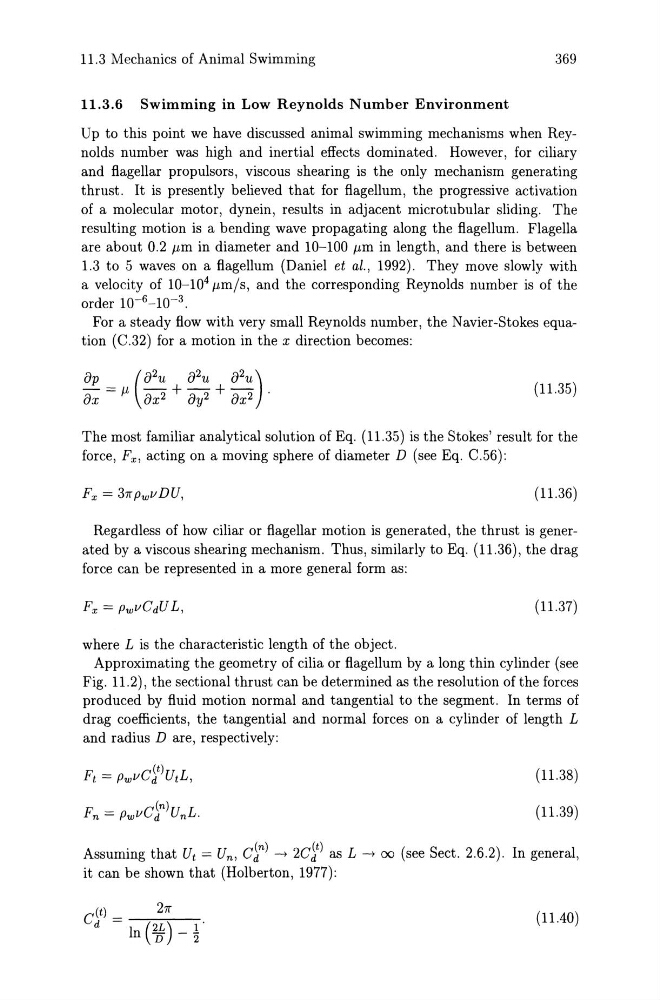
For a steady flow with very small Reynolds number, the Navier-Stokes equation (C.32) for a motion in the x direction becomes:
(11.35)
The most familiar analytical solution of Eq. (11.35) is the Stokes' result for the
force, Fx , acting on a moving sphere of diameter D (see Eq. C.56):
(11.36)
Regardless of how ciliar or flagellar motion is generated, the thrust is generated by a viscous shearing mechanism. Thus, similarly to Eq. (11.36), the drag
force can be represented in a more general form as:
( 11.37)
where L is the characteristic length of the object.
Approximating the geometry of cilia or flagellum by a long thin cylinder (see
Fig. 11.2), the sectional thrust can be determined as the resolution of the forces
produced by fluid motion normal and tangential to the segment. In terms of
drag coefficients, the tangential and normal forces on a cylinder of length L
and radius D are, respectively:
Ft = PwvC~t)UtL,
Fn = pwvC~n)UnL.
(11.38)
(11.39)
Assuming that Ut = Un, C~n) -+ 2d t ) as L -+ 00 (see Sect. 2.6.2). In general,
it can be shown that (Holberton, 1977):
(11.40)
369
11.3.6 Swimming in Low Reynolds Number Environment
Up to this point we have discussed animal swimming mechanisms when Reynolds number was high and inertial effects dominated. However, for ciliary
and flagellar propulsors, viscous shearing is the only mechanism generating
thrust. It is presently believed that for flagellum, the progressive activation
of a molecular motor, dynein, results in adjacent microtubular sliding. The
resulting motion is a bending wave propagating along the flagellum. Flagella
are about 0.2 J.tm in diameter and 10-100 J.tm in length, and there is between
1.3 to 5 waves on a flagellum (Daniel et al., 1992). They move slowly with
a velocity of 10-10 4 J.tm/s, and the corresponding Reynolds number is of the
order 10- 6 -10- 3 .
For a steady flow with very small Reynolds number, the Navier-Stokes equation (C.32) for a motion in the x direction becomes:
(11.35)
The most familiar analytical solution of Eq. (11.35) is the Stokes' result for the
force, Fx , acting on a moving sphere of diameter D (see Eq. C.56):
(11.36)
Regardless of how ciliar or flagellar motion is generated, the thrust is generated by a viscous shearing mechanism. Thus, similarly to Eq. (11.36), the drag
force can be represented in a more general form as:
( 11.37)
where L is the characteristic length of the object.
Approximating the geometry of cilia or flagellum by a long thin cylinder (see
Fig. 11.2), the sectional thrust can be determined as the resolution of the forces
produced by fluid motion normal and tangential to the segment. In terms of
drag coefficients, the tangential and normal forces on a cylinder of length L
and radius D are, respectively:
Ft = PwvC~t)UtL,
Fn = pwvC~n)UnL.
(11.38)
(11.39)
Assuming that Ut = Un, C~n) -+ 2d t ) as L -+ 00 (see Sect. 2.6.2). In general,
it can be shown that (Holberton, 1977):
(11.40)