

362
11 Locomotion of Marine Animals
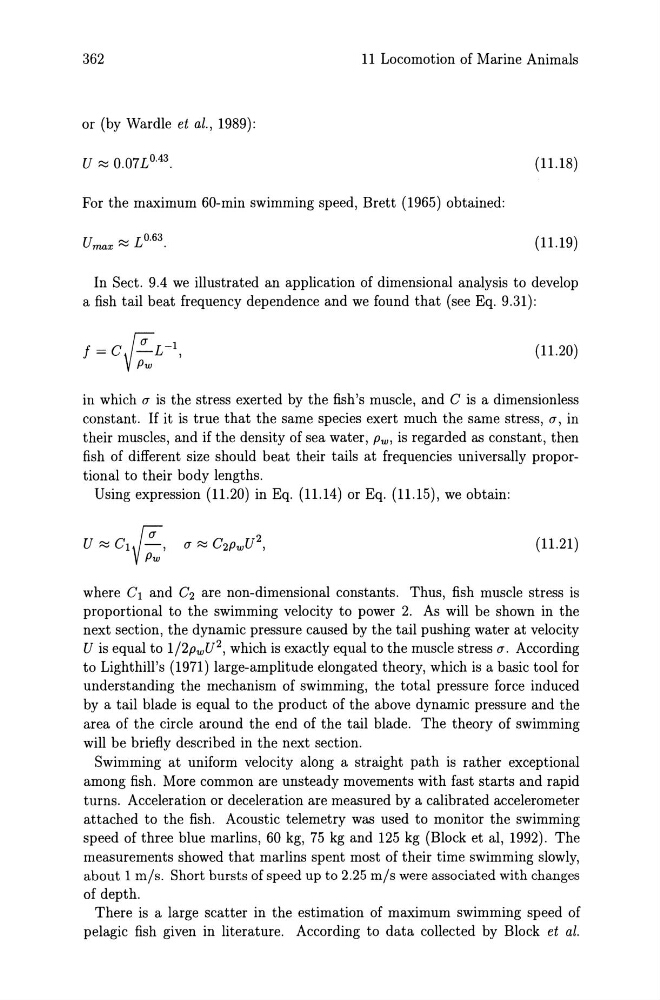
or (by Wardle et ai., 1989):
(11.18)
For the maximum 60-min swimming speed, Brett (1965) obtained:
(11.19)
In Sect. 9.4 we illustrated an application of dimensional analysis to develop
a fish tail beat frequency dependence and we found that (see Eq. 9.31):
(11.20)
in which (J is the stress exerted by the fish's muscle, and C is a dimensionless
constant. If it is true that the same species exert much the same stress, (J, in
their muscles, and if the density of sea water, Pw, is regarded as constant, then
fish of different size should beat their tails at frequencies universally proportional to their body lengths.
Using expression (11.20) in Eq. (11.14) or Eq. (11.15), we obtain:
(11.21)
where C1 and C2 are non-dimensional constants. Thus, fish muscle stress is
proportional to the swimming velocity to power 2. As will be shown in the
next section, the dynamic pressure caused by the tail pushing water at velocity
U is equal to 1/2PwU2, which is exactly equal to the muscle stress (J. According
to Lighthill's (1971) large-amplitude elongated theory, which is a basic tool for
understanding the mechanism of swimming, the total pressure force induced
by a tail blade is equal to the product of the above dynamic pressure and the
area of the circle around the end of the tail blade. The theory of swimming
will be briefly described in the next section.
Swimming at uniform velocity along a straight path is rather exceptional
among fish. More common are unsteady movements with fast starts and rapid
turns. Acceleration or deceleration are measured by a calibrated accelerometer
attached to the fish. Acoustic telemetry was used to monitor the swimming
speed of three blue marlins, 60 kg, 75 kg and 125 kg (Block et aI, 1992). The
measurements showed that marlins spent most of their time swimming slowly,
about 1 m/s. Short bursts of speed up to 2.25 m/s were associated with changes
of depth.
There is a large scatter in the estimation of maximum swimming speed of
pelagic fish given in literature. According to data collected by Block et ai.
11 Locomotion of Marine Animals
or (by Wardle et ai., 1989):
(11.18)
For the maximum 60-min swimming speed, Brett (1965) obtained:
(11.19)
In Sect. 9.4 we illustrated an application of dimensional analysis to develop
a fish tail beat frequency dependence and we found that (see Eq. 9.31):
(11.20)
in which (J is the stress exerted by the fish's muscle, and C is a dimensionless
constant. If it is true that the same species exert much the same stress, (J, in
their muscles, and if the density of sea water, Pw, is regarded as constant, then
fish of different size should beat their tails at frequencies universally proportional to their body lengths.
Using expression (11.20) in Eq. (11.14) or Eq. (11.15), we obtain:
(11.21)
where C1 and C2 are non-dimensional constants. Thus, fish muscle stress is
proportional to the swimming velocity to power 2. As will be shown in the
next section, the dynamic pressure caused by the tail pushing water at velocity
U is equal to 1/2PwU2, which is exactly equal to the muscle stress (J. According
to Lighthill's (1971) large-amplitude elongated theory, which is a basic tool for
understanding the mechanism of swimming, the total pressure force induced
by a tail blade is equal to the product of the above dynamic pressure and the
area of the circle around the end of the tail blade. The theory of swimming
will be briefly described in the next section.
Swimming at uniform velocity along a straight path is rather exceptional
among fish. More common are unsteady movements with fast starts and rapid
turns. Acceleration or deceleration are measured by a calibrated accelerometer
attached to the fish. Acoustic telemetry was used to monitor the swimming
speed of three blue marlins, 60 kg, 75 kg and 125 kg (Block et aI, 1992). The
measurements showed that marlins spent most of their time swimming slowly,
about 1 m/s. Short bursts of speed up to 2.25 m/s were associated with changes
of depth.
There is a large scatter in the estimation of maximum swimming speed of
pelagic fish given in literature. According to data collected by Block et ai.