

1l.3 Mechanics of Animal Swimming
363
(1992), the highest speeds of blue marlin was 36 mis, while yellowfin tuna
(Thunnus albacares), much smaller than blue marlin, can accelerate to 21 m/s.
Usually continuous swimming speed ranges from U / L = 0.3 S-l in wahoo, to
1.6 S-l in blue fin tuna, while burst swimming speed varies from U / L = 8 S-l
in the bonito, to 27 s-l in yellowfin tuna.
Fish, by their muscles, generate the power needed for steady swimming. Most
of this power comes from a muscle adjacent to the tail, and relatively little
comes from the outerior musculature (Rome et al., 1993). However, the structure of fish muscles is out of the scope of this book (for details see Videler,
1993).
11.3.4 Transmission of Forces Between Fish and Water
Drag Coefficient of Marine Organisms. Because fish are nearly buoyant,
they use little or no energy to support themselves. However, energy is needed
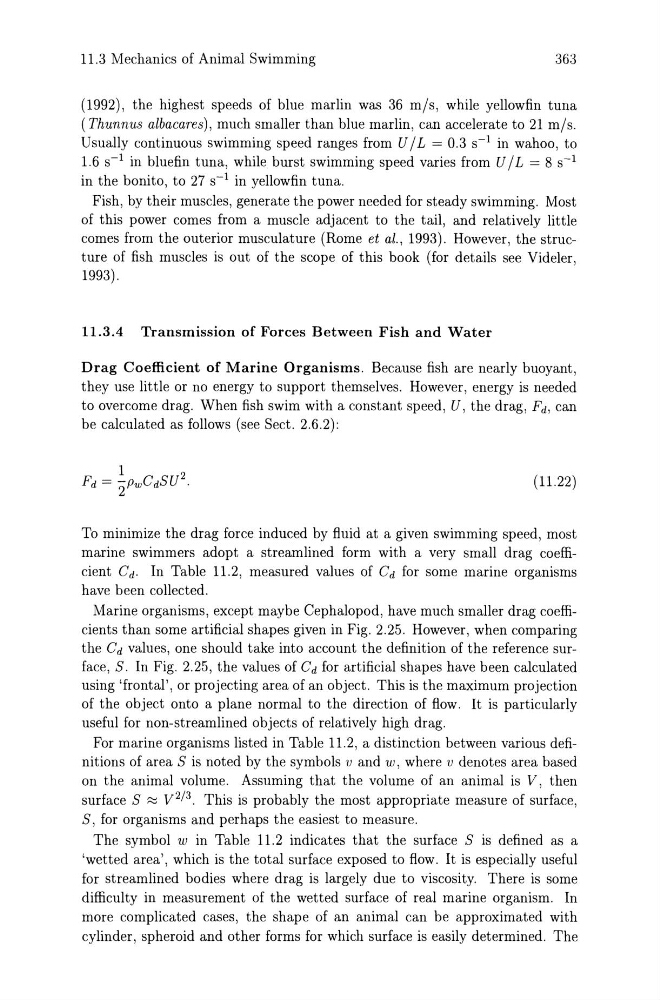
to overcome drag. When fish swim with a constant speed, U, the drag, F d , can
be calculated as follows (see Sect. 2.6.2):
(11.22)
To minimize the drag force induced by fluid at a given swimming speed, most
marine swimmers adopt a streamlined form with a very small drag coefficient Cd. In Table 11.2, measured values of Cd for some marine organisms
have been collected.
Marine organisms, except maybe Cephalopod, have much smaller drag coefficients than some artificial shapes given in Fig. 2.25. However, when comparing
the Cd values, one should take into account the definition of the reference surface, S. In Fig. 2.25, the values of Cd for artificial shapes have been calculated
using 'frontal', or projecting area of an object. This is the maximum projection
of the object onto a plane normal to the direction of flow. It is particularly
useful for non-streamlined objects of relatively high drag.
For marine organisms listed in Table 11.2, a distinction between various definitions of area S is noted by the symbols v and w, where v denotes area based
on the animal volume. Assuming that the volume of an animal is V, then
surface S ~ V 2 / 3 . This is probably the most appropriate measure of surface,
S, for organisms and perhaps the easiest to measure.
The symbol w in Table 11.2 indicates that the surface S is defined as a
'wetted area', which is the total surface exposed to flow. It is especially useful
for streamlined bodies where drag is largely due to viscosity. There is some
difficulty in measurement of the wetted surface of real marine organism. In
more complicated cases, the shape of an animal can be approximated with
cylinder, spheroid and other forms for which surface is easily determined. The
363
(1992), the highest speeds of blue marlin was 36 mis, while yellowfin tuna
(Thunnus albacares), much smaller than blue marlin, can accelerate to 21 m/s.
Usually continuous swimming speed ranges from U / L = 0.3 S-l in wahoo, to
1.6 S-l in blue fin tuna, while burst swimming speed varies from U / L = 8 S-l
in the bonito, to 27 s-l in yellowfin tuna.
Fish, by their muscles, generate the power needed for steady swimming. Most
of this power comes from a muscle adjacent to the tail, and relatively little
comes from the outerior musculature (Rome et al., 1993). However, the structure of fish muscles is out of the scope of this book (for details see Videler,
1993).
11.3.4 Transmission of Forces Between Fish and Water
Drag Coefficient of Marine Organisms. Because fish are nearly buoyant,
they use little or no energy to support themselves. However, energy is needed
to overcome drag. When fish swim with a constant speed, U, the drag, F d , can
be calculated as follows (see Sect. 2.6.2):
(11.22)
To minimize the drag force induced by fluid at a given swimming speed, most
marine swimmers adopt a streamlined form with a very small drag coefficient Cd. In Table 11.2, measured values of Cd for some marine organisms
have been collected.
Marine organisms, except maybe Cephalopod, have much smaller drag coefficients than some artificial shapes given in Fig. 2.25. However, when comparing
the Cd values, one should take into account the definition of the reference surface, S. In Fig. 2.25, the values of Cd for artificial shapes have been calculated
using 'frontal', or projecting area of an object. This is the maximum projection
of the object onto a plane normal to the direction of flow. It is particularly
useful for non-streamlined objects of relatively high drag.
For marine organisms listed in Table 11.2, a distinction between various definitions of area S is noted by the symbols v and w, where v denotes area based
on the animal volume. Assuming that the volume of an animal is V, then
surface S ~ V 2 / 3 . This is probably the most appropriate measure of surface,
S, for organisms and perhaps the easiest to measure.
The symbol w in Table 11.2 indicates that the surface S is defined as a
'wetted area', which is the total surface exposed to flow. It is especially useful
for streamlined bodies where drag is largely due to viscosity. There is some
difficulty in measurement of the wetted surface of real marine organism. In
more complicated cases, the shape of an animal can be approximated with
cylinder, spheroid and other forms for which surface is easily determined. The