

9.4 Similitude and Dimensional Analysis
Now we use 9 and Vw together with the variable h:
II = V k2 hk4 k5
2
w
g.
The equation set k2 and k5 is similar to the set (9.21). Therefore:
323
(9.23)
(9.24)
U sing the similar arguments we include the fetch X and third II term becomes:
(9.25)
N ow we can write:
gHs (9h 9X)
V2 = j V2' 112 .
w
w
w
(9.26)
Fish Tail-Beat Frequency. As we showed in Chap. 2, the drag force which a
fish has to overcome in order to move is a function of water density and velocity
of fish movement. On the other hand, this velocity depends on the frequency
at which the fish is beating its tail. If the fish beats its tail more rapidly, the
stress exerted by the fish's muscles increases with increasing frequency. The
stress needed to move the fish through the water depends also on the mass of
the fish which we characterize by fish length. A more detailed discussion on
the relationship between fish length and its mass is given in Chap. 1l.
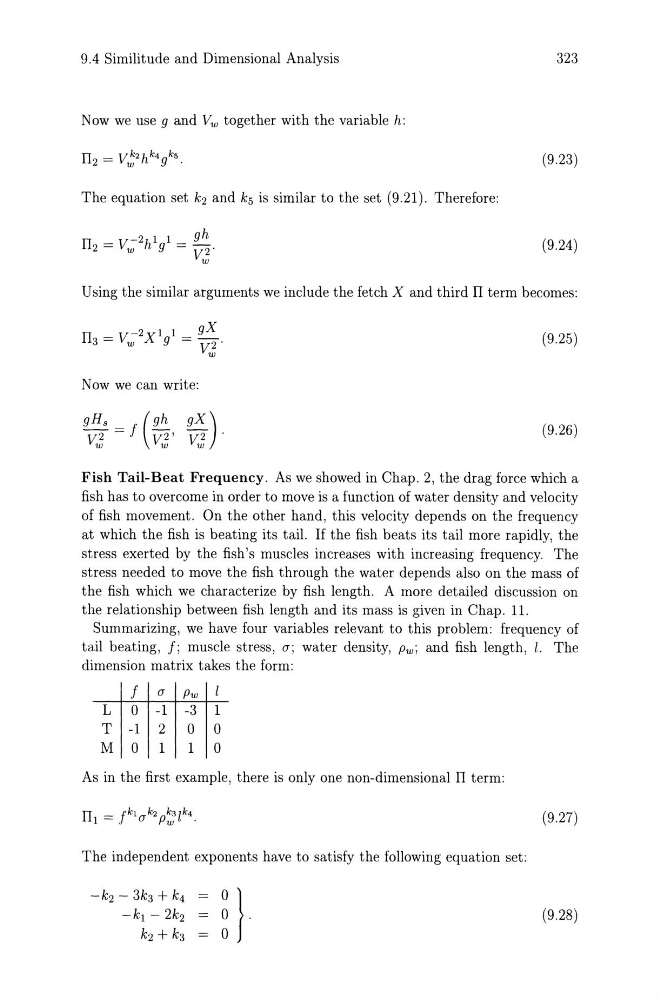
Summarizing, we have four variables relevant to this problem: frequency of
tail beating, j; muscle stress, 0'; water density, Pw; and fish length, l. The
dimension matrix takes the form:
j
0'
Pw
L 0 -1 -3 1
T -1 2 0 0
M O l l O
As in the first example, there is only one non-dimensional II term:
The independent exponents have to satisfy the following equation set:
-k2 - 3k3 + k4
-k1 - 2k2
k2 + k3
(9.27)
(9.28)
Now we use 9 and Vw together with the variable h:
II = V k2 hk4 k5
2
w
g.
The equation set k2 and k5 is similar to the set (9.21). Therefore:
323
(9.23)
(9.24)
U sing the similar arguments we include the fetch X and third II term becomes:
(9.25)
N ow we can write:
gHs (9h 9X)
V2 = j V2' 112 .
w
w
w
(9.26)
Fish Tail-Beat Frequency. As we showed in Chap. 2, the drag force which a
fish has to overcome in order to move is a function of water density and velocity
of fish movement. On the other hand, this velocity depends on the frequency
at which the fish is beating its tail. If the fish beats its tail more rapidly, the
stress exerted by the fish's muscles increases with increasing frequency. The
stress needed to move the fish through the water depends also on the mass of
the fish which we characterize by fish length. A more detailed discussion on
the relationship between fish length and its mass is given in Chap. 1l.
Summarizing, we have four variables relevant to this problem: frequency of
tail beating, j; muscle stress, 0'; water density, Pw; and fish length, l. The
dimension matrix takes the form:
j
0'
Pw
L 0 -1 -3 1
T -1 2 0 0
M O l l O
As in the first example, there is only one non-dimensional II term:
The independent exponents have to satisfy the following equation set:
-k2 - 3k3 + k4
-k1 - 2k2
k2 + k3
(9.27)
(9.28)