

324
9 Experimental Methods in Fluid Mechanics
The unknown frequency f has to be expressed with power k1 = 1. Thus, solving
Eq. (9.28) for k2' k3 and k4 we obtain: k2 = -1/2, k3 = 1/2 and k4 = 1. Hence:
_
-1/2 1/2 _ fPw l - C
III - f (J
Pw l - (J1/2 - onst,
(9.29)
and:
f = C - - .
If
l
Pw l
(9.30)
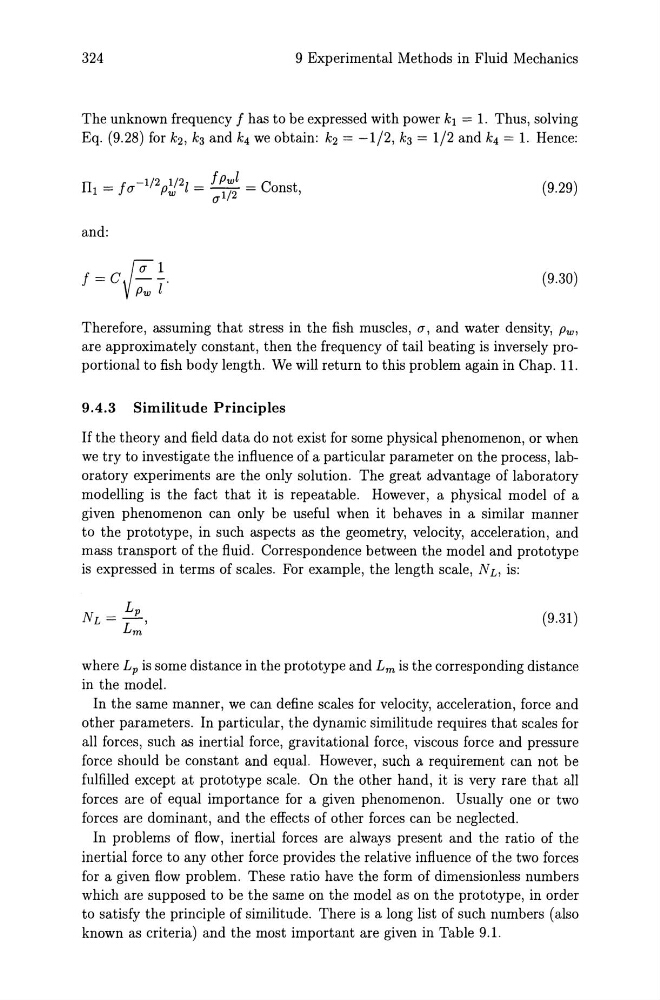
Therefore, assuming that stress in the fish muscles, (J, and water density, Pw,
are approximately constant, then the frequency of tail beating is inversely proportional to fish body length. We will return to this problem again in Chap. 11.
9.4.3 Similitude Principles
If the theory and field data do not exist for some physical phenomenon, or when
we try to investigate the influence of a particular parameter on the process, laboratory experiments are the only solution. The great advantage of laboratory
modelling is the fact that it is repeatable. However, a physical model of a
given phenomenon can only be useful when it behaves in a similar manner
to the prototype, in such aspects as the geometry, velocity, acceleration, and
mass transport of the fluid. Correspondence between the model and prototype
is expressed in terms of scales. For example, the length scale, N L, is:
(9.31 )
where Lp is some distance in the prototype and Lm is the corresponding distance
in the model.
In the same manner, we can define scales for velocity, acceleration, force and
other parameters. In particular, the dynamic similitude requires that scales for
all forces, such as inertial force, gravitational force, viscous force and pressure
force should be constant and equal. However, such a requirement can not be
fulfilled except at prototype scale. On the other hand, it is very rare that all
forces are of equal importance for a given phenomenon. Usually one or two
forces are dominant, and the effects of other forces can be neglected.
In problems of flow, inertial forces are always present and the ratio of the
inertial force to any other force provides the relative influence of the two forces
for a given flow problem. These ratio have the form of dimensionless numbers
which are supposed to be the same on the model as on the prototype, in order
to satisfy the principle of similitude. There is a long list of such numbers (also
known as criteria) and the most important are given in Table 9.1.
9 Experimental Methods in Fluid Mechanics
The unknown frequency f has to be expressed with power k1 = 1. Thus, solving
Eq. (9.28) for k2' k3 and k4 we obtain: k2 = -1/2, k3 = 1/2 and k4 = 1. Hence:
_
-1/2 1/2 _ fPw l - C
III - f (J
Pw l - (J1/2 - onst,
(9.29)
and:
f = C - - .
If
l
Pw l
(9.30)
Therefore, assuming that stress in the fish muscles, (J, and water density, Pw,
are approximately constant, then the frequency of tail beating is inversely proportional to fish body length. We will return to this problem again in Chap. 11.
9.4.3 Similitude Principles
If the theory and field data do not exist for some physical phenomenon, or when
we try to investigate the influence of a particular parameter on the process, laboratory experiments are the only solution. The great advantage of laboratory
modelling is the fact that it is repeatable. However, a physical model of a
given phenomenon can only be useful when it behaves in a similar manner
to the prototype, in such aspects as the geometry, velocity, acceleration, and
mass transport of the fluid. Correspondence between the model and prototype
is expressed in terms of scales. For example, the length scale, N L, is:
(9.31 )
where Lp is some distance in the prototype and Lm is the corresponding distance
in the model.
In the same manner, we can define scales for velocity, acceleration, force and
other parameters. In particular, the dynamic similitude requires that scales for
all forces, such as inertial force, gravitational force, viscous force and pressure
force should be constant and equal. However, such a requirement can not be
fulfilled except at prototype scale. On the other hand, it is very rare that all
forces are of equal importance for a given phenomenon. Usually one or two
forces are dominant, and the effects of other forces can be neglected.
In problems of flow, inertial forces are always present and the ratio of the
inertial force to any other force provides the relative influence of the two forces
for a given flow problem. These ratio have the form of dimensionless numbers
which are supposed to be the same on the model as on the prototype, in order
to satisfy the principle of similitude. There is a long list of such numbers (also
known as criteria) and the most important are given in Table 9.1.