

322
9 Experimental Methods in Fluid Mechanics
which is similar to the Stokes' solution (see Eq. C.56). From Stokes' solution
we know that C = 37r, thus finaly:
(9.17)
Prediction of Height of Wind-Induced Waves. The second example is
related to surface wave generation by wind. From our discussion in Chap. 3, it
follows that the significant wave height, Hs, depends on wind speed Vw , wind
fetch X, water depth h and acceleration of gravity g. Therefore, these five
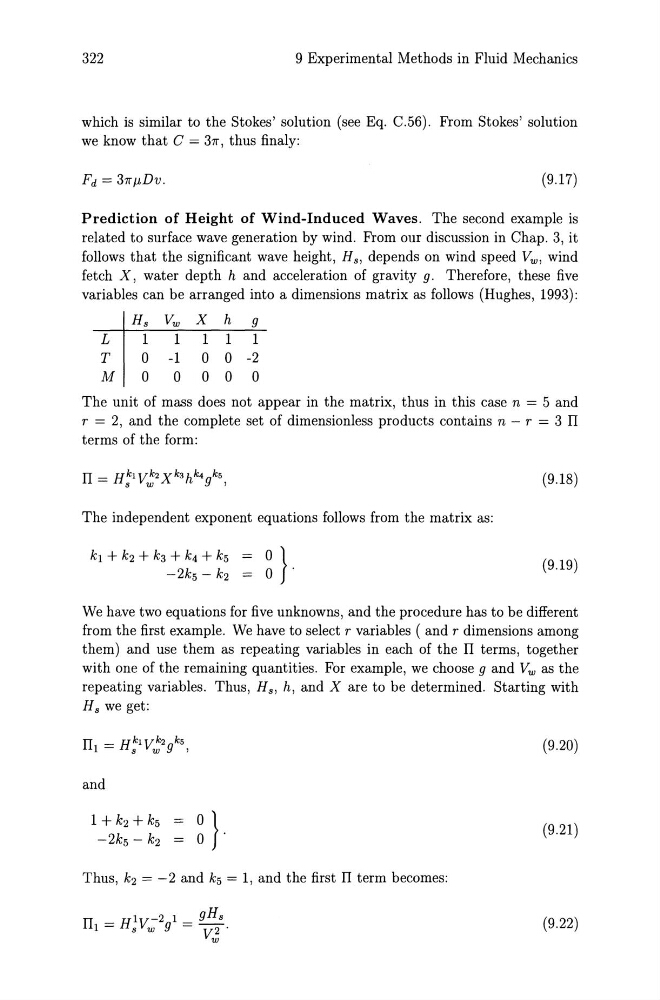
variables can be arranged into a dimensions matrix as follows (Hughes, 1993):
Hs Vw X h 9
L
1
1 1 1 1
T
M
o -1
o 0
o 0 -2
o 0 0
The unit of mass does not appear in the matrix, thus in this case n = 5 and
r = 2, and the complete set of dimensionless products contains n - r = 3 II
terms of the form:
The independent exponent equations follows from the matrix as:
kl + k2 + k3 + k4 + k5 = O}.
-2k5 - k2 = 0
(9.18)
(9.19)
We have two equations for five unknowns, and the procedure has to be different
from the first example. We have to select r variables ( and r dimensions among
them) and use them as repeating variables in each of the II terms, together
with one of the remaining quantities. For example, we choose 9 and Vw as the
repeating variables. Thus, Hs, h, and X are to be determined. Starting with
Hs we get:
and
1 + k2 + k5 - O}
-2k5 - k2 :
0 .
Thus, k2 = -2 and k5 = 1, and the first II term becomes:
(9.20)
(9.21 )
(9.22)
9 Experimental Methods in Fluid Mechanics
which is similar to the Stokes' solution (see Eq. C.56). From Stokes' solution
we know that C = 37r, thus finaly:
(9.17)
Prediction of Height of Wind-Induced Waves. The second example is
related to surface wave generation by wind. From our discussion in Chap. 3, it
follows that the significant wave height, Hs, depends on wind speed Vw , wind
fetch X, water depth h and acceleration of gravity g. Therefore, these five
variables can be arranged into a dimensions matrix as follows (Hughes, 1993):
Hs Vw X h 9
L
1
1 1 1 1
T
M
o -1
o 0
o 0 -2
o 0 0
The unit of mass does not appear in the matrix, thus in this case n = 5 and
r = 2, and the complete set of dimensionless products contains n - r = 3 II
terms of the form:
The independent exponent equations follows from the matrix as:
kl + k2 + k3 + k4 + k5 = O}.
-2k5 - k2 = 0
(9.18)
(9.19)
We have two equations for five unknowns, and the procedure has to be different
from the first example. We have to select r variables ( and r dimensions among
them) and use them as repeating variables in each of the II terms, together
with one of the remaining quantities. For example, we choose 9 and Vw as the
repeating variables. Thus, Hs, h, and X are to be determined. Starting with
Hs we get:
and
1 + k2 + k5 - O}
-2k5 - k2 :
0 .
Thus, k2 = -2 and k5 = 1, and the first II term becomes:
(9.20)
(9.21 )
(9.22)