

9.4 Similitude and Dimensional Analysis
321
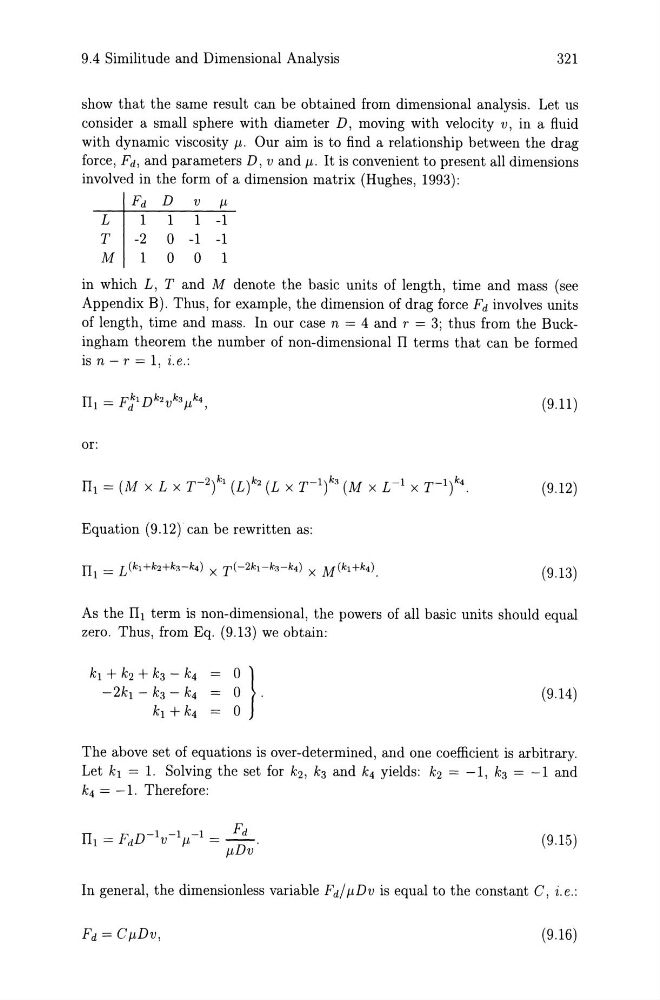
show that the same result can be obtained from dimensional analysis. Let us
consider a small sphere with diameter D, moving with velocity v, in a fluid
with dynamic viscosity It. Our aim is to find a relationship between the drag
force, Fd , and parameters D, v and Jl. It is convenient to present all dimensions
involved in the form of a dimension matrix (Hughes, 1993):
Fd D v Jl
L
1 1 1 -1
T
-2 0 -1 -1
M
1 0 0 1
in which L, T and M denote the basic units of length, time and mass (see
Appendix B). Thus, for example, the dimension of drag force Fd involves units
of length, time and mass. In our case n = 4 and r = 3; thus from the Buckingham theorem the number of non-dimensional IT terms that can be formed
is n - r = 1, i.e.:
(9.11)
or:
(9.12)
Equation (9.12) can be rewritten as:
(9.13)
As the IT1 term is non-dimensional, the powers of all basic units should equal
zero. Thus, from Eq. (9.13) we obtain:
(9.14)
The above set of equations is over-determined, and one coefficient is arbitrary.
Let k1 = 1. Solving the set for k2' k3 and k4 yields: k2 = -1, k3 = -1 and
k4 = -1. Therefore:
IT - F D-1 -1 -1 - ~
1 -
d
V
Jl
- JlDv
(9.15)
In general, the dimensionless variable Fd/JlDv is equal to the constant C, i.e.:
(9.16)
321
show that the same result can be obtained from dimensional analysis. Let us
consider a small sphere with diameter D, moving with velocity v, in a fluid
with dynamic viscosity It. Our aim is to find a relationship between the drag
force, Fd , and parameters D, v and Jl. It is convenient to present all dimensions
involved in the form of a dimension matrix (Hughes, 1993):
Fd D v Jl
L
1 1 1 -1
T
-2 0 -1 -1
M
1 0 0 1
in which L, T and M denote the basic units of length, time and mass (see
Appendix B). Thus, for example, the dimension of drag force Fd involves units
of length, time and mass. In our case n = 4 and r = 3; thus from the Buckingham theorem the number of non-dimensional IT terms that can be formed
is n - r = 1, i.e.:
(9.11)
or:
(9.12)
Equation (9.12) can be rewritten as:
(9.13)
As the IT1 term is non-dimensional, the powers of all basic units should equal
zero. Thus, from Eq. (9.13) we obtain:
(9.14)
The above set of equations is over-determined, and one coefficient is arbitrary.
Let k1 = 1. Solving the set for k2' k3 and k4 yields: k2 = -1, k3 = -1 and
k4 = -1. Therefore:
IT - F D-1 -1 -1 - ~
1 -
d
V
Jl
- JlDv
(9.15)
In general, the dimensionless variable Fd/JlDv is equal to the constant C, i.e.:
(9.16)