

312
9 Experimental Methods in Fluid Mechanics
the East-West direction. After half an hour (profiles b), water is flowing out
of the Gulf through the whole water column. There is still some transverse
circulation in the Gulf, with predominant flow in the west direction.
An application of ADCP for quantifying net fluxes across a macrotidal estuary
was recently examined by Lane et al. (1997).
9.2.5 Wave Measurements
Wave measurements at a single point have been made since the time when laboratory flumes first featured mechanically generated wave motion. At present,
such wave measurements are considered a routine laboratory capability. The
variety of instruments (wave gauges) used to obtain information on surface
waves can be grouped into resistance, capacitance and pressure type gauges.
Resistance wave gauges. Resistance wave gauges are usually formed from
two parallel wires, separated by a fixed distance. During gauge operation,
the conductance between the wires is recorded. The measured conductance is
proportional to the length of wire beneath the water surface. This means that
changes in sea surface elevation change the recorded conductance. This type
of gauge exhibits good linear response and possesses a resolution of about ±
0.1 mm.
Capacitance wave gauges. In capacitance wave gauges, the principle of
linear variation of capacitance with changes of sea surface elevation is used.
The capacitor is formed from an insulated wire held taut by a supporting rod,
with water serving as the 'ground'. The single-wire capacitance wave gauge
demonstrates good linearity and dynamic response over a reasonable length,
and is stable over a sufficiently long time.
Pressure transducers. Measurement of surface waves with pressure transducers has been practiced since 1947. Although measuring subsurface pressure
for evaluation of the surface wave height is practically feasible, an explicit transfer relationship between the wave pressure and the wave height is necessary.
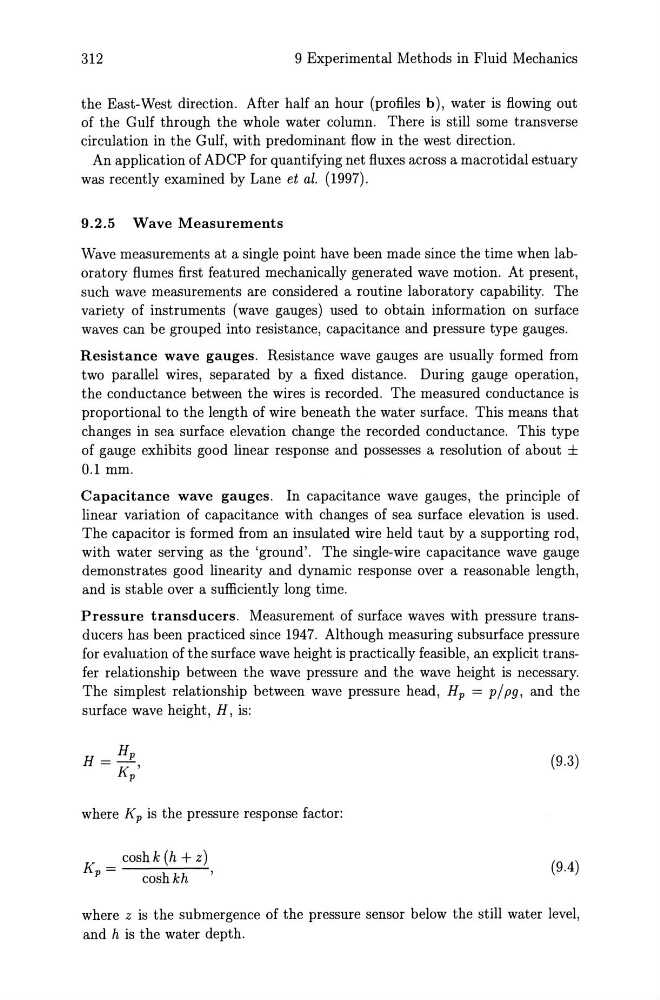
The simplest relationship between wave pressure head, H p = p / pg, and the
surface wave height, H, is:
Hp
H=K' p
where K p is the pressure response factor:
K _ _ co_sh_k_<-,-h_+_z....:...)
p -
coshkh
'
(9.3)
(9.4)
where z is the submergence of the pressure sensor below the still water level,
and h is the water depth.
9 Experimental Methods in Fluid Mechanics
the East-West direction. After half an hour (profiles b), water is flowing out
of the Gulf through the whole water column. There is still some transverse
circulation in the Gulf, with predominant flow in the west direction.
An application of ADCP for quantifying net fluxes across a macrotidal estuary
was recently examined by Lane et al. (1997).
9.2.5 Wave Measurements
Wave measurements at a single point have been made since the time when laboratory flumes first featured mechanically generated wave motion. At present,
such wave measurements are considered a routine laboratory capability. The
variety of instruments (wave gauges) used to obtain information on surface
waves can be grouped into resistance, capacitance and pressure type gauges.
Resistance wave gauges. Resistance wave gauges are usually formed from
two parallel wires, separated by a fixed distance. During gauge operation,
the conductance between the wires is recorded. The measured conductance is
proportional to the length of wire beneath the water surface. This means that
changes in sea surface elevation change the recorded conductance. This type
of gauge exhibits good linear response and possesses a resolution of about ±
0.1 mm.
Capacitance wave gauges. In capacitance wave gauges, the principle of
linear variation of capacitance with changes of sea surface elevation is used.
The capacitor is formed from an insulated wire held taut by a supporting rod,
with water serving as the 'ground'. The single-wire capacitance wave gauge
demonstrates good linearity and dynamic response over a reasonable length,
and is stable over a sufficiently long time.
Pressure transducers. Measurement of surface waves with pressure transducers has been practiced since 1947. Although measuring subsurface pressure
for evaluation of the surface wave height is practically feasible, an explicit transfer relationship between the wave pressure and the wave height is necessary.
The simplest relationship between wave pressure head, H p = p / pg, and the
surface wave height, H, is:
Hp
H=K' p
where K p is the pressure response factor:
K _ _ co_sh_k_<-,-h_+_z....:...)
p -
coshkh
'
(9.3)
(9.4)
where z is the submergence of the pressure sensor below the still water level,
and h is the water depth.