

9.2 Field and Laboratory Measurement Techniques
313
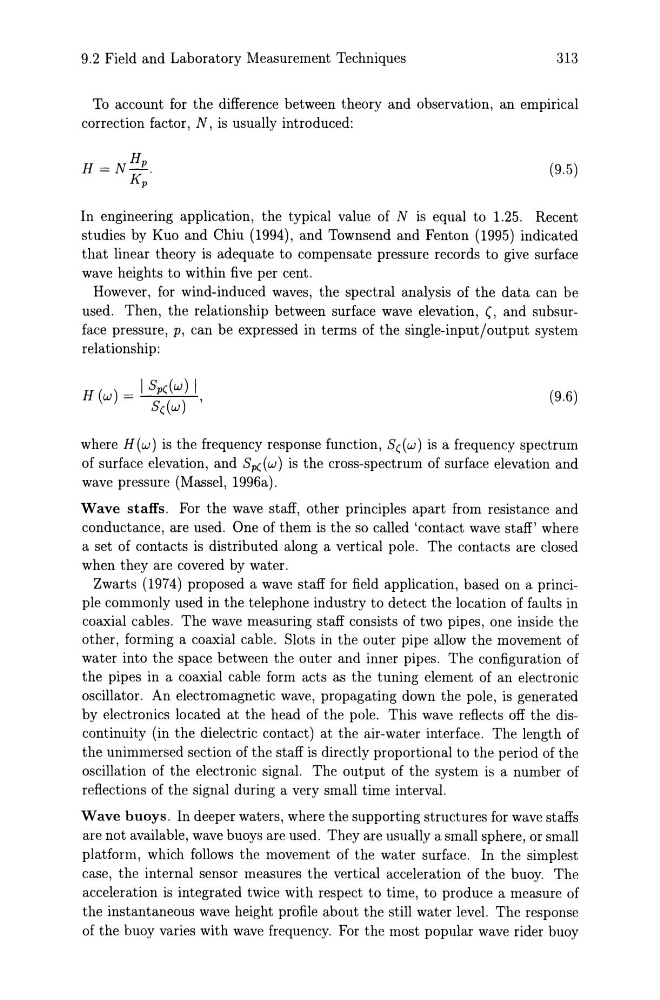
To account for the difference between theory and observation, an empirical
correction factor, N, is usually introduced:
(9.5)
In engineering application, the typical value of N is equal to 1.25. Recent
studies by Kuo and Chiu (1994), and Townsend and Fenton (1995) indicated
that linear theory is adequate to compensate pressure records to give surface
wave heights to within five per cent.
However, for wind-induced waves, the spectral analysis of the data can be
used. Then, the relationship between surface wave elevation, (, and subsurface pressure, p, can be expressed in terms of the single-input/output system
relationship:
(9.6)
where H(w) is the frequency response function, S((w) is a frequency spectrum
of surface elevation, and Sp((w) is the cross-spectrum of surface elevation and
wave pressure (Massel, 1996a).
Wave staffs. For the wave staff, other principles apart from resistance and
conductance, are used. One of them is the so called 'contact wave staff' where
a set of contacts is distributed along a vertical pole. The contacts are closed
when they are covered by water.
Zwarts (1974) proposed a wave staff for field application, based on a principle commonly used in the telephone industry to detect the location of faults in
coaxial cables. The wave measuring staff consists of two pipes, one inside the
other, forming a coaxial cable. Slots in the outer pipe allow the movement of
water into the space between the outer and inner pipes. The configuration of
the pipes in a coaxial cable form acts as the tuning element of an electronic
oscillator. An electromagnetic wave, propagating down the pole, is generated
by electronics located at the head of the pole. This wave reflects off the discontinuity (in the dielectric contact) at the air-water interface. The length of
the unimmersed section of the staff is directly proportional to the period of the
oscillation of the electronic signal. The output of the system is a number of
reflections of the signal during a very small time interval.
Wave buoys. In deeper waters, where the supporting structures for wave staffs
are not available, wave buoys are used. They are usually a small sphere, or small
platform, which follows the movement of the water surface. In the simplest
case, the internal sensor measures the vertical acceleration of the buoy. The
acceleration is integrated twice with respect to time, to produce a measure of
the instantaneous wave height profile about the still water level. The response
of the buoy varies with wave frequency. For the most popular wave rider buoy
313
To account for the difference between theory and observation, an empirical
correction factor, N, is usually introduced:
(9.5)
In engineering application, the typical value of N is equal to 1.25. Recent
studies by Kuo and Chiu (1994), and Townsend and Fenton (1995) indicated
that linear theory is adequate to compensate pressure records to give surface
wave heights to within five per cent.
However, for wind-induced waves, the spectral analysis of the data can be
used. Then, the relationship between surface wave elevation, (, and subsurface pressure, p, can be expressed in terms of the single-input/output system
relationship:
(9.6)
where H(w) is the frequency response function, S((w) is a frequency spectrum
of surface elevation, and Sp((w) is the cross-spectrum of surface elevation and
wave pressure (Massel, 1996a).
Wave staffs. For the wave staff, other principles apart from resistance and
conductance, are used. One of them is the so called 'contact wave staff' where
a set of contacts is distributed along a vertical pole. The contacts are closed
when they are covered by water.
Zwarts (1974) proposed a wave staff for field application, based on a principle commonly used in the telephone industry to detect the location of faults in
coaxial cables. The wave measuring staff consists of two pipes, one inside the
other, forming a coaxial cable. Slots in the outer pipe allow the movement of
water into the space between the outer and inner pipes. The configuration of
the pipes in a coaxial cable form acts as the tuning element of an electronic
oscillator. An electromagnetic wave, propagating down the pole, is generated
by electronics located at the head of the pole. This wave reflects off the discontinuity (in the dielectric contact) at the air-water interface. The length of
the unimmersed section of the staff is directly proportional to the period of the
oscillation of the electronic signal. The output of the system is a number of
reflections of the signal during a very small time interval.
Wave buoys. In deeper waters, where the supporting structures for wave staffs
are not available, wave buoys are used. They are usually a small sphere, or small
platform, which follows the movement of the water surface. In the simplest
case, the internal sensor measures the vertical acceleration of the buoy. The
acceleration is integrated twice with respect to time, to produce a measure of
the instantaneous wave height profile about the still water level. The response
of the buoy varies with wave frequency. For the most popular wave rider buoy