

292
8 Transport in the Oceans and Coastal Zone
8.5.4 Dynamics of Partly Mixed Estuaries
Circulation in partly mixed estuaries is primarily induced by the density difference between freshwater and sea water. A two layer circulation and stratification are maintained by a dynamic balance of advective and diffusive processes.
The most essential variations occur in the vertical and longitudinal directions.
Therefore, we limit our consideration here to estuaries that are sufficiently
elongated and laterally homogeneous.
The circulation in estuaries is usually expressed as the sum of three modes:
river discharge mode, wind stress mode, and gravitational convective mode.
We consider a simpler case of non-tidal currents when wind stress can be neglected. Water density in an elongated estuary is constant over water depth,
but increases gradually from the estuary head to the ocean due to increasing
salinity. The surface slope, horizontal density gradient and consequently the
flow velocity are constant as functions of longitudinal distance. We are interested in describing the vertical variation in current velocity rather than the
horizontal variation.
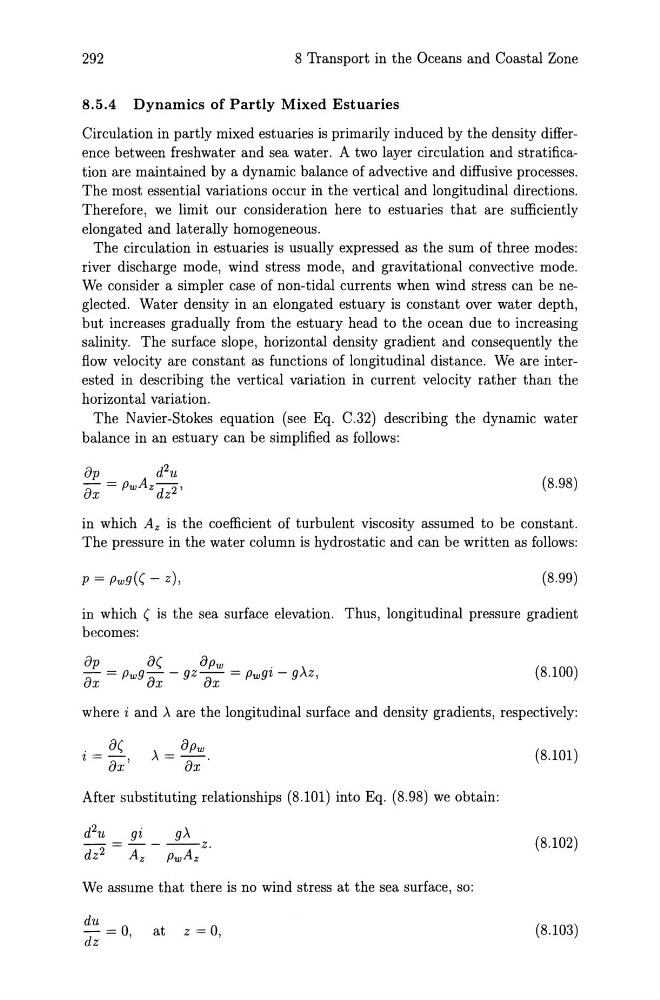
The Navier-Stokes equation (see Eq. C.32) describing the dynamic water
balance in an estuary can be simplified as follows:
(8.98)
in which Az is the coefficient of turbulent viscosity assumed to be constant.
The pressure in the water column is hydrostatic and can be written as follows:
p = Pwg(( - z),
(8.99)
in which ( is the sea surface elevation. Thus, longitudinal pressure gradient
becomes:
~
8(
8~
.
8x = Pwg 8x - gz 8x = Pwg~ - g).,z,
(8.100)
where i and)" are the longitudinal surface and density gradients, respectively:
. 8(
z = -
8x'
)., = 8pw.
8x
After substituting relationships (8.101) into Eq. (8.98) we obtain:
We assume that there is no wind stress at the sea surface, so:
du
- = 0, at z = 0,
dz
(8.101)
(8.102)
(8.103)
8 Transport in the Oceans and Coastal Zone
8.5.4 Dynamics of Partly Mixed Estuaries
Circulation in partly mixed estuaries is primarily induced by the density difference between freshwater and sea water. A two layer circulation and stratification are maintained by a dynamic balance of advective and diffusive processes.
The most essential variations occur in the vertical and longitudinal directions.
Therefore, we limit our consideration here to estuaries that are sufficiently
elongated and laterally homogeneous.
The circulation in estuaries is usually expressed as the sum of three modes:
river discharge mode, wind stress mode, and gravitational convective mode.
We consider a simpler case of non-tidal currents when wind stress can be neglected. Water density in an elongated estuary is constant over water depth,
but increases gradually from the estuary head to the ocean due to increasing
salinity. The surface slope, horizontal density gradient and consequently the
flow velocity are constant as functions of longitudinal distance. We are interested in describing the vertical variation in current velocity rather than the
horizontal variation.
The Navier-Stokes equation (see Eq. C.32) describing the dynamic water
balance in an estuary can be simplified as follows:
(8.98)
in which Az is the coefficient of turbulent viscosity assumed to be constant.
The pressure in the water column is hydrostatic and can be written as follows:
p = Pwg(( - z),
(8.99)
in which ( is the sea surface elevation. Thus, longitudinal pressure gradient
becomes:
~
8(
8~
.
8x = Pwg 8x - gz 8x = Pwg~ - g).,z,
(8.100)
where i and)" are the longitudinal surface and density gradients, respectively:
. 8(
z = -
8x'
)., = 8pw.
8x
After substituting relationships (8.101) into Eq. (8.98) we obtain:
We assume that there is no wind stress at the sea surface, so:
du
- = 0, at z = 0,
dz
(8.101)
(8.102)
(8.103)