

288
8 Transport in the Oceans and Coastal Zone
water mass in the estuary moves landward and seaward. Partly mixed water
moves upward and downward through the halodine, diluting salt water with the
freshwater and vice versa. Due to turbulent mixing, the residual circulation,
consisting of seaward flow above and landward flow below the halodine, is
better developed than in the salt-wedge estuary. The combination of both
residual and flood tidal currents suspend a lot of sediment and transport it
landward into the estuary.
In well-mixed estuaries where tidal energy dominates over river input, the
water column is completely mixed by turbulence (Fig. 8.12c). Because of this
mixing, there are no residual currents in the vertical plane. Well-mixed estuaries are usually very wide when compared with their depth, and strong currents
transport a great amount of marine sediments.
8.5.2 Some Simple Mixing Concepts
Similarly to ocean waters, mixing in estuaries results from a combination of
advective mean velocity circulation, and small-scale turbulent diffusion. The
advective velocity comprises tidal variations, wind-induced variations of any
period and seasonal variations of meteorological influences. Fluctuations of
periods less than say half a minute, can be considered as turbulence. Prior to
developing a more detailed description of mixing in various types of estuaries,
we will start with rather simplified mixing concepts. They are based on the
fundamental relationships for conservation of mass and momentum.
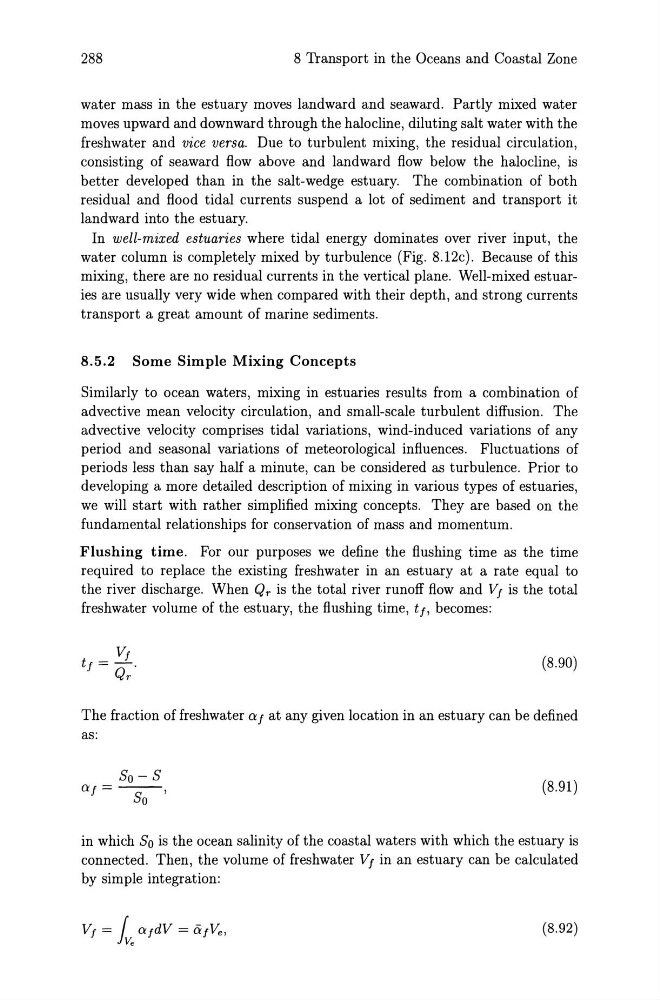
Flushing time. For our purposes we define the flushing time as the time
required to replace the existing freshwater in an estuary at a rate equal to
the river discharge. When Qr is the total river runoff flow and Vf is the total
freshwater volume of the estuary, the flushing time, t f' becomes:
(8.90)
The fraction of freshwater a f at any given location in an estuary can be defined
as:
So - S
aj = ---S;-'
(8.91 )
in which So is the ocean salinity of the coastal waters with which the estuary is
connected. Then, the volume of freshwater Vf in an estuary can be calculated
by simple integration:
(8.92)
8 Transport in the Oceans and Coastal Zone
water mass in the estuary moves landward and seaward. Partly mixed water
moves upward and downward through the halodine, diluting salt water with the
freshwater and vice versa. Due to turbulent mixing, the residual circulation,
consisting of seaward flow above and landward flow below the halodine, is
better developed than in the salt-wedge estuary. The combination of both
residual and flood tidal currents suspend a lot of sediment and transport it
landward into the estuary.
In well-mixed estuaries where tidal energy dominates over river input, the
water column is completely mixed by turbulence (Fig. 8.12c). Because of this
mixing, there are no residual currents in the vertical plane. Well-mixed estuaries are usually very wide when compared with their depth, and strong currents
transport a great amount of marine sediments.
8.5.2 Some Simple Mixing Concepts
Similarly to ocean waters, mixing in estuaries results from a combination of
advective mean velocity circulation, and small-scale turbulent diffusion. The
advective velocity comprises tidal variations, wind-induced variations of any
period and seasonal variations of meteorological influences. Fluctuations of
periods less than say half a minute, can be considered as turbulence. Prior to
developing a more detailed description of mixing in various types of estuaries,
we will start with rather simplified mixing concepts. They are based on the
fundamental relationships for conservation of mass and momentum.
Flushing time. For our purposes we define the flushing time as the time
required to replace the existing freshwater in an estuary at a rate equal to
the river discharge. When Qr is the total river runoff flow and Vf is the total
freshwater volume of the estuary, the flushing time, t f' becomes:
(8.90)
The fraction of freshwater a f at any given location in an estuary can be defined
as:
So - S
aj = ---S;-'
(8.91 )
in which So is the ocean salinity of the coastal waters with which the estuary is
connected. Then, the volume of freshwater Vf in an estuary can be calculated
by simple integration:
(8.92)