

8.5 Diffusion and Mixing in Estuaries
287
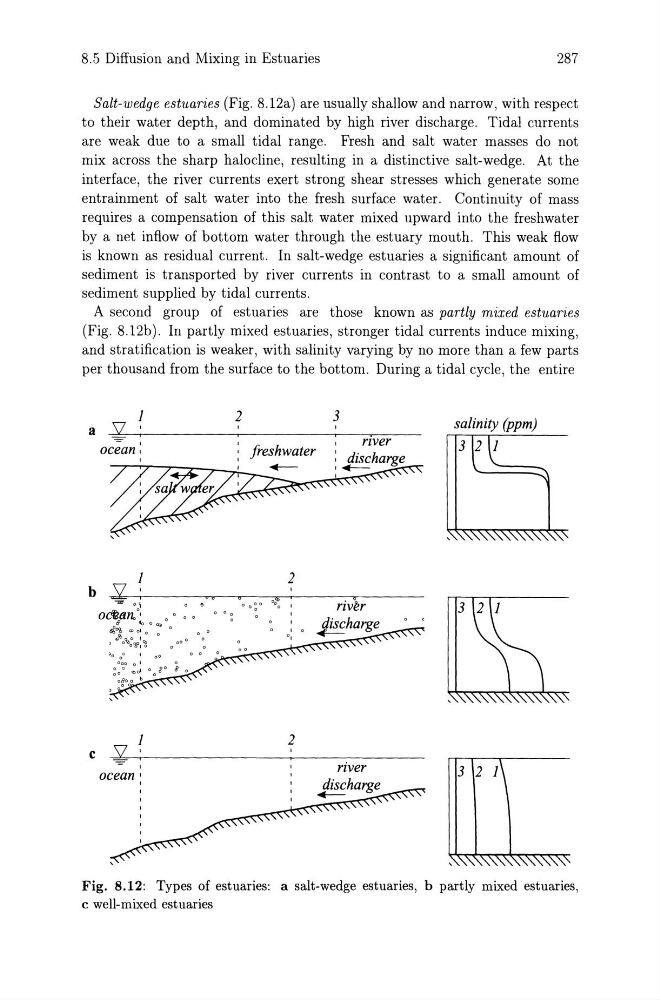
Salt-wedge estuaries (Fig. 8.12a) are usually shallow and narrow, with respect
to their water depth, and dominated by high river discharge. Tidal currents
are weak due to a small tidal range. Fresh and salt water masses do not
mix across the sharp halocline, resulting in a distinctive salt-wedge. At the
interface, the river currents exert strong shear stresses which generate some
entrainment of salt water into the fresh surface water. Continuity of mass
requires a compensation of this salt water mixed upward into the freshwater
by a net inflow of bottom water through the estuary mouth. This weak flow
is known as residual current. In salt-wedge estuaries a significant amount of
sediment is transported by river currents in contrast to a small amount of
sediment supplied by tidal currents.
A second group of estuaries are those known as partly mixed estuaries
(Fig. 8.12b). In partly mixed estuaries, stronger tidal currents induce mixing,
and stratification is weaker, with salinity varying by no more than a few parts
per thousand from the surface to the bottom. During a tidal cycle, the entire
J
a SZ '
ocean:
J
b :sz :
= 0\
o~an,°,
0
~~ roo~Oo() co 0
) &)~o%:%o: 1; 0
' 0
J
c SZ '
ocean:
2
3
, freshwater
2
,
0 0
2
Fig. 8.12: Types of estuaries: a salt-wedge estuaries, b partly mixed estuaries,
c well-mixed estuaries
287
Salt-wedge estuaries (Fig. 8.12a) are usually shallow and narrow, with respect
to their water depth, and dominated by high river discharge. Tidal currents
are weak due to a small tidal range. Fresh and salt water masses do not
mix across the sharp halocline, resulting in a distinctive salt-wedge. At the
interface, the river currents exert strong shear stresses which generate some
entrainment of salt water into the fresh surface water. Continuity of mass
requires a compensation of this salt water mixed upward into the freshwater
by a net inflow of bottom water through the estuary mouth. This weak flow
is known as residual current. In salt-wedge estuaries a significant amount of
sediment is transported by river currents in contrast to a small amount of
sediment supplied by tidal currents.
A second group of estuaries are those known as partly mixed estuaries
(Fig. 8.12b). In partly mixed estuaries, stronger tidal currents induce mixing,
and stratification is weaker, with salinity varying by no more than a few parts
per thousand from the surface to the bottom. During a tidal cycle, the entire
J
a SZ '
ocean:
J
b :sz :
= 0\
o~an,°,
0
~~ roo~Oo() co 0
) &)~o%:%o: 1; 0
' 0
J
c SZ '
ocean:
2
3
, freshwater
2
,
0 0
2
Fig. 8.12: Types of estuaries: a salt-wedge estuaries, b partly mixed estuaries,
c well-mixed estuaries