

278
8 Transport in the Oceans and Coastal Zone
t=20 s:
t=10 s
current path"'-.
o
2
3
4
5
6
7
8
9
10
11
12
Distance x from point of release (m)
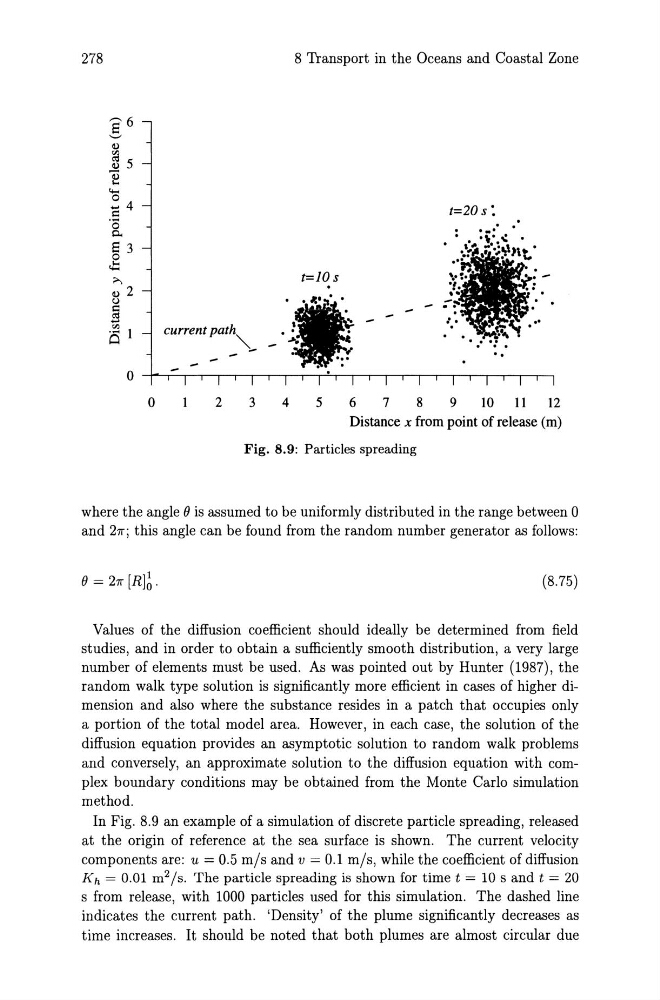
Fig. 8.9: Particles spreading
where the angle () is assumed to be uniformly distributed in the range between 0
and 27r; this angle can be found from the random number generator as follows:
(8.75)
Values of the diffusion coefficient should ideally be determined from field
studies, and in order to obtain a sufficiently smooth distribution, a very large
number of elements must be used. As was pointed out by Hunter (1987), the
random walk type solution is significantly more efficient in cases of higher dimension and also where the substance resides in a patch that occupies only
a portion of the total model area. However, in each case, the solution of the
diffusion equation provides an asymptotic solution to random walk problems
and conversely, an approximate solution to the diffusion equation with complex boundary conditions may be obtained from the Monte Carlo simulation
method.
In Fig. 8.9 an example of a simulation of discrete particle spreading, released
at the origin of reference at the sea surface is shown. The current velocity
components are: u = 0.5 mls and v = 0.1 mis, while the coefficient of diffusion
K h = 0.01 m 2 Is. The particle spreading is shown for time t = 10 sand t = 20
s from release, with 1000 particles used for this simulation. The dashed line
indicates the current path. 'Density' of the plume significantly decreases as
time increases. It should be noted that both plumes are almost circular due
8 Transport in the Oceans and Coastal Zone
t=20 s:
t=10 s
current path"'-.
o
2
3
4
5
6
7
8
9
10
11
12
Distance x from point of release (m)
Fig. 8.9: Particles spreading
where the angle () is assumed to be uniformly distributed in the range between 0
and 27r; this angle can be found from the random number generator as follows:
(8.75)
Values of the diffusion coefficient should ideally be determined from field
studies, and in order to obtain a sufficiently smooth distribution, a very large
number of elements must be used. As was pointed out by Hunter (1987), the
random walk type solution is significantly more efficient in cases of higher dimension and also where the substance resides in a patch that occupies only
a portion of the total model area. However, in each case, the solution of the
diffusion equation provides an asymptotic solution to random walk problems
and conversely, an approximate solution to the diffusion equation with complex boundary conditions may be obtained from the Monte Carlo simulation
method.
In Fig. 8.9 an example of a simulation of discrete particle spreading, released
at the origin of reference at the sea surface is shown. The current velocity
components are: u = 0.5 mls and v = 0.1 mis, while the coefficient of diffusion
K h = 0.01 m 2 Is. The particle spreading is shown for time t = 10 sand t = 20
s from release, with 1000 particles used for this simulation. The dashed line
indicates the current path. 'Density' of the plume significantly decreases as
time increases. It should be noted that both plumes are almost circular due