

8.3 Concentration of Matter for Molecular and Turbulent Diffusion
277
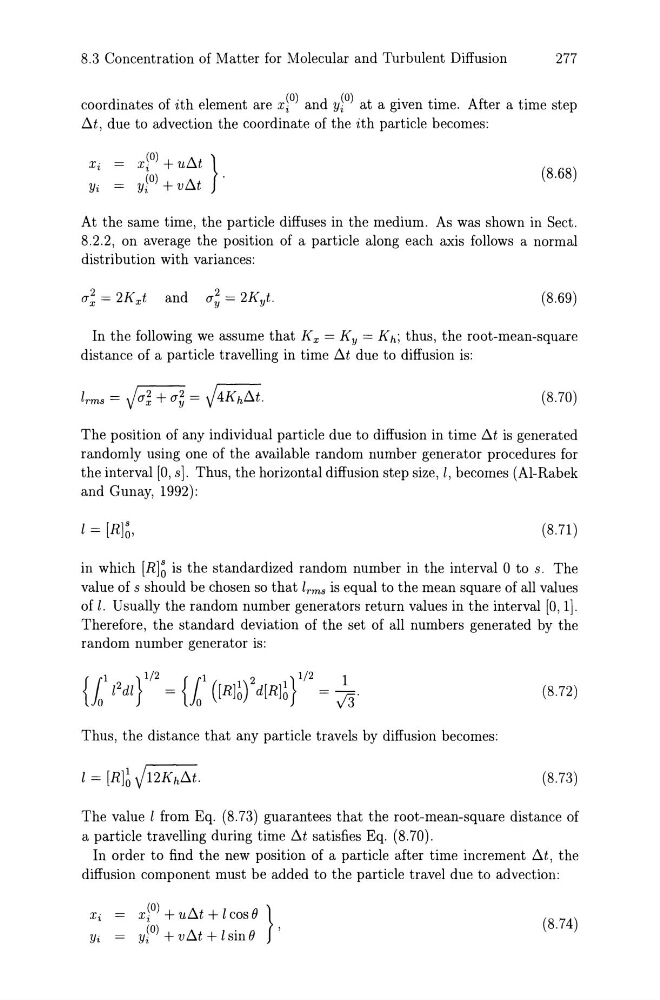
coordinates of ith element are x~O) and yjO) at a given time. After a time step
D.t, due to advection the coordinate of the ith particle becomes:
x = xCO) + uD.t }
1.
,
Y · = yCO)+v~t
.
,
1.
(8.68)
At the same time, the particle diffuses in the medium. As was shown in Sect.
8.2.2, on average the position of a particle along each axis follows a normal
distribution with variances:
(8.69)
In the following we assume that Kx = Ky = K h; thus, the root-mean-square
distance of a particle travelling in time D.t due to diffusion is:
lrms = V(J~ + (J~ = V4Kh~t.
(8.70)
The position of any individual particle due to diffusion in time ~t is generated
randomly using one of the available random number generator procedures for
the interval [0, s]. Thus, the horizontal diffusion step size, I, becomes (Al-Rabek
and Gunay, 1992):
I = [R]~,
(8.71)
in which [R]~ is the standardized random number in the interval ° to s. The
value of s should be chosen so that lrms is equal to the mean square of all values
of l. Usually the random number generators return values in the interval [0,1].
Therefore, the standard deviation of the set of all numbers generated by the
random number generator is:
{ I } 1/2
{ I
2
} 1/2
10 12dl = 10 (lR]~) d[R]~
(8.72)
Thus, the distance that any particle travels by diffusion becomes:
(8.73)
The value I from Eq. (8.73) guarantees that the root-mean-square distance of
a particle travelling during time D.t satisfies Eq. (8.70).
In order to find the new position of a particle after time increment D.t, the
diffusion component must be added to the particle travel due to advection:
Xi
= x~O) + u~t + I cos () }
Yi = y~O)+v~t+lsin()
,
(8.74)
277
coordinates of ith element are x~O) and yjO) at a given time. After a time step
D.t, due to advection the coordinate of the ith particle becomes:
x = xCO) + uD.t }
1.
,
Y · = yCO)+v~t
.
,
1.
(8.68)
At the same time, the particle diffuses in the medium. As was shown in Sect.
8.2.2, on average the position of a particle along each axis follows a normal
distribution with variances:
(8.69)
In the following we assume that Kx = Ky = K h; thus, the root-mean-square
distance of a particle travelling in time D.t due to diffusion is:
lrms = V(J~ + (J~ = V4Kh~t.
(8.70)
The position of any individual particle due to diffusion in time ~t is generated
randomly using one of the available random number generator procedures for
the interval [0, s]. Thus, the horizontal diffusion step size, I, becomes (Al-Rabek
and Gunay, 1992):
I = [R]~,
(8.71)
in which [R]~ is the standardized random number in the interval ° to s. The
value of s should be chosen so that lrms is equal to the mean square of all values
of l. Usually the random number generators return values in the interval [0,1].
Therefore, the standard deviation of the set of all numbers generated by the
random number generator is:
{ I } 1/2
{ I
2
} 1/2
10 12dl = 10 (lR]~) d[R]~
(8.72)
Thus, the distance that any particle travels by diffusion becomes:
(8.73)
The value I from Eq. (8.73) guarantees that the root-mean-square distance of
a particle travelling during time D.t satisfies Eq. (8.70).
In order to find the new position of a particle after time increment D.t, the
diffusion component must be added to the particle travel due to advection:
Xi
= x~O) + u~t + I cos () }
Yi = y~O)+v~t+lsin()
,
(8.74)