

7.8 Coastal Water Movement
247
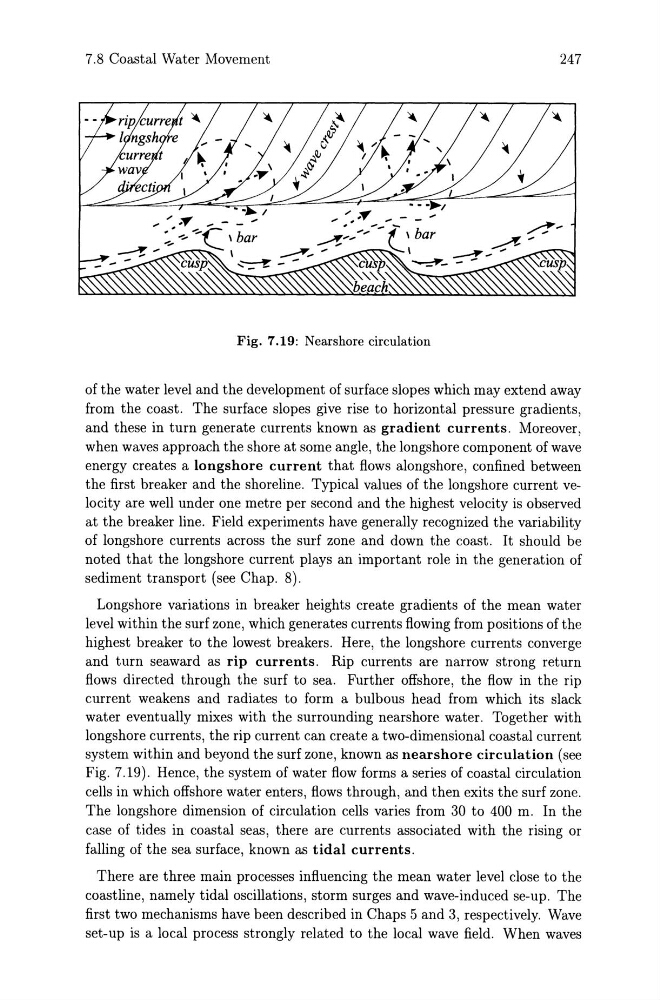
Fig. 7.19: Nearshore circulation
of the water level and the development of surface slopes which may extend away
from the coast. The surface slopes give rise to horizontal pressure gradients,
and these in turn generate currents known as gradient currents. Moreover,
when waves approach the shore at some angle, the longshore component of wave
energy creates a longshore current that flows alongshore, confined between
the first breaker and the shoreline. Typical values of the longshore current velocity are well under one metre per second and the highest velocity is observed
at the breaker line. Field experiments have generally recognized the variability
of longshore currents across the surf zone and down the coast. It should be
noted that the longshore current plays an important role in the generation of
sediment transport (see Chap. 8).
Longshore variations in breaker heights create gradients of the mean water
level within the surf zone, which generates currents flowing from positions of the
highest breaker to the lowest breakers. Here, the longshore currents converge
and turn seaward as rip currents. Rip currents are narrow strong return
flows directed through the surf to sea. Further offshore, the flow in the rip
current weakens and radiates to form a bulbous head from which its slack
water eventually mixes with the surrounding nearshore water. Together with
longshore currents, the rip current can create a two-dimensional coastal current
system within and beyond the surf zone, known as nearshore circulation (see
Fig. 7.19). Hence, the system of water flow forms a series of coastal circulation
cells in which offshore water enters, flows through, and then exits the surf zone.
The longshore dimension of circulation cells varies from 30 to 400 m. In the
case of tides in coastal seas, there are currents associated with the rising or
falling of the sea surface, known as tidal currents.
There are three main processes influencing the mean water level close to the
coastline, namely tidal oscillations, storm surges and wave-induced se-up. The
first two mechanisms have been described in Chaps 5 and 3, respectively. Wave
set-up is a local process strongly related to the local wave field. When waves
247
Fig. 7.19: Nearshore circulation
of the water level and the development of surface slopes which may extend away
from the coast. The surface slopes give rise to horizontal pressure gradients,
and these in turn generate currents known as gradient currents. Moreover,
when waves approach the shore at some angle, the longshore component of wave
energy creates a longshore current that flows alongshore, confined between
the first breaker and the shoreline. Typical values of the longshore current velocity are well under one metre per second and the highest velocity is observed
at the breaker line. Field experiments have generally recognized the variability
of longshore currents across the surf zone and down the coast. It should be
noted that the longshore current plays an important role in the generation of
sediment transport (see Chap. 8).
Longshore variations in breaker heights create gradients of the mean water
level within the surf zone, which generates currents flowing from positions of the
highest breaker to the lowest breakers. Here, the longshore currents converge
and turn seaward as rip currents. Rip currents are narrow strong return
flows directed through the surf to sea. Further offshore, the flow in the rip
current weakens and radiates to form a bulbous head from which its slack
water eventually mixes with the surrounding nearshore water. Together with
longshore currents, the rip current can create a two-dimensional coastal current
system within and beyond the surf zone, known as nearshore circulation (see
Fig. 7.19). Hence, the system of water flow forms a series of coastal circulation
cells in which offshore water enters, flows through, and then exits the surf zone.
The longshore dimension of circulation cells varies from 30 to 400 m. In the
case of tides in coastal seas, there are currents associated with the rising or
falling of the sea surface, known as tidal currents.
There are three main processes influencing the mean water level close to the
coastline, namely tidal oscillations, storm surges and wave-induced se-up. The
first two mechanisms have been described in Chaps 5 and 3, respectively. Wave
set-up is a local process strongly related to the local wave field. When waves