

10
1 Introducing Sea Water
a
b
non-wetting liquid
wetting liquid
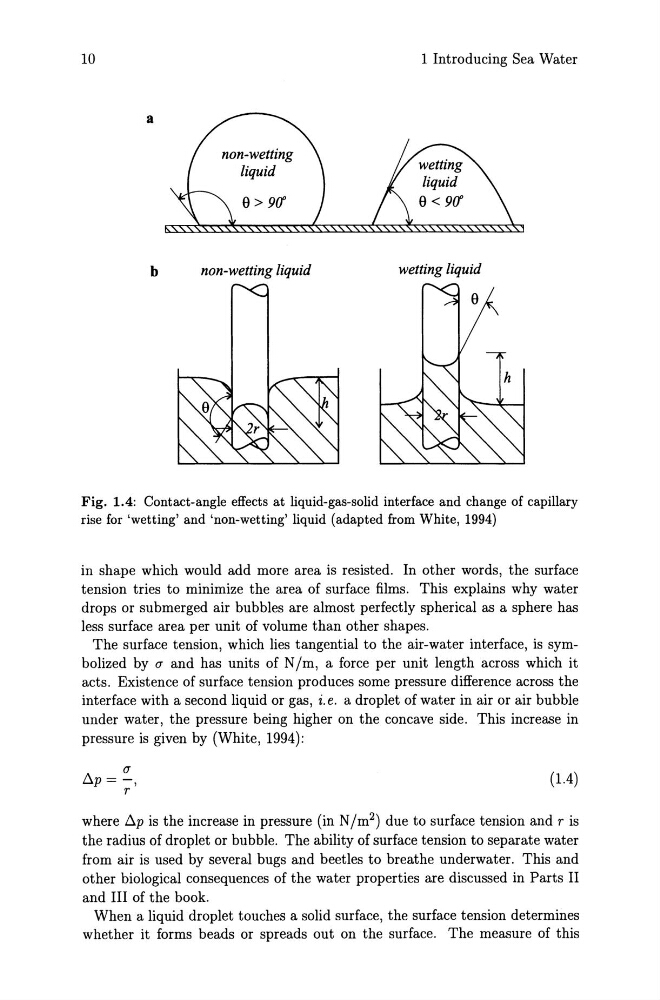
Fig. 1.4: Contact-angle effects at liquid-gas-solid interface and change of capillary
rise for 'wetting' and 'non-wetting' liquid (adapted from White, 1994)
in shape which would add more area is resisted. In other words, the surface
tension tries to minimize the area of surface films. This explains why water
drops or submerged air bubbles are almost perfectly spherical as a sphere has
less surface area per unit of volume than other shapes.
The surface tension, which lies tangential to the air-water interface, is symbolized by (J and has units of N jm, a force per unit length across which it
acts. Existence of surface tension produces some pressure difference across the
interface with a second liquid or gas, i. e. a droplet of water in air or air bubble
under water, the pressure being higher on the concave side. This increase in
pressure is given by (White, 1994):
(J
D..p = -,
r
(1.4)
where D..p is the increase in pressure (in Njm 2 ) due to surface tension and r is
the radius of droplet or bubble. The ability of surface tension to separate water
from air is used by several bugs and beetles to breathe underwater. This and
other biological consequences of the water properties are discussed in Parts II
and III of the book.
When a liquid droplet touches a solid surface, the surface tension determines
whether it forms beads or spreads out on the surface. The measure of this
1 Introducing Sea Water
a
b
non-wetting liquid
wetting liquid
Fig. 1.4: Contact-angle effects at liquid-gas-solid interface and change of capillary
rise for 'wetting' and 'non-wetting' liquid (adapted from White, 1994)
in shape which would add more area is resisted. In other words, the surface
tension tries to minimize the area of surface films. This explains why water
drops or submerged air bubbles are almost perfectly spherical as a sphere has
less surface area per unit of volume than other shapes.
The surface tension, which lies tangential to the air-water interface, is symbolized by (J and has units of N jm, a force per unit length across which it
acts. Existence of surface tension produces some pressure difference across the
interface with a second liquid or gas, i. e. a droplet of water in air or air bubble
under water, the pressure being higher on the concave side. This increase in
pressure is given by (White, 1994):
(J
D..p = -,
r
(1.4)
where D..p is the increase in pressure (in Njm 2 ) due to surface tension and r is
the radius of droplet or bubble. The ability of surface tension to separate water
from air is used by several bugs and beetles to breathe underwater. This and
other biological consequences of the water properties are discussed in Parts II
and III of the book.
When a liquid droplet touches a solid surface, the surface tension determines
whether it forms beads or spreads out on the surface. The measure of this