

l.2 Physical and Chemical Properties of Sea Water
9
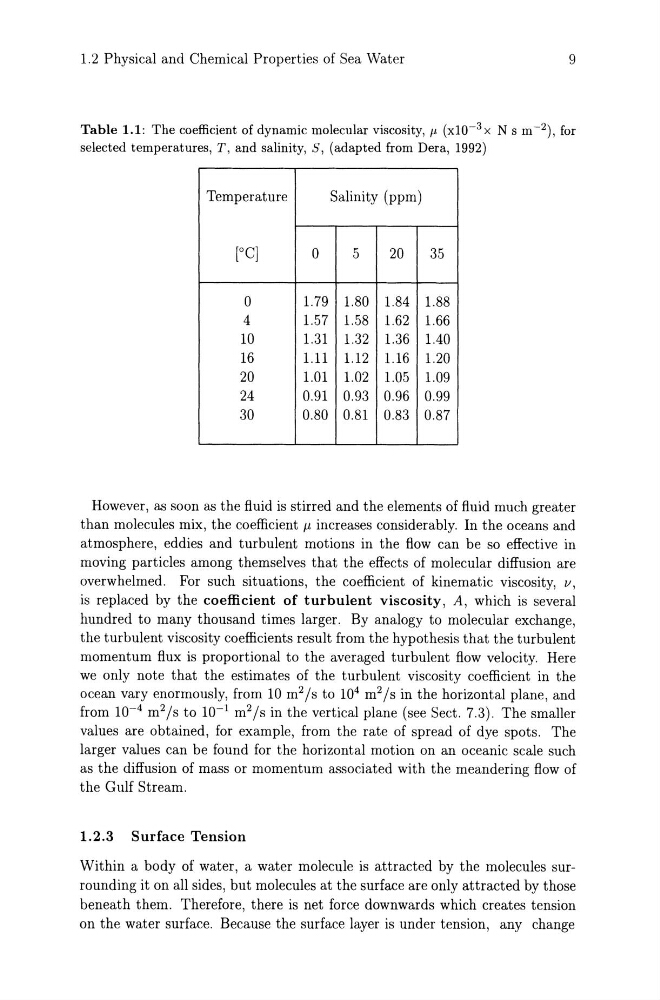
Table 1.1: The coefficient of dynamic molecular viscosity, It (x10- 3 x N s m- 2 ), for
selected temperatures, T, and salinity, S, (adapted from Dera, 1992)
Temperature
Salinity (ppm)
[0C]
0
5
20
35
0
l.79 l.80 l.84 l.88
4
l.57 l.58 l.62 l.66
10
l.31 l.32 l.36 1.40
16
1.11 1.12 1.16 l.20
20
1.01 1.02 1.05 1.09
24
0.91 0.93 0.96 0.99
30
0.80 0.81 0.83 0.87
However, as soon as the fluid is stirred and the elements of fluid much greater
than molecules mix, the coefficient J.L increases considerably. In the oceans and
atmosphere, eddies and turbulent motions in the flow can be so effective in
moving particles among themselves that the effects of molecular diffusion are
overwhelmed. For such situations, the coefficient of kinematic viscosity, v,
is replaced by the coefficient of turbulent viscosity, A, which is several
hundred to many thousand times larger. By analogy to molecular exchange,
the turbulent viscosity coefficients result from the hypothesis that the turbulent
momentum flux is proportional to the averaged turbulent flow velocity. Here
we only note that the estimates of the turbulent viscosity coefficient in the
ocean vary enormously, from 10 m 2 /s to 10 4 m 2 /s in the horizontal plane, and
from 10- 4 m 2 /s to 10- 1 m 2 /s in the vertical plane (see Sect. 7.3). The smaller
values are obtained, for example, from the rate of spread of dye spots. The
larger values can be found for the horizontal motion on an oceanic scale such
as the diffusion of mass or momentum associated with the meandering flow of
the Gulf Stream.
1.2.3 Surface Tension
Within a body of water, a water molecule is attracted by the molecules surrounding it on all sides, but molecules at the surface are only attracted by those
beneath them. Therefore, there is net force downwards which creates tension
on the water surface. Because the surface layer is under tension, any change
9
Table 1.1: The coefficient of dynamic molecular viscosity, It (x10- 3 x N s m- 2 ), for
selected temperatures, T, and salinity, S, (adapted from Dera, 1992)
Temperature
Salinity (ppm)
[0C]
0
5
20
35
0
l.79 l.80 l.84 l.88
4
l.57 l.58 l.62 l.66
10
l.31 l.32 l.36 1.40
16
1.11 1.12 1.16 l.20
20
1.01 1.02 1.05 1.09
24
0.91 0.93 0.96 0.99
30
0.80 0.81 0.83 0.87
However, as soon as the fluid is stirred and the elements of fluid much greater
than molecules mix, the coefficient J.L increases considerably. In the oceans and
atmosphere, eddies and turbulent motions in the flow can be so effective in
moving particles among themselves that the effects of molecular diffusion are
overwhelmed. For such situations, the coefficient of kinematic viscosity, v,
is replaced by the coefficient of turbulent viscosity, A, which is several
hundred to many thousand times larger. By analogy to molecular exchange,
the turbulent viscosity coefficients result from the hypothesis that the turbulent
momentum flux is proportional to the averaged turbulent flow velocity. Here
we only note that the estimates of the turbulent viscosity coefficient in the
ocean vary enormously, from 10 m 2 /s to 10 4 m 2 /s in the horizontal plane, and
from 10- 4 m 2 /s to 10- 1 m 2 /s in the vertical plane (see Sect. 7.3). The smaller
values are obtained, for example, from the rate of spread of dye spots. The
larger values can be found for the horizontal motion on an oceanic scale such
as the diffusion of mass or momentum associated with the meandering flow of
the Gulf Stream.
1.2.3 Surface Tension
Within a body of water, a water molecule is attracted by the molecules surrounding it on all sides, but molecules at the surface are only attracted by those
beneath them. Therefore, there is net force downwards which creates tension
on the water surface. Because the surface layer is under tension, any change