

1.2 Physical and Chemical Properties of Sea Water
11
spreading is the contact angle 8 (see Fig. 1.4a). If the contact angle is less than
90°, the liquid is 'wetting'. If the angle (J > 90°, the liquid is 'non-wetting'.
Water is extremely wetting to a clean glass surface. On the other hand, mercury
is non-wetting to this surface with contact angle (J = 130°.
Surface tension is the mechanism which causes water to rise in a capillary
tube, and is of great biological importance. This phenomenon is called capillarity. The rise is positive (capillary rise) if liquids are wetting and negative
(capillary depression) if liquids are non-wetting (see Fig. l.4b). For wetting liquid the meniscus of the surface of liquid in the tube is concave, and convex for
non-wetting liquid. The height of capillary rise can be found from the formula
(White, 1994):
20" cos (J
h = - - -
pgr
(1.5)
in which r is the radius of the tube. The other symbols have been explained
earlier in this section.
1.2.4 Inorganic Salts
Most of the water in the oceans contains dissolved salts and gases. Virtually
every element is present in a dissolved state in sea water. However, there is
a group of ions which make up the majority of the mass (of about 99%) of
dissolved inorganic salts in sea water. They include: Na+, K+, Mg2+, CI-,
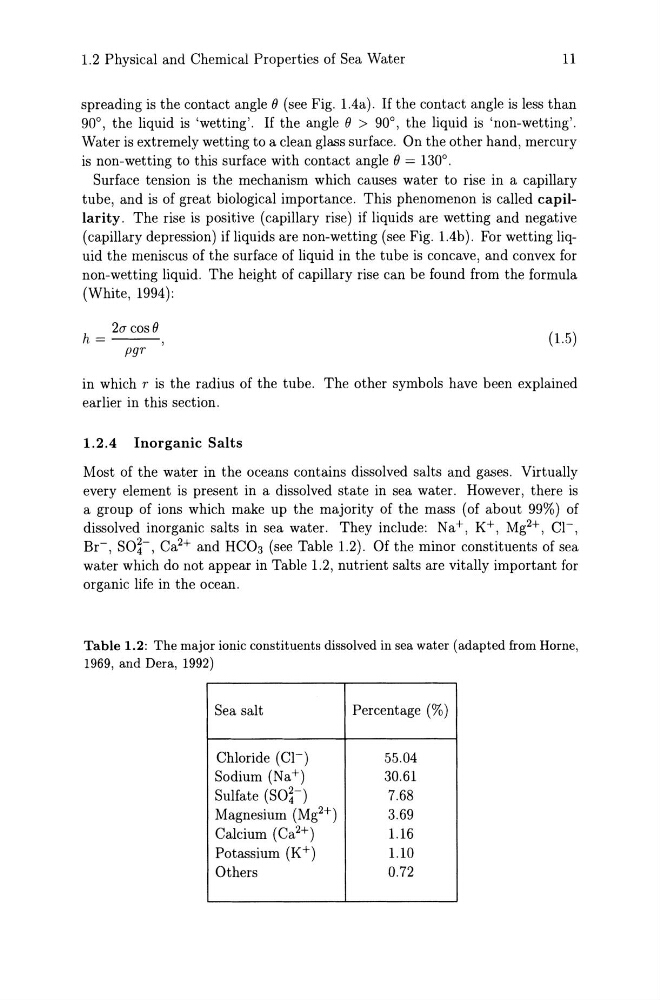
Br-, SO~-, Ca2+ and HC03 (see Table 1.2). Of the minor constituents of sea
water which do not appear in Table 1.2, nutrient salts are vitally important for
organic life in the ocean.
Table 1.2: The major ionic constituents dissolved in sea water (adapted from Horne,
1969, and Dera, 1992)
Sea salt
Percentage (%)
Chloride (CI-)
55.04
Sodium (Na+)
30.61
Sulfate (SO~-)
7.68
Magnesium (Mg2+)
3.69
Calcium (Ca 2 +)
1.16
Potassium (K+)
1.10
Others
0.72
11
spreading is the contact angle 8 (see Fig. 1.4a). If the contact angle is less than
90°, the liquid is 'wetting'. If the angle (J > 90°, the liquid is 'non-wetting'.
Water is extremely wetting to a clean glass surface. On the other hand, mercury
is non-wetting to this surface with contact angle (J = 130°.
Surface tension is the mechanism which causes water to rise in a capillary
tube, and is of great biological importance. This phenomenon is called capillarity. The rise is positive (capillary rise) if liquids are wetting and negative
(capillary depression) if liquids are non-wetting (see Fig. l.4b). For wetting liquid the meniscus of the surface of liquid in the tube is concave, and convex for
non-wetting liquid. The height of capillary rise can be found from the formula
(White, 1994):
20" cos (J
h = - - -
pgr
(1.5)
in which r is the radius of the tube. The other symbols have been explained
earlier in this section.
1.2.4 Inorganic Salts
Most of the water in the oceans contains dissolved salts and gases. Virtually
every element is present in a dissolved state in sea water. However, there is
a group of ions which make up the majority of the mass (of about 99%) of
dissolved inorganic salts in sea water. They include: Na+, K+, Mg2+, CI-,
Br-, SO~-, Ca2+ and HC03 (see Table 1.2). Of the minor constituents of sea
water which do not appear in Table 1.2, nutrient salts are vitally important for
organic life in the ocean.
Table 1.2: The major ionic constituents dissolved in sea water (adapted from Horne,
1969, and Dera, 1992)
Sea salt
Percentage (%)
Chloride (CI-)
55.04
Sodium (Na+)
30.61
Sulfate (SO~-)
7.68
Magnesium (Mg2+)
3.69
Calcium (Ca 2 +)
1.16
Potassium (K+)
1.10
Others
0.72