

7.7 Continental Shelf Flow
239
reach the surface and result in the formation of a front (Fig. 7.14b). This front
is displaced offshore and cold waters from below are exposed to the surface,
which enhances the primary production.
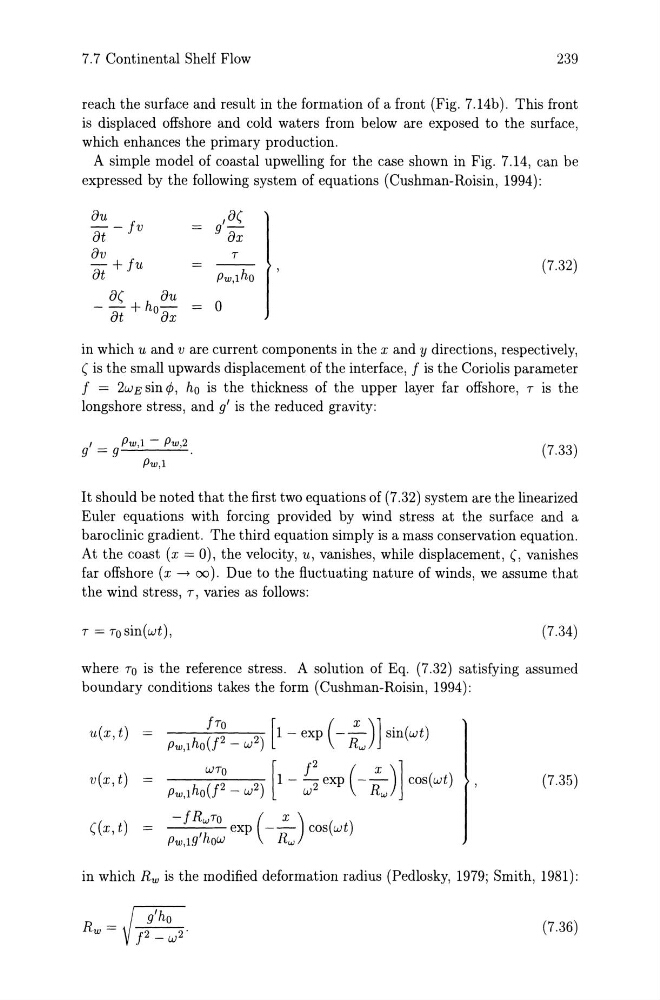
A simple model of coastal upwelling for the case shown in Fig. 7.14, can be
expressed by the following system of equations (Cushman-Roisin, 1994):
fJu
- - j v
fJt
,fJ(
g -
fJx
fJv
T
(7.32)
- + j u
Pw,lh o
fJt
fJ(
fJu
0
- -+hofJt
fJx
in which u and v are current components in the x and y directions, respectively,
( is the small upwards displacement of the interface, j is the Coriolis parameter
j = 2w E sin longshore stress, and g' is the reduced gravity:
g' = 9 Pw,l - Pw,2
Pw,l
(7.33)
It should be noted that the first two equations of (7.32) system are the linearized
Euler equations with forcing provided by wind stress at the surface and a
baroclinic gradient. The third equation simply is a mass conservation equation.
At the coast (x = 0), the velocity, u, vanishes, while displacement, (, vanishes
far offshore (x ---+ (0). Due to the fluctuating nature of winds, we assume that
the wind stress, T, varies as follows:
T = Tosin(wt),
(7.34)
where TO is the reference stress. A solution of Eq. (7.32) satisfying assumed
boundary conditions takes the form (Cushman-Roisin, 1994):
u(x, t)
JTO
[
(X)] .
( 2
2) 1 - exp - - sm(wt)
Pw,lh o j - w
Rw
v(x, t)
WTo
[ j 2
(X )]
( 2
2) 1 - 2' exp - - cos(wt)
Pw,lho f - w
w
Rw
(7.35)
((x, t) = _-....:.-j_~.;,:,W_TO=-- exp ( __ X_) cos(wt)
Pw,lg how
Rw
in which Rw is the modified deformation radius (Pedlosky, 1979; Smith, 1981):
~
/hO
Rw =
2
2'
j -w
(7.36)
239
reach the surface and result in the formation of a front (Fig. 7.14b). This front
is displaced offshore and cold waters from below are exposed to the surface,
which enhances the primary production.
A simple model of coastal upwelling for the case shown in Fig. 7.14, can be
expressed by the following system of equations (Cushman-Roisin, 1994):
fJu
- - j v
fJt
,fJ(
g -
fJx
fJv
T
(7.32)
- + j u
Pw,lh o
fJt
fJ(
fJu
0
- -+hofJt
fJx
in which u and v are current components in the x and y directions, respectively,
( is the small upwards displacement of the interface, j is the Coriolis parameter
j = 2w E sin longshore stress, and g' is the reduced gravity:
g' = 9 Pw,l - Pw,2
Pw,l
(7.33)
It should be noted that the first two equations of (7.32) system are the linearized
Euler equations with forcing provided by wind stress at the surface and a
baroclinic gradient. The third equation simply is a mass conservation equation.
At the coast (x = 0), the velocity, u, vanishes, while displacement, (, vanishes
far offshore (x ---+ (0). Due to the fluctuating nature of winds, we assume that
the wind stress, T, varies as follows:
T = Tosin(wt),
(7.34)
where TO is the reference stress. A solution of Eq. (7.32) satisfying assumed
boundary conditions takes the form (Cushman-Roisin, 1994):
u(x, t)
JTO
[
(X)] .
( 2
2) 1 - exp - - sm(wt)
Pw,lh o j - w
Rw
v(x, t)
WTo
[ j 2
(X )]
( 2
2) 1 - 2' exp - - cos(wt)
Pw,lho f - w
w
Rw
(7.35)
((x, t) = _-....:.-j_~.;,:,W_TO=-- exp ( __ X_) cos(wt)
Pw,lg how
Rw
in which Rw is the modified deformation radius (Pedlosky, 1979; Smith, 1981):
~
/hO
Rw =
2
2'
j -w
(7.36)