

240
7 Ocean Currents
Thus, the upwelling is trapped along the coast within a distance of the order of
Rw. For long periods (weeks or months) when f » w, the distance Rw becomes
the Rossby radius of deformation:
R = v'glho.
f
(7.37)
It should be noted that the solution (7.35) is applicable for the intermediate
stage of upwelling when the colder water is not yet exposed to the surface. At
the final stage, after prolonged wind action, the front forms and particles which
were initially against the coast (zero), are now at some distance, I, from the
coast, i. e.:
I
1= - - R
f
'
(7.38)
in which I is the wind impulse resulting from the integration of the wind-stress
term, T / PWl h, over time as follows:
I ~ _l_JTdt.
Pw,lho
(7.39)
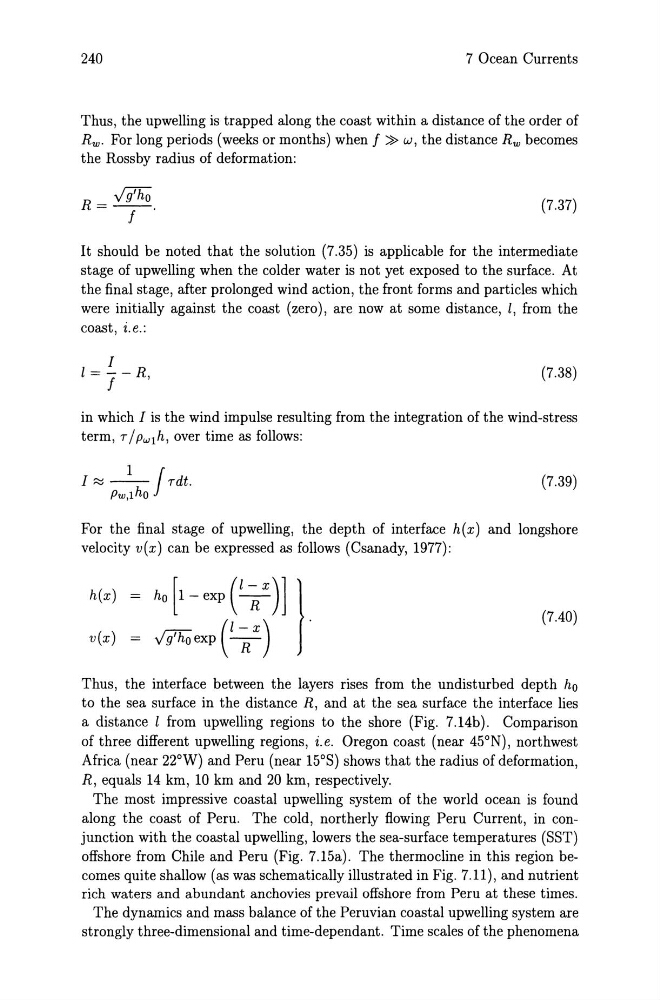
For the final stage of upwelling, the depth of interface h( x) and longshore
velocity v (x) can be expressed as follows (Csanady, 1977):
hex)
(7.40)
vex)
Thus, the interface between the layers rises from the undisturbed depth ho
to the sea surface in the distance R, and at the sea surface the interface lies
a distance I from upwelling regions to the shore (Fig. 7.14b). Comparison
of three different upwelling regions, i.e. Oregon coast (near 45°N), northwest
Africa (near 22°W) and Peru (near 15°S) shows that the radius of deformation,
R, equals 14 km, 10 km and 20 km, respectively.
The most impressive coastal upwelling system of the world ocean is found
along the coast of Peru. The cold, northerly flowing Peru Current, in conjunction with the coastal upwelling, lowers the sea-surface temperatures (SST)
offshore from Chile and Peru (Fig. 7.15a). The thermocline in this region becomes quite shallow (as was schematically illustrated in Fig. 7.11), and nutrient
rich waters and abundant anchovies prevail offshore from Peru at these times.
The dynamics and mass balance of the Peruvian coastal upwelling system are
strongly three-dimensional and time-dependant. Time scales of the phenomena
7 Ocean Currents
Thus, the upwelling is trapped along the coast within a distance of the order of
Rw. For long periods (weeks or months) when f » w, the distance Rw becomes
the Rossby radius of deformation:
R = v'glho.
f
(7.37)
It should be noted that the solution (7.35) is applicable for the intermediate
stage of upwelling when the colder water is not yet exposed to the surface. At
the final stage, after prolonged wind action, the front forms and particles which
were initially against the coast (zero), are now at some distance, I, from the
coast, i. e.:
I
1= - - R
f
'
(7.38)
in which I is the wind impulse resulting from the integration of the wind-stress
term, T / PWl h, over time as follows:
I ~ _l_JTdt.
Pw,lho
(7.39)
For the final stage of upwelling, the depth of interface h( x) and longshore
velocity v (x) can be expressed as follows (Csanady, 1977):
hex)
(7.40)
vex)
Thus, the interface between the layers rises from the undisturbed depth ho
to the sea surface in the distance R, and at the sea surface the interface lies
a distance I from upwelling regions to the shore (Fig. 7.14b). Comparison
of three different upwelling regions, i.e. Oregon coast (near 45°N), northwest
Africa (near 22°W) and Peru (near 15°S) shows that the radius of deformation,
R, equals 14 km, 10 km and 20 km, respectively.
The most impressive coastal upwelling system of the world ocean is found
along the coast of Peru. The cold, northerly flowing Peru Current, in conjunction with the coastal upwelling, lowers the sea-surface temperatures (SST)
offshore from Chile and Peru (Fig. 7.15a). The thermocline in this region becomes quite shallow (as was schematically illustrated in Fig. 7.11), and nutrient
rich waters and abundant anchovies prevail offshore from Peru at these times.
The dynamics and mass balance of the Peruvian coastal upwelling system are
strongly three-dimensional and time-dependant. Time scales of the phenomena