

238
a
x
b
x
"
' \ .
-- , , -
-.
final position of pycnocline
----_-:.-:.":.:.:
7 Ocean Currents
y
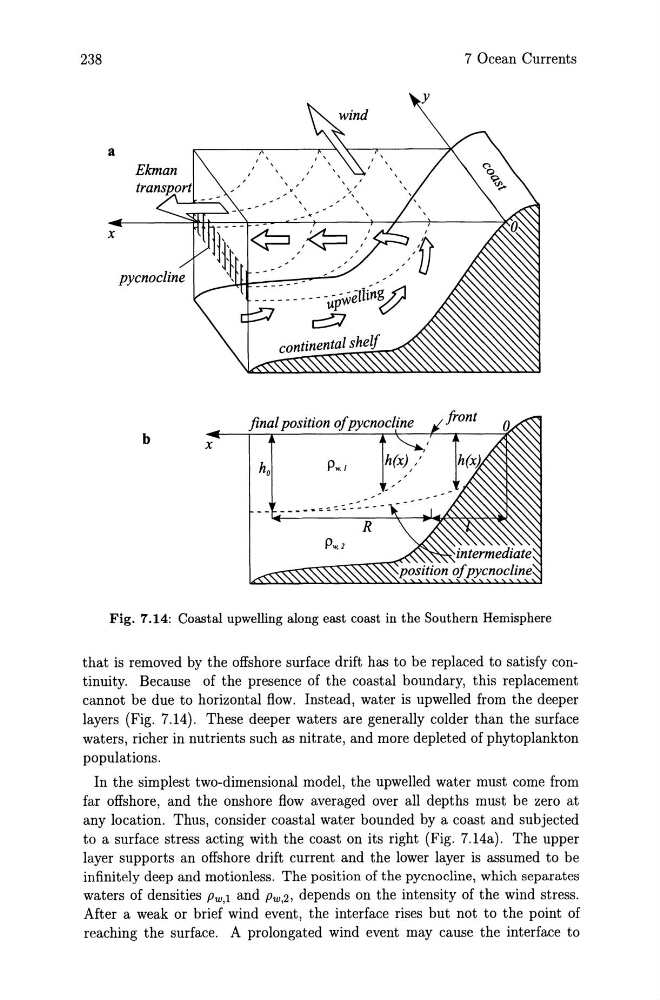
Fig. 7.14: Coastal upwelling along east coast in the Southern Hemisphere
that is removed by the offshore surface drift has to be replaced to satisfy continuity. Because of the presence of the coastal boundary, this replacement
cannot be due to horizontal flow. Instead, water is upwelled from the deeper
layers (Fig. 7.14). These deeper waters are generally colder than the surface
waters, richer in nutrients such as nitrate, and more depleted of phytoplankton
populations.
In the simplest two-dimensional model, the upwelled water must come from
far offshore, and the onshore flow averaged over all depths must be zero at
any location. Thus, consider coastal water bounded by a coast and subjected
to a surface stress acting with the coast on its right (Fig. 7.14a). The upper
layer supports an offshore drift current and the lower layer is assumed to be
infinitely deep and motionless. The position of the pycnocline, which separates
waters of densities Pw,l and Pw,2, depends on the intensity of the wind stress.
After a weak or brief wind event, the interface rises but not to the point of
reaching the surface. A prolongated wind event may cause the interface to
a
x
b
x
"
' \ .
-- , , -
-.
final position of pycnocline
----_-:.-:.":.:.:
7 Ocean Currents
y
Fig. 7.14: Coastal upwelling along east coast in the Southern Hemisphere
that is removed by the offshore surface drift has to be replaced to satisfy continuity. Because of the presence of the coastal boundary, this replacement
cannot be due to horizontal flow. Instead, water is upwelled from the deeper
layers (Fig. 7.14). These deeper waters are generally colder than the surface
waters, richer in nutrients such as nitrate, and more depleted of phytoplankton
populations.
In the simplest two-dimensional model, the upwelled water must come from
far offshore, and the onshore flow averaged over all depths must be zero at
any location. Thus, consider coastal water bounded by a coast and subjected
to a surface stress acting with the coast on its right (Fig. 7.14a). The upper
layer supports an offshore drift current and the lower layer is assumed to be
infinitely deep and motionless. The position of the pycnocline, which separates
waters of densities Pw,l and Pw,2, depends on the intensity of the wind stress.
After a weak or brief wind event, the interface rises but not to the point of
reaching the surface. A prolongated wind event may cause the interface to