

7.7 Continental Shelf Flow
237
The Agulhas Current is one of the strongest currents of the world ocean with
little seasonal variation. Its speed, of about 1.6 mls (peak speed is about 2.5
m/s), is almost constantly maintained throughout the year; the width of the
current is about 90-170 km. Near 31°S, the current transport is estimated as
70 Sv; this transport increases by 6 Sv every 100 km, and near 35°S it carries
95-135 Sv. Further south the current encounters the Antarctic Circumpolar
Current and most of its transport turns back to the Indian Ocean Gyre (see
Fig. 7.6).
The nature and kinematics of the Agulhas Current termination are very complicated. This current exhibits a unique circulation feature that consists of a
turnabout at which its direction is more or less reversed, which is known as
the Agulhas retroflection (Lutjeharms and van Ballegooyen, 1988). The area
of retroflection lies between 16°E and 200E and has a diameter of 340 km. The
Agulhas retroflection area may move in western, southern or northern directions, together with a range of rings and eddies in various stages of decay.
Another unique aspect of the Agulhas Current is that it runs against the
prevailing wind direction during the Southwest Monsoon season, which results
in a steepening of wind waves in the region of the current. Further south, the
current runs into the swell approaching from the Southern Ocean. Close to the
African coastline, between Durban and Port Elizabeth, the steepening of these
waves produces giant waves with enormous heights of 15-18 ill (see Sect. 3.5.4).
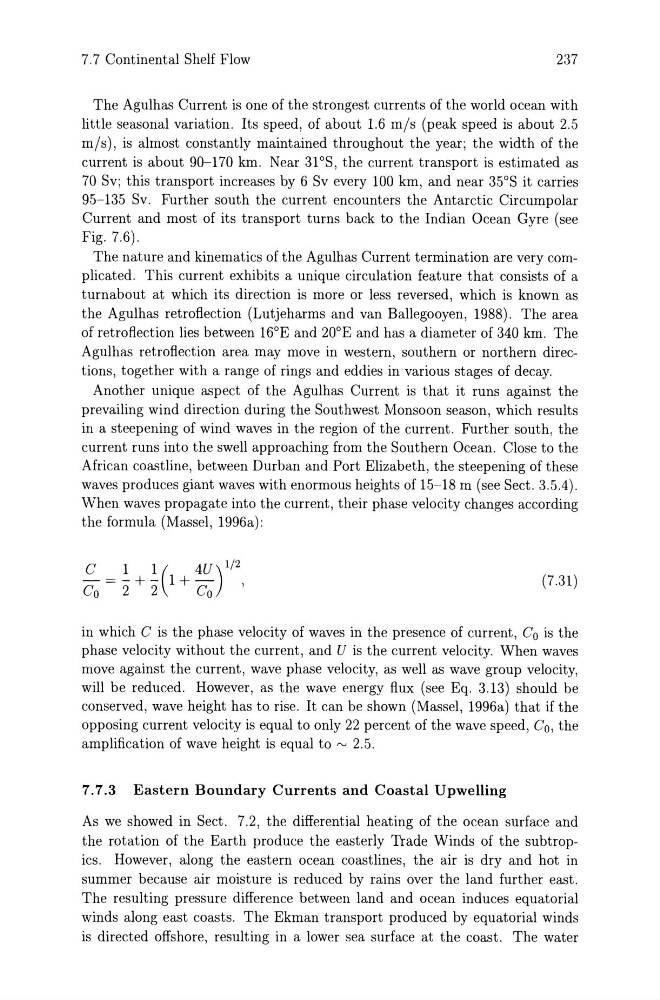
When waves propagate into the current, their phase velocity changes according
the formula (Massel, 1996a):
(7.31)
in which C is the phase velocity of waves in the presence of current, Co is the
phase velocity without the current, and U is the current velocity. When waves
move against the current, wave phase velocity, as well as wave group velocity,
will be reduced. However, as the wave energy flux (see Eq. 3.13) should be
conserved, wave height has to rise. It can be shown (Massel, 1996a) that if the
opposing current velocity is equal to only 22 percent of the wave speed, Co, the
amplification of wave height is equal to ~ 2.5.
7.7.3 Eastern Boundary Currents and Coastal Upwelling
As we showed in Sect. 7.2, the differential heating of the ocean surface and
the rotation of the Earth produce the easterly Trade Winds of the subtropics. However, along the eastern ocean coastlines, the air is dry and hot in
summer because air moisture is reduced by rains over the land further east.
The resulting pressure difference between land and ocean induces equatorial
winds along east coasts. The Ekman transport produced by equatorial winds
is directed offshore, resulting in a lower sea surface at the coast. The water
237
The Agulhas Current is one of the strongest currents of the world ocean with
little seasonal variation. Its speed, of about 1.6 mls (peak speed is about 2.5
m/s), is almost constantly maintained throughout the year; the width of the
current is about 90-170 km. Near 31°S, the current transport is estimated as
70 Sv; this transport increases by 6 Sv every 100 km, and near 35°S it carries
95-135 Sv. Further south the current encounters the Antarctic Circumpolar
Current and most of its transport turns back to the Indian Ocean Gyre (see
Fig. 7.6).
The nature and kinematics of the Agulhas Current termination are very complicated. This current exhibits a unique circulation feature that consists of a
turnabout at which its direction is more or less reversed, which is known as
the Agulhas retroflection (Lutjeharms and van Ballegooyen, 1988). The area
of retroflection lies between 16°E and 200E and has a diameter of 340 km. The
Agulhas retroflection area may move in western, southern or northern directions, together with a range of rings and eddies in various stages of decay.
Another unique aspect of the Agulhas Current is that it runs against the
prevailing wind direction during the Southwest Monsoon season, which results
in a steepening of wind waves in the region of the current. Further south, the
current runs into the swell approaching from the Southern Ocean. Close to the
African coastline, between Durban and Port Elizabeth, the steepening of these
waves produces giant waves with enormous heights of 15-18 ill (see Sect. 3.5.4).
When waves propagate into the current, their phase velocity changes according
the formula (Massel, 1996a):
(7.31)
in which C is the phase velocity of waves in the presence of current, Co is the
phase velocity without the current, and U is the current velocity. When waves
move against the current, wave phase velocity, as well as wave group velocity,
will be reduced. However, as the wave energy flux (see Eq. 3.13) should be
conserved, wave height has to rise. It can be shown (Massel, 1996a) that if the
opposing current velocity is equal to only 22 percent of the wave speed, Co, the
amplification of wave height is equal to ~ 2.5.
7.7.3 Eastern Boundary Currents and Coastal Upwelling
As we showed in Sect. 7.2, the differential heating of the ocean surface and
the rotation of the Earth produce the easterly Trade Winds of the subtropics. However, along the eastern ocean coastlines, the air is dry and hot in
summer because air moisture is reduced by rains over the land further east.
The resulting pressure difference between land and ocean induces equatorial
winds along east coasts. The Ekman transport produced by equatorial winds
is directed offshore, resulting in a lower sea surface at the coast. The water