

210
7 Ocean Currents
and Z, and their respective velocity components u, v and w, being positive in
the east, north and upward directions, respectively; the origin of coordinates is
located at the sea surface. Thus, we have (Pond and Pickard, 1983):
Pressure Coriolis Gravity External forces
du
op
+Pwjv
Pwdi = ox
+Fx
dv
op
(7.12)
PWdi = oy
-Pwju
+Fy
dw
op
PW dt = oz
-Pw9
+Fz
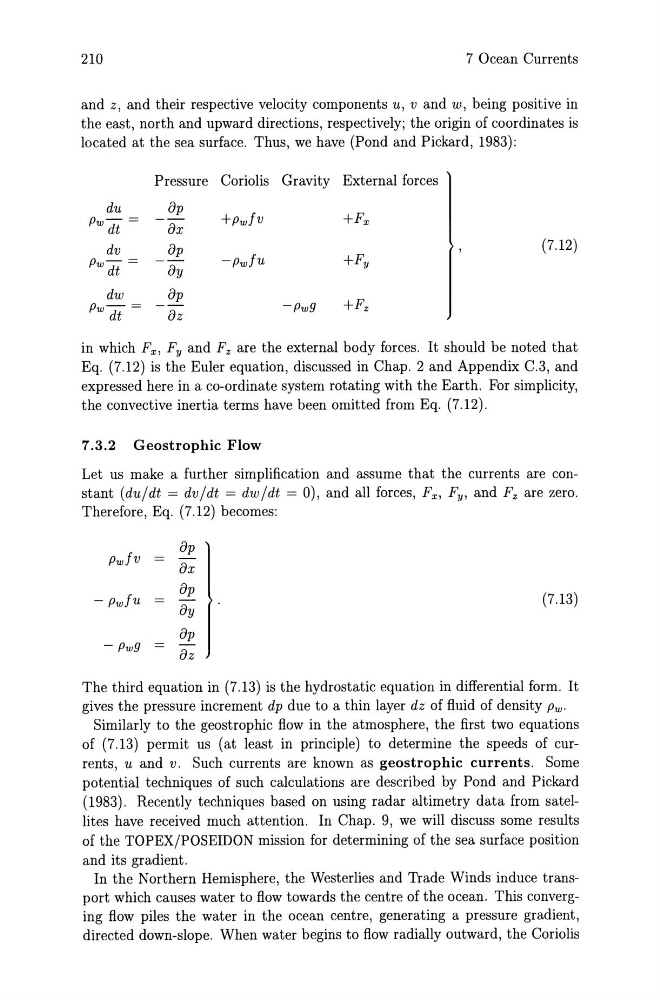
in which Fx, Fy and Fz are the external body forces. It should be noted that
Eq. (7.12) is the Euler equation, discussed in Chap. 2 and Appendix C.3, and
expressed here in a co-ordinate system rotating with the Earth. For simplicity,
the convective inertia terms have been omitted from Eq. (7.12).
7.3.2 Geostrophic Flow
Let us make a further simplification and assume that the currents are constant (du/dt = dv/dt = dw/dt = 0), and all forces, Fx, Fy, and Fz are zero.
Therefore, Eq. (7.12) becomes:
Pwjv
op
ox
- Pwju
op
(7.13)
oy
op
- Pw9 =
oz
The third equation in (7.13) is the hydrostatic equation in differential form. It
gives the pressure increment dp due to a thin layer dz of fluid of density PW'
Similarly to the geostrophic flow in the atmosphere, the first two equations
of (7.13) permit us (at least in principle) to determine the speeds of currents, u and v. Such currents are known as geostrophic currents. Some
potential techniques of such calculations are described by Pond and Pickard
(1983). Recently techniques based on using radar altimetry data from satellites have received much attention. In Chap. 9, we will discuss some results
of the TOPEX/POSEIDON mission for determining of the sea surface position
and its gradient.
In the Northern Hemisphere, the Westerlies and Trade Winds induce transport which causes water to flow towards the centre of the ocean. This converging flow piles the water in the ocean centre, generating a pressure gradient,
directed down-slope. When water begins to flow radially outward, the Coriolis
7 Ocean Currents
and Z, and their respective velocity components u, v and w, being positive in
the east, north and upward directions, respectively; the origin of coordinates is
located at the sea surface. Thus, we have (Pond and Pickard, 1983):
Pressure Coriolis Gravity External forces
du
op
+Pwjv
Pwdi = ox
+Fx
dv
op
(7.12)
PWdi = oy
-Pwju
+Fy
dw
op
PW dt = oz
-Pw9
+Fz
in which Fx, Fy and Fz are the external body forces. It should be noted that
Eq. (7.12) is the Euler equation, discussed in Chap. 2 and Appendix C.3, and
expressed here in a co-ordinate system rotating with the Earth. For simplicity,
the convective inertia terms have been omitted from Eq. (7.12).
7.3.2 Geostrophic Flow
Let us make a further simplification and assume that the currents are constant (du/dt = dv/dt = dw/dt = 0), and all forces, Fx, Fy, and Fz are zero.
Therefore, Eq. (7.12) becomes:
Pwjv
op
ox
- Pwju
op
(7.13)
oy
op
- Pw9 =
oz
The third equation in (7.13) is the hydrostatic equation in differential form. It
gives the pressure increment dp due to a thin layer dz of fluid of density PW'
Similarly to the geostrophic flow in the atmosphere, the first two equations
of (7.13) permit us (at least in principle) to determine the speeds of currents, u and v. Such currents are known as geostrophic currents. Some
potential techniques of such calculations are described by Pond and Pickard
(1983). Recently techniques based on using radar altimetry data from satellites have received much attention. In Chap. 9, we will discuss some results
of the TOPEX/POSEIDON mission for determining of the sea surface position
and its gradient.
In the Northern Hemisphere, the Westerlies and Trade Winds induce transport which causes water to flow towards the centre of the ocean. This converging flow piles the water in the ocean centre, generating a pressure gradient,
directed down-slope. When water begins to flow radially outward, the Coriolis