

7.3 Wind-Driven Surface and Near-Surface Currents
209
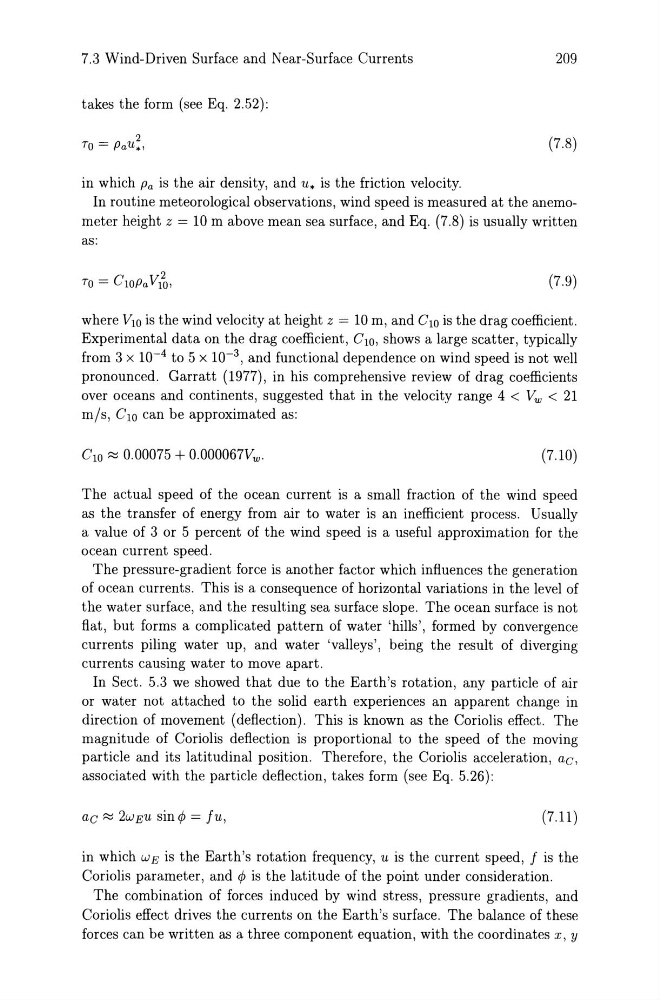
takes the form (see Eq. 2.52):
(7.8)
in which Pa is the air density, and u* is the friction velocity.
In routine meteorological observations, wind speed is measured at the anemometer height z = 10 m above mean sea surface, and Eq. (7.8) is usually written
as:
(7.9)
where VlO is the wind velocity at height z = 10 m, and ClO is the drag coefficient.
Experimental data on the drag coefficient, ClO, shows a large scatter, typically
from 3 x 10- 4 to 5 X 10- 3 , and functional dependence on wind speed is not well
pronounced. Garratt (1977), in his comprehensive review of drag coefficients
over oceans and continents, suggested that in the velocity range 4 < Vw < 21
mis, ClO can be approximated as:
ClO :::; 0.00075 + 0.000067Vw .
(7.10)
The actual speed of the ocean current is a small fraction of the wind speed
as the transfer of energy from air to water is an inefficient process. Usually
a value of 3 or 5 percent of the wind speed is a useful approximation for the
ocean current speed.
The pressure-gradient force is another factor which influences the generation
of ocean currents. This is a consequence of horizontal variations in the level of
the water surface, and the resulting sea surface slope. The ocean surface is not
flat, but forms a complicated pattern of water 'hills', formed by convergence
currents piling water up, and water 'valleys', being the result of diverging
currents causing water to move apart.
In Sect. 5.3 we showed that due to the Earth's rotation, any particle of air
or water not attached to the solid earth experiences an apparent change in
direction of movement (deflection). This is known as the Coriolis effect. The
magnitude of Coriolis deflection is proportional to the speed of the moving
particle and its latitudinal position. Therefore, the Coriolis acceleration, ac,
associated with the particle deflection, takes form (see Eq. 5.26):
ac:::; 2WEU sinet> = ju,
(7.11)
in which WE is the Earth's rotation frequency, u is the current speed, j is the
Coriolis parameter, and et > is the latitude of the point under consideration.
The combination of forces induced by wind stress, pressure gradients, and
Coriolis effect drives the currents on the Earth's surface. The balance of these
forces can be written as a three component equation, with the coordinates x, y
209
takes the form (see Eq. 2.52):
(7.8)
in which Pa is the air density, and u* is the friction velocity.
In routine meteorological observations, wind speed is measured at the anemometer height z = 10 m above mean sea surface, and Eq. (7.8) is usually written
as:
(7.9)
where VlO is the wind velocity at height z = 10 m, and ClO is the drag coefficient.
Experimental data on the drag coefficient, ClO, shows a large scatter, typically
from 3 x 10- 4 to 5 X 10- 3 , and functional dependence on wind speed is not well
pronounced. Garratt (1977), in his comprehensive review of drag coefficients
over oceans and continents, suggested that in the velocity range 4 < Vw < 21
mis, ClO can be approximated as:
ClO :::; 0.00075 + 0.000067Vw .
(7.10)
The actual speed of the ocean current is a small fraction of the wind speed
as the transfer of energy from air to water is an inefficient process. Usually
a value of 3 or 5 percent of the wind speed is a useful approximation for the
ocean current speed.
The pressure-gradient force is another factor which influences the generation
of ocean currents. This is a consequence of horizontal variations in the level of
the water surface, and the resulting sea surface slope. The ocean surface is not
flat, but forms a complicated pattern of water 'hills', formed by convergence
currents piling water up, and water 'valleys', being the result of diverging
currents causing water to move apart.
In Sect. 5.3 we showed that due to the Earth's rotation, any particle of air
or water not attached to the solid earth experiences an apparent change in
direction of movement (deflection). This is known as the Coriolis effect. The
magnitude of Coriolis deflection is proportional to the speed of the moving
particle and its latitudinal position. Therefore, the Coriolis acceleration, ac,
associated with the particle deflection, takes form (see Eq. 5.26):
ac:::; 2WEU sinet> = ju,
(7.11)
in which WE is the Earth's rotation frequency, u is the current speed, j is the
Coriolis parameter, and et > is the latitude of the point under consideration.
The combination of forces induced by wind stress, pressure gradients, and
Coriolis effect drives the currents on the Earth's surface. The balance of these
forces can be written as a three component equation, with the coordinates x, y