

208
7 Ocean Currents
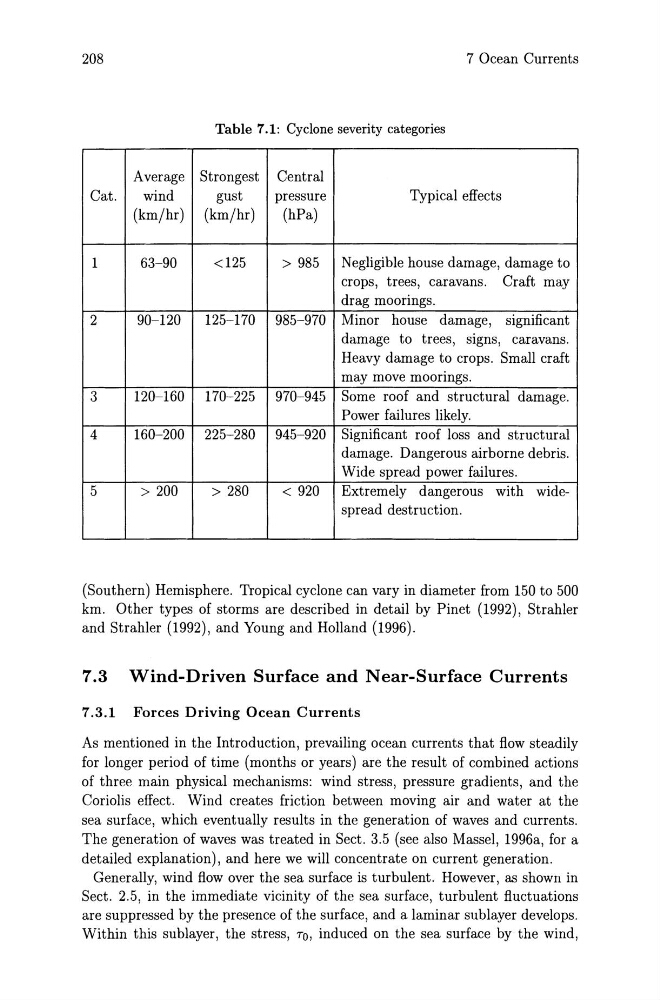
Table 7.1: Cyclone severity categories
Average Strongest Central
Cat.
wind
gust
pressure
Typical effects
(km/hr) (km/hr)
(hPa)
1
63-90
<125
> 985
Negligible house damage, damage to
crops, trees, caravans. Craft may
drag moorings.
2
90-120
125-170 985-970 Minor house damage, significant
damage to trees, signs, caravans.
Heavy damage to crops. Small craft
may move moorings.
3
120-160 170-225 970-945 Some roof and structural damage.
Power failures likely.
4
160-200 225-280 945-920 Significant roof loss and structural
damage. Dangerous airborne debris.
Wide spread power failures.
5
> 200
> 280
< 920
Extremely dangerous with widespread destruction.
(Southern) Hemisphere. Tropical cyclone can vary in diameter from 150 to 500
km. Other types of storms are described in detail by Pinet (1992), Strahler
and Strahler (1992), and Young and Holland (1996).
7.3 Wind-Driven Surface and Near-Surface Currents
7.3.1 Forces Driving Ocean Currents
As mentioned in the Introduction, prevailing ocean currents that flow steadily
for longer period of time (months or years) are the result of combined actions
of three main physical mechanisms: wind stress, pressure gradients, and the
Coriolis effect. Wind creates friction between moving air and water at the
sea surface, which eventually results in the generation of waves and currents.
The generation of waves was treated in Sect. 3.5 (see also Massel, 1996a, for a
detailed explanation), and here we will concentrate on current generation.
Generally, wind flow over the sea surface is turbulent. However, as shown in
Sect. 2.5, in the immediate vicinity of the sea surface, turbulent fluctuations
are suppressed by the presence of the surface, and a laminar sub layer develops.
Within this sublayer, the stress, TO, induced on the sea surface by the wind,
7 Ocean Currents
Table 7.1: Cyclone severity categories
Average Strongest Central
Cat.
wind
gust
pressure
Typical effects
(km/hr) (km/hr)
(hPa)
1
63-90
<125
> 985
Negligible house damage, damage to
crops, trees, caravans. Craft may
drag moorings.
2
90-120
125-170 985-970 Minor house damage, significant
damage to trees, signs, caravans.
Heavy damage to crops. Small craft
may move moorings.
3
120-160 170-225 970-945 Some roof and structural damage.
Power failures likely.
4
160-200 225-280 945-920 Significant roof loss and structural
damage. Dangerous airborne debris.
Wide spread power failures.
5
> 200
> 280
< 920
Extremely dangerous with widespread destruction.
(Southern) Hemisphere. Tropical cyclone can vary in diameter from 150 to 500
km. Other types of storms are described in detail by Pinet (1992), Strahler
and Strahler (1992), and Young and Holland (1996).
7.3 Wind-Driven Surface and Near-Surface Currents
7.3.1 Forces Driving Ocean Currents
As mentioned in the Introduction, prevailing ocean currents that flow steadily
for longer period of time (months or years) are the result of combined actions
of three main physical mechanisms: wind stress, pressure gradients, and the
Coriolis effect. Wind creates friction between moving air and water at the
sea surface, which eventually results in the generation of waves and currents.
The generation of waves was treated in Sect. 3.5 (see also Massel, 1996a, for a
detailed explanation), and here we will concentrate on current generation.
Generally, wind flow over the sea surface is turbulent. However, as shown in
Sect. 2.5, in the immediate vicinity of the sea surface, turbulent fluctuations
are suppressed by the presence of the surface, and a laminar sub layer develops.
Within this sublayer, the stress, TO, induced on the sea surface by the wind,