

204
7 Ocean Currents
be lowest to right. In south latitudes, face the wind and the barometer will be
lowest to your left (Harvey, 1985).
Let us assume a pressure gradient of 1 mb in 100 km in latitude, if! = 45°,
and Pa =1.2 kg/m 3 . Then, the Coriolis parameter, j, becomes:
(7.5)
and the speed of the geostrophic wind is:
1
10 2 kg/m/s 2
V =
= 81m/s
9
1.2 kg/m3 x 1.03 x 1O-4S-1
105 m
.
.
(7.6)
On synoptic charts with systems of isobars, a geostrophic wind scale is provided for determining wind speed, Vg , from the spacing of the isobars. Usually,
a standard spacing of 4 mb is used. We note that the geostrophic wind assumption is not valid for curved isobars or close to the Equator, where the Corio lis
parameter j becomes zero.
7.2.3 Major Surface Wind Patterns
As was shown above, horizontal pressure gradients are the most important
forces responsible for the initiation and maintenance of large-scale motions
in the atmosphere. Prior to describing the global surface wind patterns, we
consider the simplest example of the relationship between wind and pressure
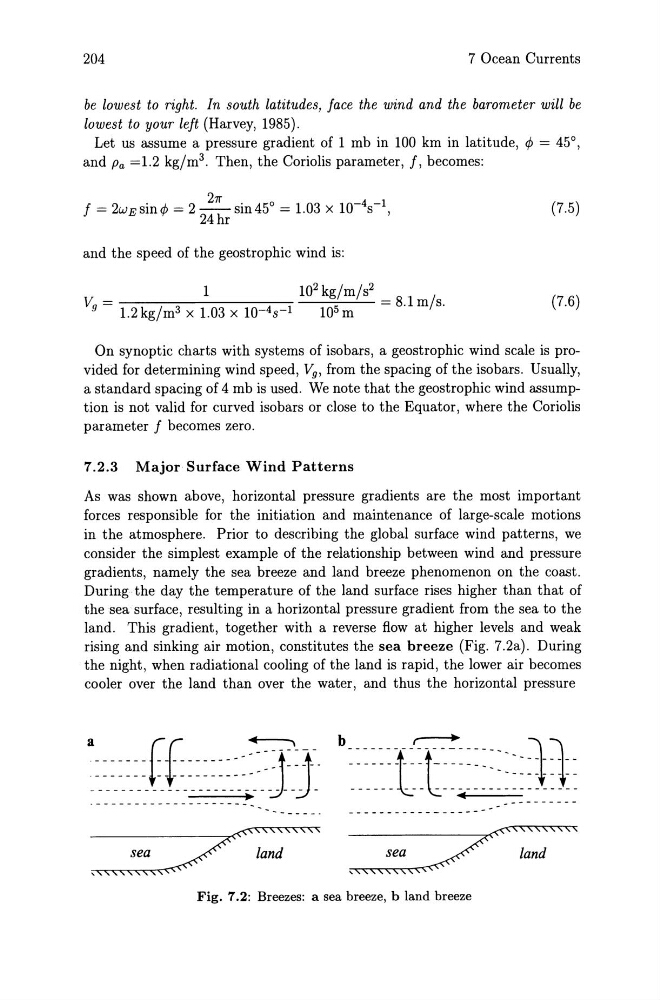
gradients, namely the sea breeze and land breeze phenomenon on the coast.
During the day the temperature of the land surface rises higher than that of
the sea surface, resulting in a horizontal pressure gradient from the sea to the
land. This gradient, together with a reverse flow at higher levels and weak
rising and sinking air motion, constitutes the sea breeze (Fig. 7.2a). During
the night, when radiational cooling of the land is rapid, the lower air becomes
cooler over the land than over the water, and thus the horizontal pressure
a - - - - - - - [f---------~J- --- j-- b - - - - - - -l--~t- ------------)-~--------~---------------- ----- ---------- -------------~-t~:::::::::::::::::::~:------ -
------ --- ---.-----~~~~~~~~~~
----------------~~"""'"
""':::"~ land
----------------~~"""'"
''''':~~,/ land
Fig. 7.2: Breezes: a sea breeze, b land breeze
7 Ocean Currents
be lowest to right. In south latitudes, face the wind and the barometer will be
lowest to your left (Harvey, 1985).
Let us assume a pressure gradient of 1 mb in 100 km in latitude, if! = 45°,
and Pa =1.2 kg/m 3 . Then, the Coriolis parameter, j, becomes:
(7.5)
and the speed of the geostrophic wind is:
1
10 2 kg/m/s 2
V =
= 81m/s
9
1.2 kg/m3 x 1.03 x 1O-4S-1
105 m
.
.
(7.6)
On synoptic charts with systems of isobars, a geostrophic wind scale is provided for determining wind speed, Vg , from the spacing of the isobars. Usually,
a standard spacing of 4 mb is used. We note that the geostrophic wind assumption is not valid for curved isobars or close to the Equator, where the Corio lis
parameter j becomes zero.
7.2.3 Major Surface Wind Patterns
As was shown above, horizontal pressure gradients are the most important
forces responsible for the initiation and maintenance of large-scale motions
in the atmosphere. Prior to describing the global surface wind patterns, we
consider the simplest example of the relationship between wind and pressure
gradients, namely the sea breeze and land breeze phenomenon on the coast.
During the day the temperature of the land surface rises higher than that of
the sea surface, resulting in a horizontal pressure gradient from the sea to the
land. This gradient, together with a reverse flow at higher levels and weak
rising and sinking air motion, constitutes the sea breeze (Fig. 7.2a). During
the night, when radiational cooling of the land is rapid, the lower air becomes
cooler over the land than over the water, and thus the horizontal pressure
a - - - - - - - [f---------~J- --- j-- b - - - - - - -l--~t- ------------)-~--------~---------------- ----- ---------- -------------~-t~:::::::::::::::::::~:------ -
------ --- ---.-----~~~~~~~~~~
----------------~~"""'"
""':::"~ land
----------------~~"""'"
''''':~~,/ land
Fig. 7.2: Breezes: a sea breeze, b land breeze