

7.2 Wind Pattern on Earth
205
Polar heights
Polar Easter~lt~'e~st:;~~~~~7"
Polar heights
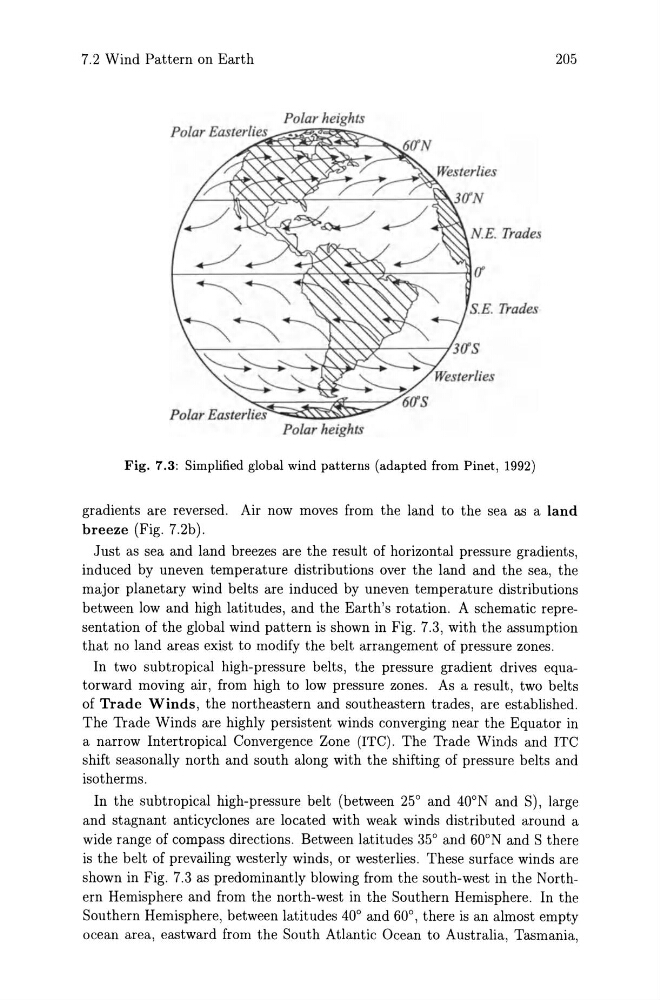
Fig. 7.3: Simplified global wind patterns (adapted from Pinet, 1992)
gradients are reversed. Air now moves from the land to the sea as a land
breeze (Fig. 7.2b).
Just as sea and land breezes are the result of horizontal pressure gradients,
induced by uneven temperature distributions over the land and the sea, the
major planetary wind belts are induced by uneven temperature distributions
between low and high latitudes, and the Earth's rotation. A schematic representation of the global wind pattern is shown in Fig. 7.3, with the assumption
that no land areas exist to modify the belt arrangement of pressure zones.
In two subtropical high-pressure belts, the pressure gradient drives equatorward moving air, from high to low pressure zones. As a result , two belts
of Trade Winds, the northeastern and southeastern trades, are established.
The Trade Winds are highly persistent winds converging near the Equator in
a narrow Intertropical Convergence Zone (ITC). The Trade Winds and ITC
shift seasonally north and south along with the shifting of pressure belts and
isotherms.
In the subtropical high-pressure belt (between 25° and 400N and S), large
and stagnant anticyclones are located with weak winds distributed around a
wide range of compass directions. Between latitudes 35° and 60 0 N and S there
is the belt of prevailing westerly winds , or westerlies. These surface winds are
shown in Fig. 7.3 as predominantly blowing from the south-west in the Northern Hemisphere and from the north-west in the Southern Hemisphere. In the
Southern Hemisphere, between latitudes 40° and 60°, there is an almost empty
ocean area, eastward from the South Atlantic Ocean to Australia, Tasmania,
205
Polar heights
Polar Easter~lt~'e~st:;~~~~~7"
Polar heights
Fig. 7.3: Simplified global wind patterns (adapted from Pinet, 1992)
gradients are reversed. Air now moves from the land to the sea as a land
breeze (Fig. 7.2b).
Just as sea and land breezes are the result of horizontal pressure gradients,
induced by uneven temperature distributions over the land and the sea, the
major planetary wind belts are induced by uneven temperature distributions
between low and high latitudes, and the Earth's rotation. A schematic representation of the global wind pattern is shown in Fig. 7.3, with the assumption
that no land areas exist to modify the belt arrangement of pressure zones.
In two subtropical high-pressure belts, the pressure gradient drives equatorward moving air, from high to low pressure zones. As a result , two belts
of Trade Winds, the northeastern and southeastern trades, are established.
The Trade Winds are highly persistent winds converging near the Equator in
a narrow Intertropical Convergence Zone (ITC). The Trade Winds and ITC
shift seasonally north and south along with the shifting of pressure belts and
isotherms.
In the subtropical high-pressure belt (between 25° and 400N and S), large
and stagnant anticyclones are located with weak winds distributed around a
wide range of compass directions. Between latitudes 35° and 60 0 N and S there
is the belt of prevailing westerly winds , or westerlies. These surface winds are
shown in Fig. 7.3 as predominantly blowing from the south-west in the Northern Hemisphere and from the north-west in the Southern Hemisphere. In the
Southern Hemisphere, between latitudes 40° and 60°, there is an almost empty
ocean area, eastward from the South Atlantic Ocean to Australia, Tasmania,