

7.2 Wind Pattern on Earth
a
992 mb 1000 mb
low
,
I dp
~~
:~
Padn
fVw
TC/r
b
,
LriE
Pa dn
high
203
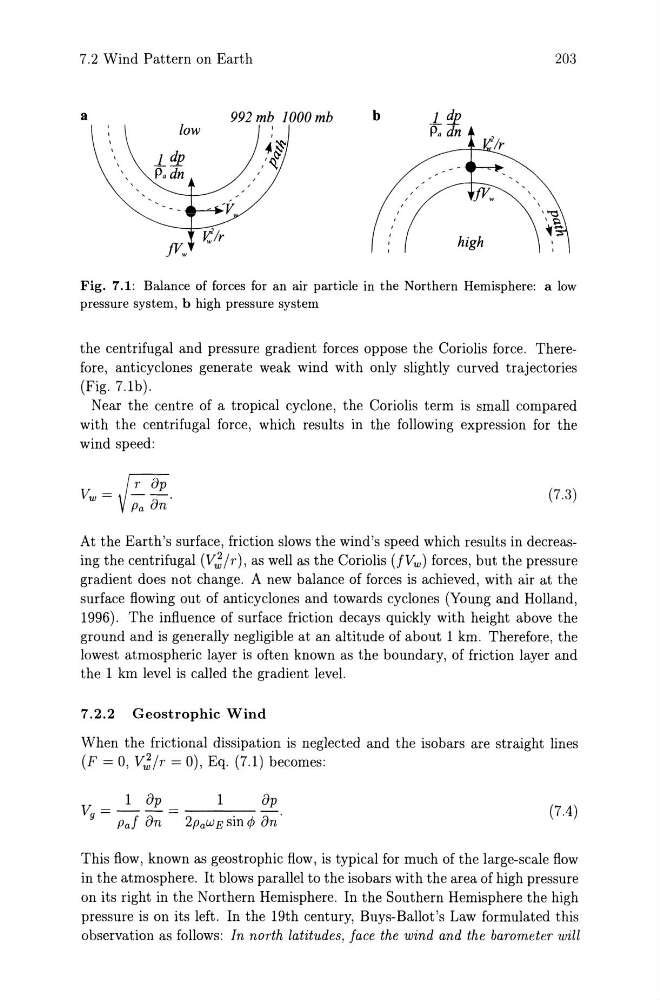
Fig. 7.1: Balance of forces for an air particle in the Northern Hemisphere: a low
pressure system, b high pressure system
the centrifugal and pressure gradient forces oppose the Coriolis force. Therefore, anticyclones generate weak wind with only slightly curved trajectories
(Fig.7.1b).
Near the centre of a tropical cyclone, the Coriolis term is small compared
with the centrifugal force, which results in the following expression for the
wind speed:
{[l op
11: -
- -
w -
Pa on'
(7.3)
At the Earth's surface, friction slows the wind's speed which results in decreasing the centrifugal (V~ / r), as well as the Coriolis (fVw ) forces, but the pressure
gradient does not change. A new balance of forces is achieved, with air at the
surface flowing out of anticyclones and towards cyclones (Young and Holland,
1996). The influence of surface friction decays quickly with height above the
ground and is generally negligible at an altitude of about 1 km. Therefore, the
lowest atmospheric layer is often known as the boundary, of friction layer and
the 1 km level is called the gradient level.
7.2.2 Geostrophic Wind
When the frictional dissipation is neglected and the isobars are straight lines
(F = 0, V~/r = 0), Eq. (7.1) becomes:
1 op
1
op
Vg = - - =
- .
Paf on 2Paw E sin ¢ on
(7.4)
This flow, known as geostrophic flow, is typical for much of the large-scale flow
in the atmosphere. It blows parallel to the isobars with the area of high pressure
on its right in the Northern Hemisphere. In the Southern Hemisphere the high
pressure is on its left. In the 19th century, Buys-Ballot's Law formulated this
observation as follows: In north latitudes, face the wind and the barometer will
a
992 mb 1000 mb
low
,
I dp
~~
:~
Padn
fVw
TC/r
b
,
LriE
Pa dn
high
203
Fig. 7.1: Balance of forces for an air particle in the Northern Hemisphere: a low
pressure system, b high pressure system
the centrifugal and pressure gradient forces oppose the Coriolis force. Therefore, anticyclones generate weak wind with only slightly curved trajectories
(Fig.7.1b).
Near the centre of a tropical cyclone, the Coriolis term is small compared
with the centrifugal force, which results in the following expression for the
wind speed:
{[l op
11: -
- -
w -
Pa on'
(7.3)
At the Earth's surface, friction slows the wind's speed which results in decreasing the centrifugal (V~ / r), as well as the Coriolis (fVw ) forces, but the pressure
gradient does not change. A new balance of forces is achieved, with air at the
surface flowing out of anticyclones and towards cyclones (Young and Holland,
1996). The influence of surface friction decays quickly with height above the
ground and is generally negligible at an altitude of about 1 km. Therefore, the
lowest atmospheric layer is often known as the boundary, of friction layer and
the 1 km level is called the gradient level.
7.2.2 Geostrophic Wind
When the frictional dissipation is neglected and the isobars are straight lines
(F = 0, V~/r = 0), Eq. (7.1) becomes:
1 op
1
op
Vg = - - =
- .
Paf on 2Paw E sin ¢ on
(7.4)
This flow, known as geostrophic flow, is typical for much of the large-scale flow
in the atmosphere. It blows parallel to the isobars with the area of high pressure
on its right in the Northern Hemisphere. In the Southern Hemisphere the high
pressure is on its left. In the 19th century, Buys-Ballot's Law formulated this
observation as follows: In north latitudes, face the wind and the barometer will