

202
7 Ocean Currents
Continental shelf and coastal waters playa specific role for the global ocean
ecology, linking the land masses with the ocean waters. Because of interactions
with decreasing depths and coasts, the water circulation and associated chemistry and biology are very complex. Therefore it is difficult to generalize about
the coastal and shelf environments. At the end of this chapter, we provide only
a description of some specific phenomena, such as wave-driven currents and
upwelling.
7.2 Wind Patterns on Earth
7.2.1 Forces Driving the Wind
The significance of the wind field over the ocean for generation of surface waves
has been discussed in Sec. 3.5. In particular, the link between wave parameters
and the local wind speed, Vw , and wind fetch, X, has been documented. Local
winds may be generated by local atmospheric systems which may last only a few
days. However, ocean currents in meso- and global scales are driven by average
conditions, prevailing for months or years. Therefore, prior to discussing the
main wind-driven ocean currents, we will briefly characterize the major patterns
of wind on the Earth.
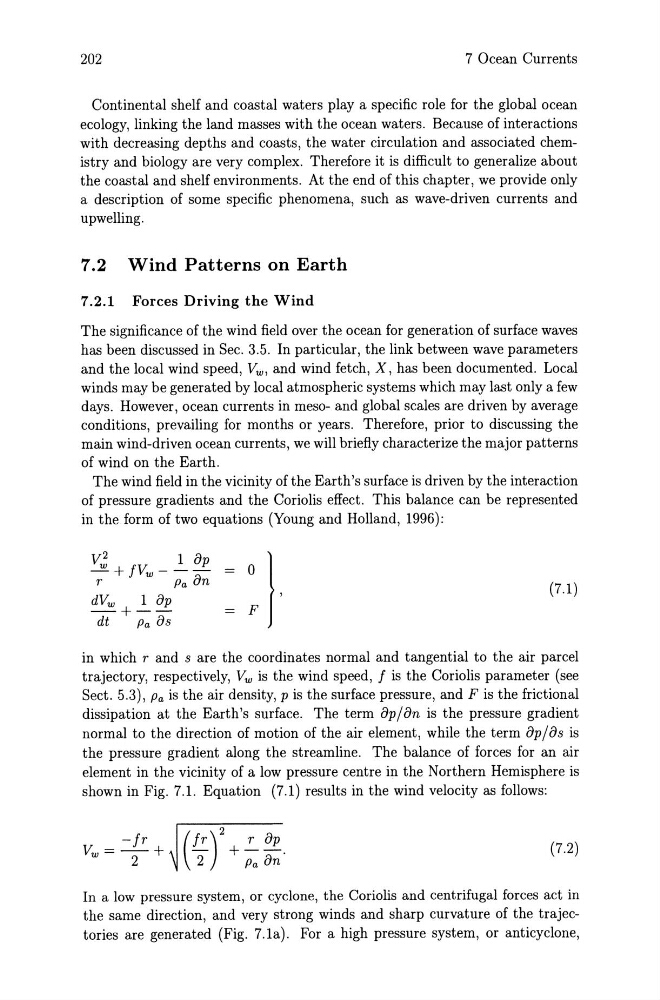
The wind field in the vicinity of the Earth's surface is driven by the interaction
of pressure gradients and the Coriolis effect. This balance can be represented
in the form of two equations (Young and Holland, 1996):
V~
1 ap
-+fVw - - -
r
Pa an
dVw
1 ap
- + - -
dt
Pa os
(7.1)
in which rand s are the coordinates normal and tangential to the air parcel
trajectory, respectively, Vw is the wind speed, f is the Corio lis parameter (see
Sect. 5.3), Pa is the air density, p is the surface pressure, and F is the frictional
dissipation at the Earth's surface. The term ap/an is the pressure gradient
normal to the direction of motion of the air element, while the term ap/as is
the pressure gradient along the streamline. The balance of forces for an air
element in the vicinity of a low pressure centre in the Northern Hemisphere is
shown in Fig. 7.1. Equation (7.1) results in the wind velocity as follows:
-fr
Vw =--+
2
( fr)2 +!...- a p .
2
Pa an
(7.2)
In a low pressure system, or cyclone, the Coriolis and centrifugal forces act in
the same direction, and very strong winds and sharp curvature of the trajectories are generated (Fig. 7.1a). For a high pressure system, or anticyclone,
7 Ocean Currents
Continental shelf and coastal waters playa specific role for the global ocean
ecology, linking the land masses with the ocean waters. Because of interactions
with decreasing depths and coasts, the water circulation and associated chemistry and biology are very complex. Therefore it is difficult to generalize about
the coastal and shelf environments. At the end of this chapter, we provide only
a description of some specific phenomena, such as wave-driven currents and
upwelling.
7.2 Wind Patterns on Earth
7.2.1 Forces Driving the Wind
The significance of the wind field over the ocean for generation of surface waves
has been discussed in Sec. 3.5. In particular, the link between wave parameters
and the local wind speed, Vw , and wind fetch, X, has been documented. Local
winds may be generated by local atmospheric systems which may last only a few
days. However, ocean currents in meso- and global scales are driven by average
conditions, prevailing for months or years. Therefore, prior to discussing the
main wind-driven ocean currents, we will briefly characterize the major patterns
of wind on the Earth.
The wind field in the vicinity of the Earth's surface is driven by the interaction
of pressure gradients and the Coriolis effect. This balance can be represented
in the form of two equations (Young and Holland, 1996):
V~
1 ap
-+fVw - - -
r
Pa an
dVw
1 ap
- + - -
dt
Pa os
(7.1)
in which rand s are the coordinates normal and tangential to the air parcel
trajectory, respectively, Vw is the wind speed, f is the Corio lis parameter (see
Sect. 5.3), Pa is the air density, p is the surface pressure, and F is the frictional
dissipation at the Earth's surface. The term ap/an is the pressure gradient
normal to the direction of motion of the air element, while the term ap/as is
the pressure gradient along the streamline. The balance of forces for an air
element in the vicinity of a low pressure centre in the Northern Hemisphere is
shown in Fig. 7.1. Equation (7.1) results in the wind velocity as follows:
-fr
Vw =--+
2
( fr)2 +!...- a p .
2
Pa an
(7.2)
In a low pressure system, or cyclone, the Coriolis and centrifugal forces act in
the same direction, and very strong winds and sharp curvature of the trajectories are generated (Fig. 7.1a). For a high pressure system, or anticyclone,