

174
5. Tides
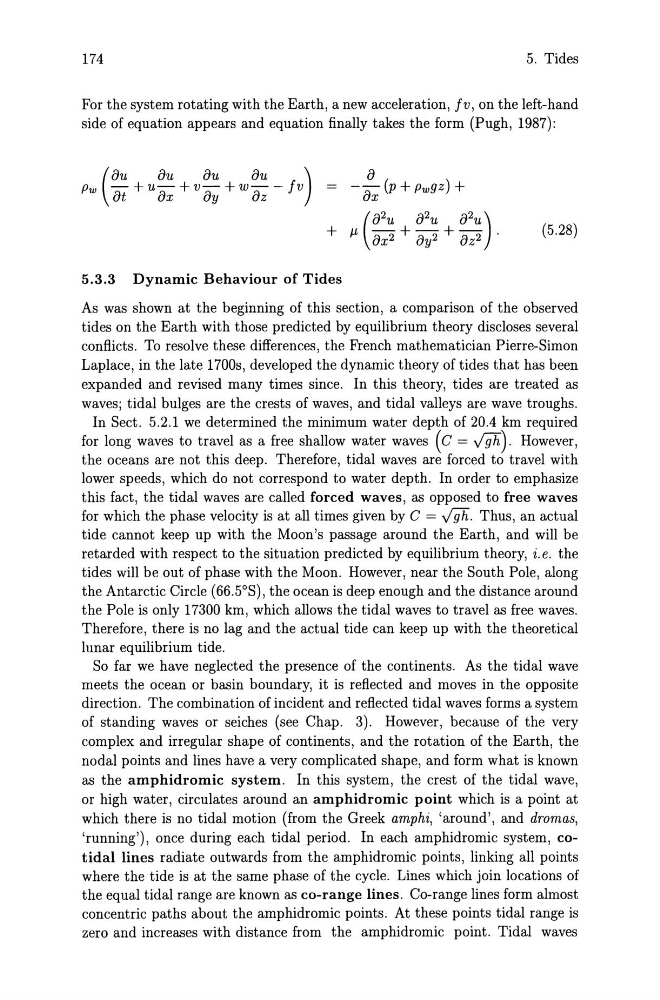
For the system rotating with the Earth, a new acceleration, Iv, on the left-hand
side of equation appears and equation finally takes the form (Pugh, 1987):
( au au au au
)
Pw - + u- + v- + w- - Iv
at ax ay az
(5.28)
5.3.3 Dynamic Behaviour of Tides
As was shown at the beginning of this section, a comparison of the observed
tides on the Earth with those predicted by equilibrium theory discloses several
conflicts. To resolve these differences, the French mathematician Pierre-Simon
Laplace, in the late 1700s, developed the dynamic theory of tides that has been
expanded and revised many times since. In this theory, tides are treated as
waves; tidal bulges are the crests of waves, and tidal valleys are wave troughs.
In Sect. 5.2.1 we determined the minimum water depth of 20.4 km required
for long waves to travel as a free shallow water waves (c = .../ih). However,
the oceans are not this deep. Therefore, tidal waves are forced to travel with
lower speeds, which do not correspond to water depth. In order to emphasize
this fact, the tidal waves are called forced waves, as opposed to free waves
for which the phase velocity is at all times given by C = .../ih. Thus, an actual
tide cannot keep up with the Moon's passage around the Earth, and will be
retarded with respect to the situation predicted by equilibrium theory, i. e. the
tides will be out of phase with the Moon. However, near the South Pole, along
the Antarctic Circle (66.5°S), the ocean is deep enough and the distance around
the Pole is only 17300 km, which allows the tidal waves to travel as free waves.
Therefore, there is no lag and the actual tide can keep up with the theoretical
lunar equilibrium tide.
So far we have neglected the presence of the continents. As the tidal wave
meets the ocean or basin boundary, it is reflected and moves in the opposite
direction. The combination of incident and reflected tidal waves forms a system
of standing waves or seiches (see Chap. 3). However, because of the very
complex and irregular shape of continents, and the rotation of the Earth, the
nodal points and lines have a very complicated shape, and form what is known
as the amphidromic system. In this system, the crest of the tidal wave,
or high water, circulates around an amphidromic point which is a point at
which there is no tidal motion (from the Greek amphi, 'around', and dramas,
'running'), once during each tidal period. In each amphidromic system, cotidal lines radiate outwards from the amphidromic points, linking all points
where the tide is at the same phase of the cycle. Lines which join locations of
the equal tidal range are known as co-range lines. Co-range lines form almost
concentric paths about the amphidromic points. At these points tidal range is
zero and increases with distance from the amphidromic point. Tidal waves
5. Tides
For the system rotating with the Earth, a new acceleration, Iv, on the left-hand
side of equation appears and equation finally takes the form (Pugh, 1987):
( au au au au
)
Pw - + u- + v- + w- - Iv
at ax ay az
(5.28)
5.3.3 Dynamic Behaviour of Tides
As was shown at the beginning of this section, a comparison of the observed
tides on the Earth with those predicted by equilibrium theory discloses several
conflicts. To resolve these differences, the French mathematician Pierre-Simon
Laplace, in the late 1700s, developed the dynamic theory of tides that has been
expanded and revised many times since. In this theory, tides are treated as
waves; tidal bulges are the crests of waves, and tidal valleys are wave troughs.
In Sect. 5.2.1 we determined the minimum water depth of 20.4 km required
for long waves to travel as a free shallow water waves (c = .../ih). However,
the oceans are not this deep. Therefore, tidal waves are forced to travel with
lower speeds, which do not correspond to water depth. In order to emphasize
this fact, the tidal waves are called forced waves, as opposed to free waves
for which the phase velocity is at all times given by C = .../ih. Thus, an actual
tide cannot keep up with the Moon's passage around the Earth, and will be
retarded with respect to the situation predicted by equilibrium theory, i. e. the
tides will be out of phase with the Moon. However, near the South Pole, along
the Antarctic Circle (66.5°S), the ocean is deep enough and the distance around
the Pole is only 17300 km, which allows the tidal waves to travel as free waves.
Therefore, there is no lag and the actual tide can keep up with the theoretical
lunar equilibrium tide.
So far we have neglected the presence of the continents. As the tidal wave
meets the ocean or basin boundary, it is reflected and moves in the opposite
direction. The combination of incident and reflected tidal waves forms a system
of standing waves or seiches (see Chap. 3). However, because of the very
complex and irregular shape of continents, and the rotation of the Earth, the
nodal points and lines have a very complicated shape, and form what is known
as the amphidromic system. In this system, the crest of the tidal wave,
or high water, circulates around an amphidromic point which is a point at
which there is no tidal motion (from the Greek amphi, 'around', and dramas,
'running'), once during each tidal period. In each amphidromic system, cotidal lines radiate outwards from the amphidromic points, linking all points
where the tide is at the same phase of the cycle. Lines which join locations of
the equal tidal range are known as co-range lines. Co-range lines form almost
concentric paths about the amphidromic points. At these points tidal range is
zero and increases with distance from the amphidromic point. Tidal waves