

5.3 Dynamic Model of Tides
173
N
,
~(OE
r
s
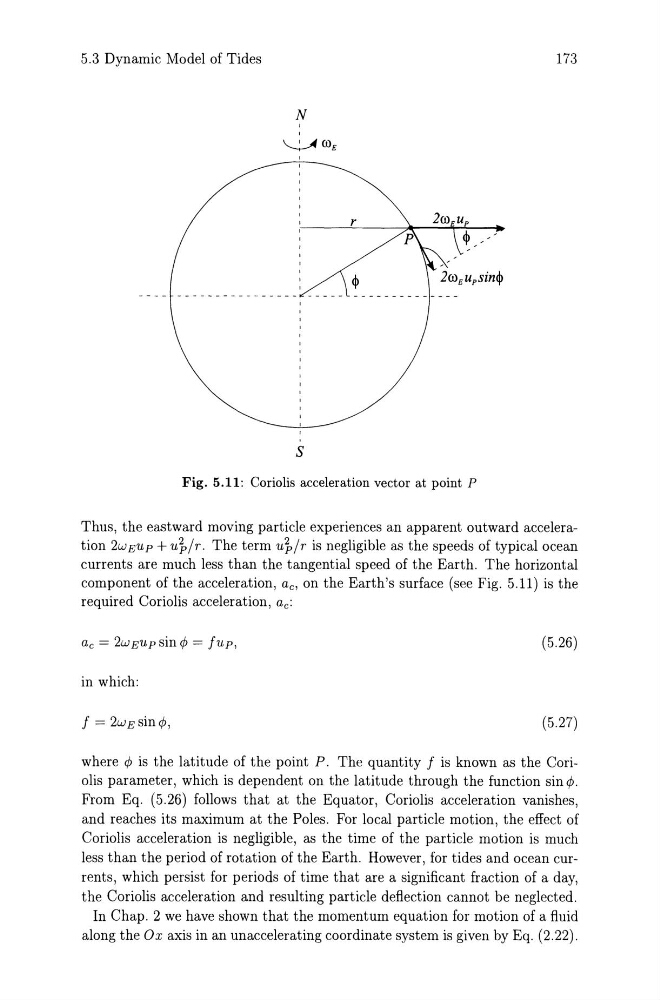
Fig. 5.11: Coriolis acceleration vector at point P
Thus, the eastward moving particle experiences an apparent outward acceleration 2WEUP + u~/r. The term u~/r is negligible as the speeds of typical ocean
currents are much less than the tangential speed of the Earth. The horizontal
component of the acceleration, ac , on the Earth's surface (see Fig. 5.11) is the
required Coriolis acceleration, ac :
ac = 2wEupsin1; = jup,
(5.26)
in which:
j = 2WE sin 1;,
(5.27)
where 1; is the latitude of the point P. The quantity j is known as the Coriolis parameter, which is dependent on the latitude through the function sin 1;.
From Eq. (5.26) follows that at the Equator, Coriolis acceleration vanishes,
and reaches its maximum at the Poles. For local particle motion, the effect of
Coriolis acceleration is negligible, as the time of the particle motion is much
less than the period of rotation of the Earth. However, for tides and ocean currents, which persist for periods of time that are a significant fraction of a day,
the Coriolis acceleration and resulting particle deflection cannot be neglected.
In Chap. 2 we have shown that the momentum equation for motion of a fluid
along the Ox axis in an un accelerating coordinate system is given by Eq. (2.22).
173
N
,
~(OE
r
s
Fig. 5.11: Coriolis acceleration vector at point P
Thus, the eastward moving particle experiences an apparent outward acceleration 2WEUP + u~/r. The term u~/r is negligible as the speeds of typical ocean
currents are much less than the tangential speed of the Earth. The horizontal
component of the acceleration, ac , on the Earth's surface (see Fig. 5.11) is the
required Coriolis acceleration, ac :
ac = 2wEupsin1; = jup,
(5.26)
in which:
j = 2WE sin 1;,
(5.27)
where 1; is the latitude of the point P. The quantity j is known as the Coriolis parameter, which is dependent on the latitude through the function sin 1;.
From Eq. (5.26) follows that at the Equator, Coriolis acceleration vanishes,
and reaches its maximum at the Poles. For local particle motion, the effect of
Coriolis acceleration is negligible, as the time of the particle motion is much
less than the period of rotation of the Earth. However, for tides and ocean currents, which persist for periods of time that are a significant fraction of a day,
the Coriolis acceleration and resulting particle deflection cannot be neglected.
In Chap. 2 we have shown that the momentum equation for motion of a fluid
along the Ox axis in an un accelerating coordinate system is given by Eq. (2.22).