

5.3 Dynamic Model of Tides
a
!
!
!
!
!
!
t = 0
N
r
I
I
I
I
I
I
t = TI2
co-tidal
line
amphidromic
point
175
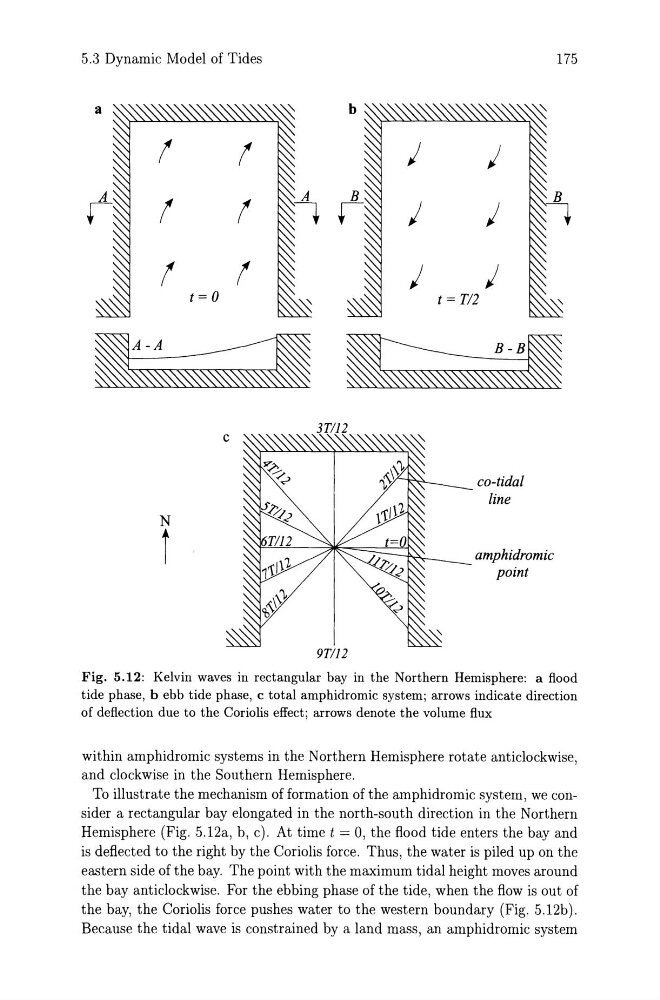
Fig. 5.12: Kelvin waves in rectangular bay in the Northern Hemisphere: a flood
tide phase, b ebb tide phase, c total amphidromic system; arrows indicate direction
of deflection due to the Corio lis effect; arrows denote the volume flux
within amphidromic systems in the Northern Hemisphere rotate anticlockwise,
and clockwise in the Southern Hemisphere.
To illustrate the mechanism of formation of the amphidromic system, we consider a rectangular bay elongated in the north-south direction in the Northern
Hemisphere (Fig. 5.12a, b, c). At time t = 0, the flood tide enters the bay and
is deflected to the right by the Coriolis force. Thus, the water is piled up on the
eastern side of the bay. The point with the maximum tidal height moves around
the bay anticlockwise. For the ebbing phase of the tide, when the flow is out of
the bay, the Corio lis force pushes water to the western boundary (Fig. 5.12b).
Because the tidal wave is constrained by a land mass, an amphidromic system
a
!
!
!
!
!
!
t = 0
N
r
I
I
I
I
I
I
t = TI2
co-tidal
line
amphidromic
point
175
Fig. 5.12: Kelvin waves in rectangular bay in the Northern Hemisphere: a flood
tide phase, b ebb tide phase, c total amphidromic system; arrows indicate direction
of deflection due to the Corio lis effect; arrows denote the volume flux
within amphidromic systems in the Northern Hemisphere rotate anticlockwise,
and clockwise in the Southern Hemisphere.
To illustrate the mechanism of formation of the amphidromic system, we consider a rectangular bay elongated in the north-south direction in the Northern
Hemisphere (Fig. 5.12a, b, c). At time t = 0, the flood tide enters the bay and
is deflected to the right by the Coriolis force. Thus, the water is piled up on the
eastern side of the bay. The point with the maximum tidal height moves around
the bay anticlockwise. For the ebbing phase of the tide, when the flow is out of
the bay, the Corio lis force pushes water to the western boundary (Fig. 5.12b).
Because the tidal wave is constrained by a land mass, an amphidromic system