

162
5. Tides
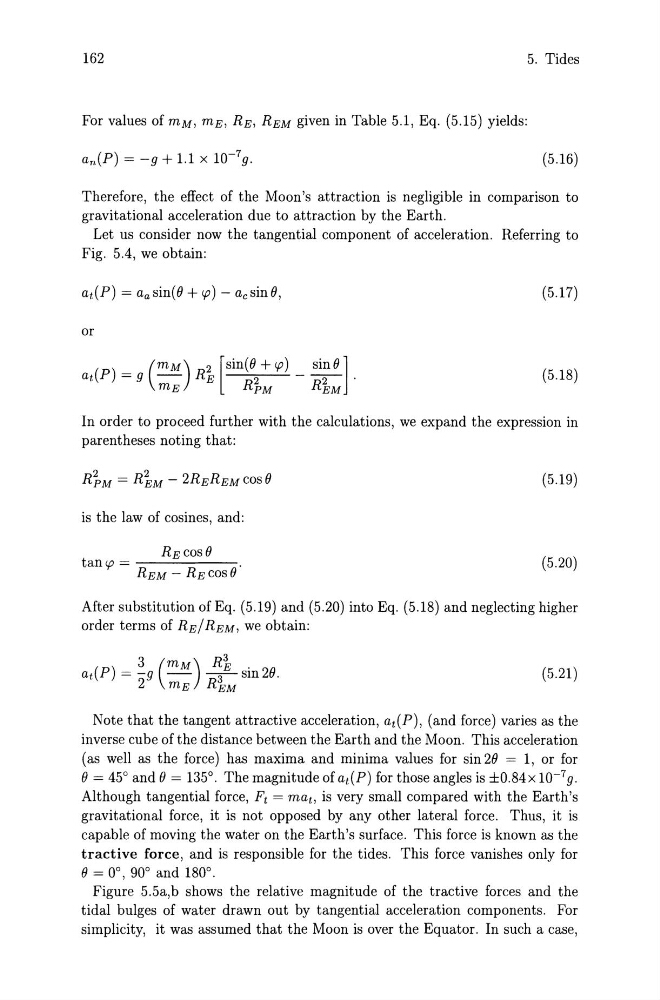
For values of mM, mE, RE, REM given in Table 5.1, Eq. (5.15) yields:
an(P) = -g + 1.1 X 10- 7 g.
(5.16)
Therefore, the effect of the Moon's attraction is negligible in comparison to
gravitational acceleration due to attraction by the Earth.
Let us consider now the tangential component of acceleration. Referring to
Fig. 5.4, we obtain:
(5.17)
or
( ) _ (mM) 2 [sin(o+'P) _ sinO]
at P - 9
RE
2
2 ·
mE
RpM
REM
(5.18)
In order to proceed further with the calculations, we expand the expression in
parentheses noting that:
(5.19)
is the law of cosines, and:
(5.20)
After substitution of Eq. (5.19) and (5.20) into Eq. (5.18) and neglecting higher
order terms of REI REM, we obtain:
3 (mM) R1 .
at(P)=-g -
-3-sm20.
2
mE REM
(5.21)
Note that the tangent attractive acceleration, at (P), (and force) varies as the
inverse cube of the distance between the Earth and the Moon. This acceleration
(as well as the force) has maxima and minima values for sin 20 = 1, or for
o = 45° and 0 = 135°. The magnitude of at(p) for those angles is ±0.84x 10- 7 g.
Although tangential force, Ft = mat, is very small compared with the Earth's
gravitational force, it is not opposed by any other lateral force. Thus, it is
capable of moving the water on the Earth's surface. This force is known as the
tractive force, and is responsible for the tides. This force vanishes only for
(;I = 0°,90° and 180°.
Figure 5.5a,b shows the relative magnitude of the tractive forces and the
tidal bulges of water drawn out by tangential acceleration components. For
simplicity, it was assumed that the Moon is over the Equator. In such a case,
5. Tides
For values of mM, mE, RE, REM given in Table 5.1, Eq. (5.15) yields:
an(P) = -g + 1.1 X 10- 7 g.
(5.16)
Therefore, the effect of the Moon's attraction is negligible in comparison to
gravitational acceleration due to attraction by the Earth.
Let us consider now the tangential component of acceleration. Referring to
Fig. 5.4, we obtain:
(5.17)
or
( ) _ (mM) 2 [sin(o+'P) _ sinO]
at P - 9
RE
2
2 ·
mE
RpM
REM
(5.18)
In order to proceed further with the calculations, we expand the expression in
parentheses noting that:
(5.19)
is the law of cosines, and:
(5.20)
After substitution of Eq. (5.19) and (5.20) into Eq. (5.18) and neglecting higher
order terms of REI REM, we obtain:
3 (mM) R1 .
at(P)=-g -
-3-sm20.
2
mE REM
(5.21)
Note that the tangent attractive acceleration, at (P), (and force) varies as the
inverse cube of the distance between the Earth and the Moon. This acceleration
(as well as the force) has maxima and minima values for sin 20 = 1, or for
o = 45° and 0 = 135°. The magnitude of at(p) for those angles is ±0.84x 10- 7 g.
Although tangential force, Ft = mat, is very small compared with the Earth's
gravitational force, it is not opposed by any other lateral force. Thus, it is
capable of moving the water on the Earth's surface. This force is known as the
tractive force, and is responsible for the tides. This force vanishes only for
(;I = 0°,90° and 180°.
Figure 5.5a,b shows the relative magnitude of the tractive forces and the
tidal bulges of water drawn out by tangential acceleration components. For
simplicity, it was assumed that the Moon is over the Equator. In such a case,