

5.2 Tide Generating Forces and Equilibrium Theory
a
b
18(f
27(f
to the
Moon
tidal bulge
163
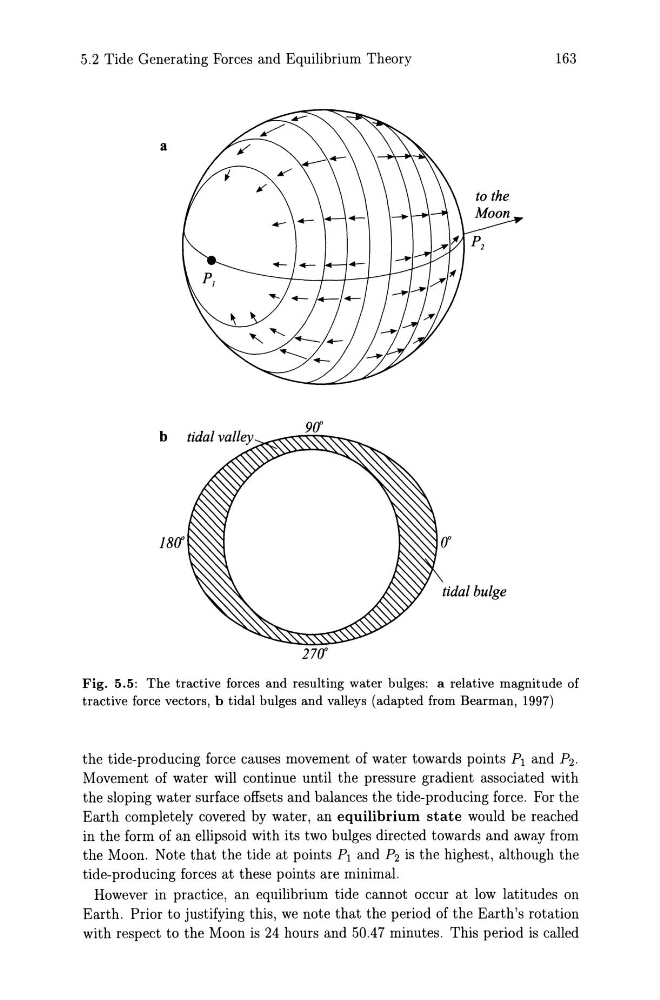
Fig. 5.5: The tractive forces and resulting water bulges: a relative magnitude of
tractive force vectors, b tidal bulges and valleys (adapted from Bearman, 1997)
the tide-producing force causes movement of water towards points PI and P2.
Movement of water will continue until the pressure gradient associated with
the sloping water surface offsets and balances the tide-producing force. For the
Earth completely covered by water, an equilibrium state would be reached
in the form of an ellipsoid with its two bulges directed towards and away from
the Moon. Note that the tide at points PI and P2 is the highest, although the
tide-producing forces at these points are minimal.
However in practice, an equilibrium tide cannot occur at low latitudes on
Earth. Prior to justifying this, we note that the period of the Earth's rotation
with respect to the Moon is 24 hours and 50.47 minutes. This period is called
a
b
18(f
27(f
to the
Moon
tidal bulge
163
Fig. 5.5: The tractive forces and resulting water bulges: a relative magnitude of
tractive force vectors, b tidal bulges and valleys (adapted from Bearman, 1997)
the tide-producing force causes movement of water towards points PI and P2.
Movement of water will continue until the pressure gradient associated with
the sloping water surface offsets and balances the tide-producing force. For the
Earth completely covered by water, an equilibrium state would be reached
in the form of an ellipsoid with its two bulges directed towards and away from
the Moon. Note that the tide at points PI and P2 is the highest, although the
tide-producing forces at these points are minimal.
However in practice, an equilibrium tide cannot occur at low latitudes on
Earth. Prior to justifying this, we note that the period of the Earth's rotation
with respect to the Moon is 24 hours and 50.47 minutes. This period is called