

5.2 Tide Generating Forces and Equilibrium Theory
Earth
/a n
~,,~a,
P,' e a,
161
- - - PM
---- _______ ~
Aloon
<1>---8
- - - - - - - - - - - - - - - - - ~ - - - --. Al
REM
\
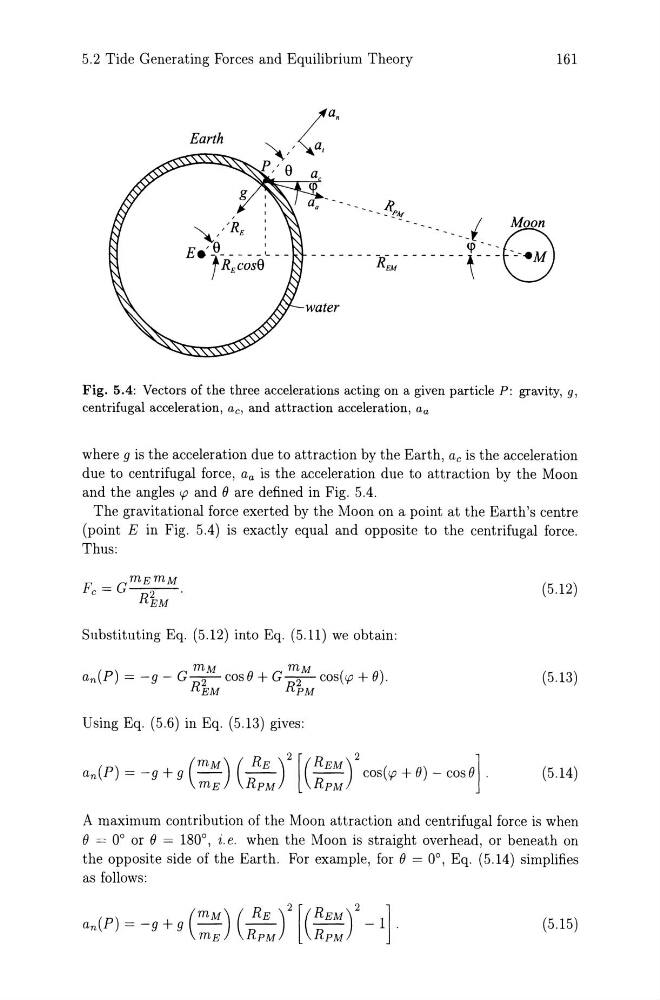
Fig. 5.4: Vectors of the three accelerations acting on a given particle P: gravity, g,
centrifugal acceleration, a c, and attraction acceleration, o,a
where 9 is the acceleration due to attraction by the Earth, a c is the acceleration
due to centrifugal force, aa is the acceleration due to attraction by the Moon
and the angles cp and () are defined in Fig. 5.4.
The gravitational force exerted by the Moon on a point at the Earth's centre
(point E in Fig. 5.4) is exactly equal and opposite to the centrifugal force.
Thus:
(5.12)
Substituting Eq. (5.12) into Eq. (5.11) we obtain:
mM
mM
an(P) = -9 - 0 - 2 - cos () + 0 - 2 - cos(cp + ()).
REM
RpM
(5.13)
Using Eq. (5.6) in Eq. (5.13) gives:
(5.14)
A maximum contribution of the Moon attraction and centrifugal force is when
() = 0° or () = 180°, i.e. when the Moon is straight overhead, or beneath on
the opposite side of the Earth. For example, for () = 0°, Eq. (5.14) simplifies
as follows:
(5.15)
Earth
/a n
~,,~a,
P,' e a,
161
- - - PM
---- _______ ~
Aloon
<1>---8
- - - - - - - - - - - - - - - - - ~ - - - --. Al
REM
\
Fig. 5.4: Vectors of the three accelerations acting on a given particle P: gravity, g,
centrifugal acceleration, a c, and attraction acceleration, o,a
where 9 is the acceleration due to attraction by the Earth, a c is the acceleration
due to centrifugal force, aa is the acceleration due to attraction by the Moon
and the angles cp and () are defined in Fig. 5.4.
The gravitational force exerted by the Moon on a point at the Earth's centre
(point E in Fig. 5.4) is exactly equal and opposite to the centrifugal force.
Thus:
(5.12)
Substituting Eq. (5.12) into Eq. (5.11) we obtain:
mM
mM
an(P) = -9 - 0 - 2 - cos () + 0 - 2 - cos(cp + ()).
REM
RpM
(5.13)
Using Eq. (5.6) in Eq. (5.13) gives:
(5.14)
A maximum contribution of the Moon attraction and centrifugal force is when
() = 0° or () = 180°, i.e. when the Moon is straight overhead, or beneath on
the opposite side of the Earth. For example, for () = 0°, Eq. (5.14) simplifies
as follows:
(5.15)