

160
-----------------•
Earth s centre
. - centrifugal force
< -- gravitational force due to the Moon
. - net tide producing force
5. Tides
~
to Moon
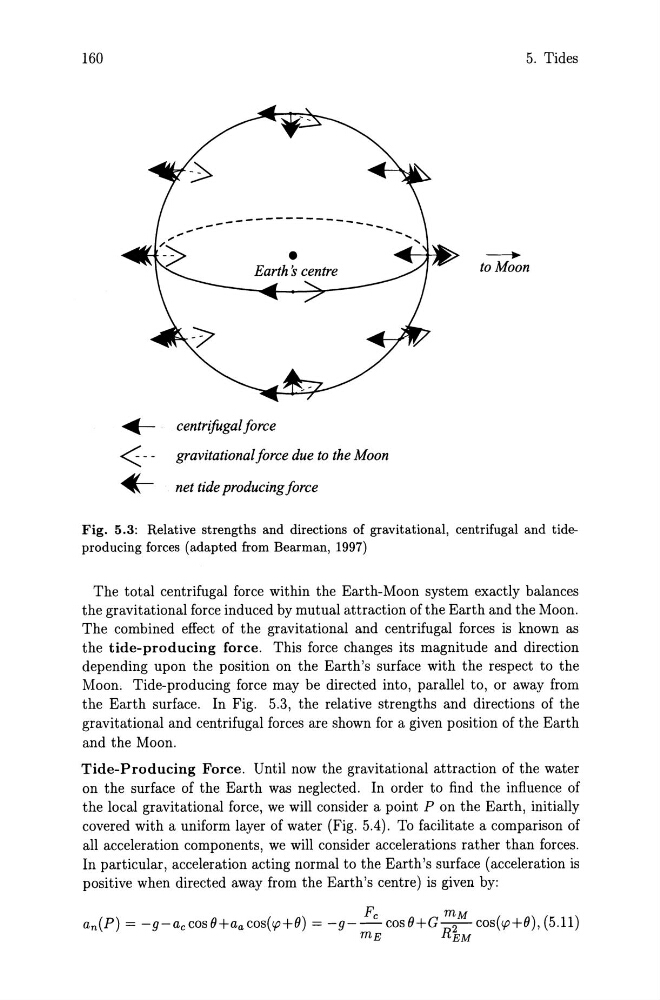
Fig. 5.3: Relative strengths and directions of gravitational, centrifugal and tideproducing forces (adapted from Bearman, 1997)
The total centrifugal force within the Earth-Moon system exactly balances
the gravitational force induced by mutual attraction of the Earth and the Moon.
The combined effect of the gravitational and centrifugal forces is known as
the tide-producing force. This force changes its magnitude and direction
depending upon the position on the Earth's surface with the respect to the
Moon, Tide-producing force may be directed into, parallel to, or away from
the Earth surface. In Fig. 5.3, the relative strengths and directions of the
gravitational and centrifugal forces are shown for a given position of the Earth
and the Moon.
Tide-Producing Force. Until now the gravitational attraction of the water
on the surface of the Earth was neglected. In order to find the influence of
the local gravitational force, we will consider a point P on the Earth, initially
covered with a uniform layer of water (Fig. 5.4). To facilitate a comparison of
all acceleration components, we will consider accelerations rather than forces.
In particular, acceleration acting normal to the Earth's surface (acceleration is
positive when directed away from the Earth's centre) is given by:
-----------------•
Earth s centre
. - centrifugal force
< -- gravitational force due to the Moon
. - net tide producing force
5. Tides
~
to Moon
Fig. 5.3: Relative strengths and directions of gravitational, centrifugal and tideproducing forces (adapted from Bearman, 1997)
The total centrifugal force within the Earth-Moon system exactly balances
the gravitational force induced by mutual attraction of the Earth and the Moon.
The combined effect of the gravitational and centrifugal forces is known as
the tide-producing force. This force changes its magnitude and direction
depending upon the position on the Earth's surface with the respect to the
Moon, Tide-producing force may be directed into, parallel to, or away from
the Earth surface. In Fig. 5.3, the relative strengths and directions of the
gravitational and centrifugal forces are shown for a given position of the Earth
and the Moon.
Tide-Producing Force. Until now the gravitational attraction of the water
on the surface of the Earth was neglected. In order to find the influence of
the local gravitational force, we will consider a point P on the Earth, initially
covered with a uniform layer of water (Fig. 5.4). To facilitate a comparison of
all acceleration components, we will consider accelerations rather than forces.
In particular, acceleration acting normal to the Earth's surface (acceleration is
positive when directed away from the Earth's centre) is given by: