

4.3 Statistical and Spectral Properties of Waves
151
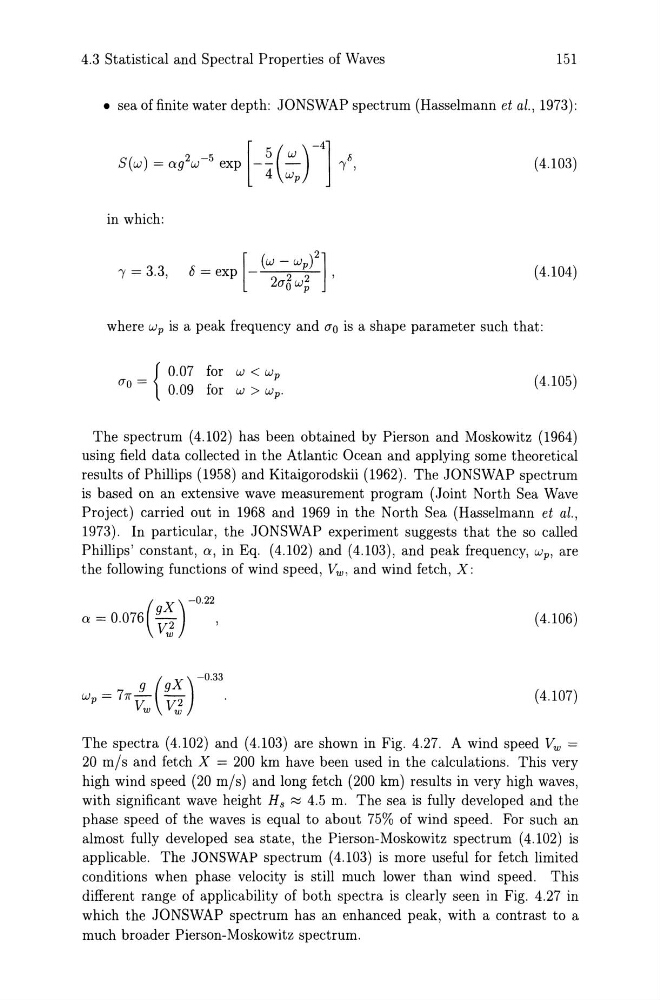
• sea of finite water depth: JONSWAP spectrum (Hasselmann et al., 1973):
(4.103)
in which:
T = 3.3,
(4.104)
where wp is a peak frequency and 0'0 is a shape parameter such that:
{
0.07 for W < wp
0'0 =
0.09 for W > wp.
( 4.105)
The spectrum (4.lO2) has been obtained by Pierson and Moskowitz (1964)
using field data collected in the Atlantic Ocean and applying some theoretical
results of Phillips (1958) and Kitaigorodskii (1962). The JONSWAP spectrum
is based on an extensive wave measurement program (Joint North Sea Wave
Project) carried out in 1968 and 1969 in the North Sea (Hasselmann et at.,
1973). In particular, the JONSWAP experiment suggests that the so called
Phillips' constant, 0:, in Eq. (4.lO2) and (4.lO3), and peak frequency, w p , are
the following functions of wind speed, Vw , and wind fetch, X:
(
gX)-0.22
0: = 0.076 V';
,
(4.lO6)
(
)
-033
W = 77f..!L gX
p
v: V 2
w
w
(4.lO7)
The spectra (4.lO2) and (4.lO3) are shown in Fig. 4.27. A wind speed Vw =
20 mls and fetch X = 200 km have been used in the calculations. This very
high wind speed (20 m/s) and long fetch (200 km) results in very high waves,
with significant wave height Hs ~ 4.5 m. The sea is fully developed and the
phase speed of the waves is equal to about 75% of wind speed. For such an
almost fully developed sea state, the Pierson-Moskowitz spectrum (4.lO2) is
applicable. The JONSWAP spectrum (4.lO3) is more useful for fetch limited
conditions when phase velocity is still much lower than wind speed. This
different range of applicability of both spectra is clearly seen in Fig. 4.27 in
which the JONSWAP spectrum has an enhanced peak, with a contrast to a
much broader Pierson-Moskowitz spectrum.
151
• sea of finite water depth: JONSWAP spectrum (Hasselmann et al., 1973):
(4.103)
in which:
T = 3.3,
(4.104)
where wp is a peak frequency and 0'0 is a shape parameter such that:
{
0.07 for W < wp
0'0 =
0.09 for W > wp.
( 4.105)
The spectrum (4.lO2) has been obtained by Pierson and Moskowitz (1964)
using field data collected in the Atlantic Ocean and applying some theoretical
results of Phillips (1958) and Kitaigorodskii (1962). The JONSWAP spectrum
is based on an extensive wave measurement program (Joint North Sea Wave
Project) carried out in 1968 and 1969 in the North Sea (Hasselmann et at.,
1973). In particular, the JONSWAP experiment suggests that the so called
Phillips' constant, 0:, in Eq. (4.lO2) and (4.lO3), and peak frequency, w p , are
the following functions of wind speed, Vw , and wind fetch, X:
(
gX)-0.22
0: = 0.076 V';
,
(4.lO6)
(
)
-033
W = 77f..!L gX
p
v: V 2
w
w
(4.lO7)
The spectra (4.lO2) and (4.lO3) are shown in Fig. 4.27. A wind speed Vw =
20 mls and fetch X = 200 km have been used in the calculations. This very
high wind speed (20 m/s) and long fetch (200 km) results in very high waves,
with significant wave height Hs ~ 4.5 m. The sea is fully developed and the
phase speed of the waves is equal to about 75% of wind speed. For such an
almost fully developed sea state, the Pierson-Moskowitz spectrum (4.lO2) is
applicable. The JONSWAP spectrum (4.lO3) is more useful for fetch limited
conditions when phase velocity is still much lower than wind speed. This
different range of applicability of both spectra is clearly seen in Fig. 4.27 in
which the JONSWAP spectrum has an enhanced peak, with a contrast to a
much broader Pierson-Moskowitz spectrum.