

138
4 How to Determine Wave Parameters
,-.., 12
E
-...
' "
E
""
'-'
II
E
....
10
' -
0
<\)
i:l
'"
0
~
.0
-t:
t':I
-...
t:l..
'"
....
8
'0
en
:::
E
II
<\)
....
!::
0
' -
<\)
cl::
-t:
\.)
0()
..s!
6
~
Co)
~ I
~
= t':I
....
~
....
<\)
I
en
is
;:.
4
~
$ I
2
o
-1.2 -1.0 -0.8 -0.6 -0.4 -0.2 0.0 0.2 0.4 0.6 0.8 1.0 1.2
Non-dimensional velocity
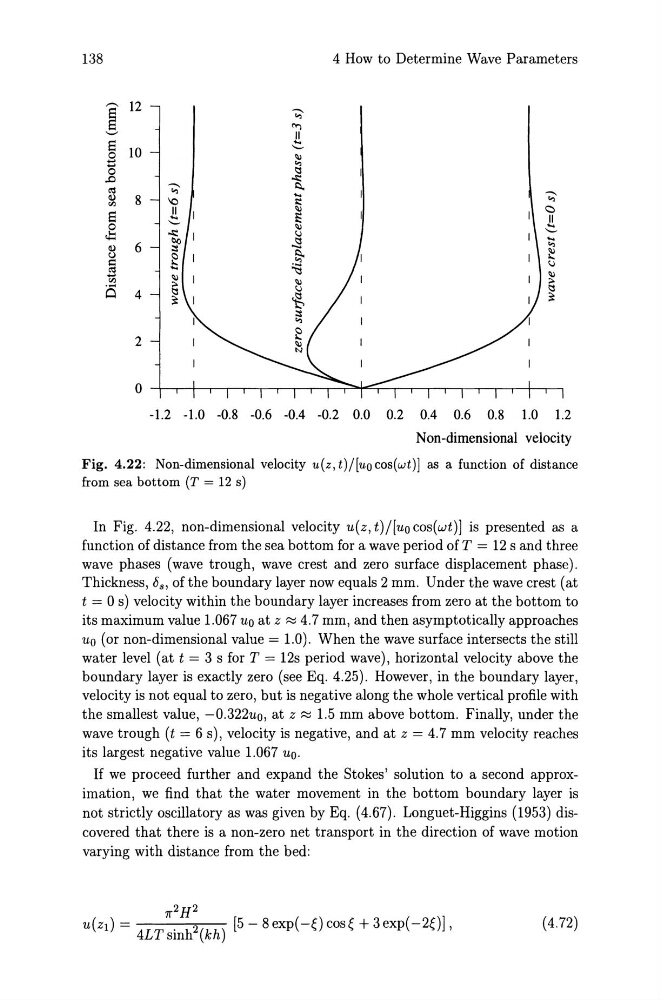
Fig. 4.22: Non-dimensional velocity u(z, t)/[uo cos(wt)] as a function of distance
from sea bottom (T = 12 s)
In Fig. 4.22, non-dimensional velocity u(z, t)/[uo cos(wt)] is presented as a
function of distance from the sea bottom for a wave period of T = 12 s and three
wave phases (wave trough, wave crest and zero surface displacement phase).
Thickness, 8s , of the boundary layer now equals 2 mm. Under the wave crest (at
t = 0 s) velocity within the boundary layer increases from zero at the bottom to
its maximum value 1.067 Uo at z >::; 4.7 mm, and then asymptotically approaches
Uo (or non-dimensional value = 1.0). When the wave surface intersects the still
water level (at t = 3 s for T = 12s period wave), horizontal velocity above the
boundary layer is exactly zero (see Eq. 4.25). However, in the boundary layer,
velocity is not equal to zero, but is negative along the whole vertical profile with
the smallest value, -0.322uo, at z >::; 1.5 mm above bottom. Finally, under the
wave trough (t = 6 s), velocity is negative, and at z = 4.7 mm velocity reaches
its largest negative value 1.067 uo.
If we proceed further and expand the Stokes' solution to a second approximation, we find that the water movement in the bottom boundary layer is
not strictly oscillatory as was given by Eq. (4.67). Longuet-Higgins (1953) discovered that there is a non-zero net transport in the direction of wave motion
varying with distance from the bed:
1I'2H2
U(Zl) =
. 2( ) [5 - 8 exp( -~) cos ~ + 3 exp( -2~)],
4LTsmh kh
(4.72)
4 How to Determine Wave Parameters
,-.., 12
E
-...
' "
E
""
'-'
II
E
....
10
' -
0
<\)
i:l
'"
0
~
.0
-t:
t':I
-...
t:l..
'"
....
8
'0
en
:::
E
II
<\)
....
!::
0
' -
<\)
cl::
-t:
\.)
0()
..s!
6
~
Co)
~ I
~
= t':I
....
~
....
<\)
I
en
is
;:.
4
~
$ I
2
o
-1.2 -1.0 -0.8 -0.6 -0.4 -0.2 0.0 0.2 0.4 0.6 0.8 1.0 1.2
Non-dimensional velocity
Fig. 4.22: Non-dimensional velocity u(z, t)/[uo cos(wt)] as a function of distance
from sea bottom (T = 12 s)
In Fig. 4.22, non-dimensional velocity u(z, t)/[uo cos(wt)] is presented as a
function of distance from the sea bottom for a wave period of T = 12 s and three
wave phases (wave trough, wave crest and zero surface displacement phase).
Thickness, 8s , of the boundary layer now equals 2 mm. Under the wave crest (at
t = 0 s) velocity within the boundary layer increases from zero at the bottom to
its maximum value 1.067 Uo at z >::; 4.7 mm, and then asymptotically approaches
Uo (or non-dimensional value = 1.0). When the wave surface intersects the still
water level (at t = 3 s for T = 12s period wave), horizontal velocity above the
boundary layer is exactly zero (see Eq. 4.25). However, in the boundary layer,
velocity is not equal to zero, but is negative along the whole vertical profile with
the smallest value, -0.322uo, at z >::; 1.5 mm above bottom. Finally, under the
wave trough (t = 6 s), velocity is negative, and at z = 4.7 mm velocity reaches
its largest negative value 1.067 uo.
If we proceed further and expand the Stokes' solution to a second approximation, we find that the water movement in the bottom boundary layer is
not strictly oscillatory as was given by Eq. (4.67). Longuet-Higgins (1953) discovered that there is a non-zero net transport in the direction of wave motion
varying with distance from the bed:
1I'2H2
U(Zl) =
. 2( ) [5 - 8 exp( -~) cos ~ + 3 exp( -2~)],
4LTsmh kh
(4.72)