

4.2 Wave Parameters Based on Small Amplitude Wave Theory
137
Assuming that the bottom is flat and smooth, and flow is laminar, the velocity
distribution in the boundary layer has been found by Stokes solving the viscous
equation of motion in the form (Freds0e and Deigaard, 1992):
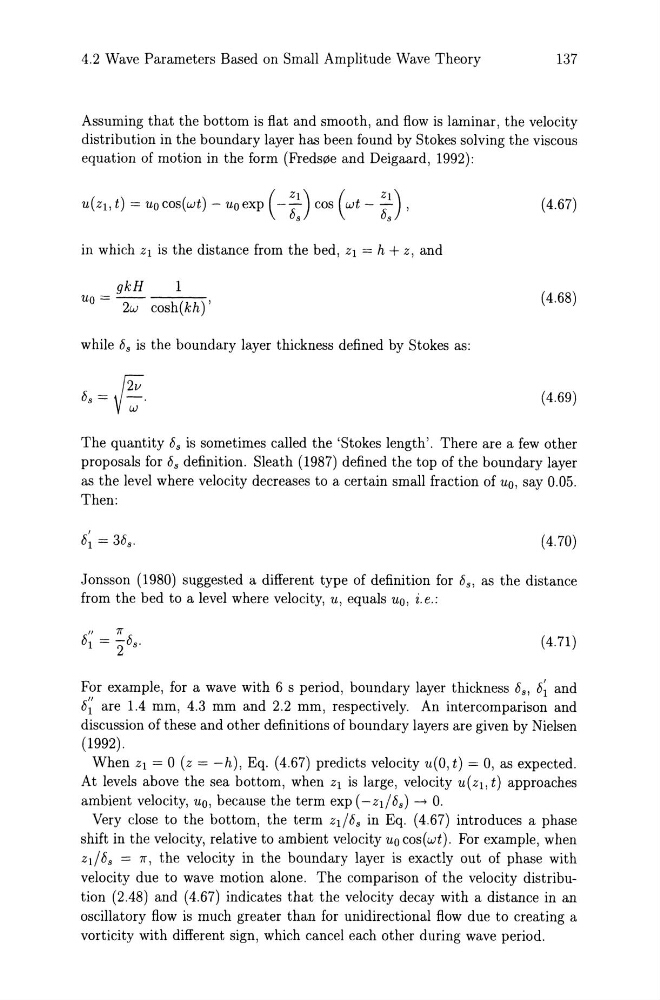
U(Zl,t) = uocos(wt) - uoexp (- ~:) cos (wt - ~J '
( 4.67)
in which Zl is the distance from the bed, Zl = h + z, and
gkH
1
Uo = - -
,
2w cosh(kh)
( 4.68)
while 88 is the boundary layer thickness defined by Stokes as:
88 = ~.
(4.69)
The quantity 88 is sometimes called the 'Stokes length'. There are a few other
proposals for 88 definition. Sleath (1987) defined the top of the boundary layer
as the level where velocity decreases to a certain small fraction of uo, say 0.05.
Then:
8~ = 388 ,
(4.70)
Jonsson (1980) suggested a different type of definition for 8s , as the distance
from the bed to a level where velocity, u, equals uo, i.e.:
(4.71 )
For example, for a wave with 6 s period, boundary layer thickness 8., 8~ and
8~ are 1.4 mm, 4.3 mm and 2.2 mm, respectively. An intercomparison and
discussion of these and other definitions of boundary layers are given by Nielsen
(1992).
When Zl = 0 (z = -h), Eq. (4.67) predicts velocity u(O, t) = 0, as expected.
At levels above the sea bottom, when Zl is large, velocity U(Zl' t) approaches
ambient velocity, uo, because the term exp (-zI/88 ) --> O.
Very close to the bottom, the term zI/88 in Eq. (4.67) introduces a phase
shift in the velocity, relative to ambient velocity Uo cos(wt). For example, when
zI/ 8 8 = 11", the velocity in the boundary layer is exactly out of phase with
velocity due to wave motion alone. The comparison of the velocity distribution (2.48) and (4.67) indicates that the velocity decay with a distance in an
oscillatory flow is much greater than for unidirectional flow due to creating a
vorticity with different sign, which cancel each other during wave period.
137
Assuming that the bottom is flat and smooth, and flow is laminar, the velocity
distribution in the boundary layer has been found by Stokes solving the viscous
equation of motion in the form (Freds0e and Deigaard, 1992):
U(Zl,t) = uocos(wt) - uoexp (- ~:) cos (wt - ~J '
( 4.67)
in which Zl is the distance from the bed, Zl = h + z, and
gkH
1
Uo = - -
,
2w cosh(kh)
( 4.68)
while 88 is the boundary layer thickness defined by Stokes as:
88 = ~.
(4.69)
The quantity 88 is sometimes called the 'Stokes length'. There are a few other
proposals for 88 definition. Sleath (1987) defined the top of the boundary layer
as the level where velocity decreases to a certain small fraction of uo, say 0.05.
Then:
8~ = 388 ,
(4.70)
Jonsson (1980) suggested a different type of definition for 8s , as the distance
from the bed to a level where velocity, u, equals uo, i.e.:
(4.71 )
For example, for a wave with 6 s period, boundary layer thickness 8., 8~ and
8~ are 1.4 mm, 4.3 mm and 2.2 mm, respectively. An intercomparison and
discussion of these and other definitions of boundary layers are given by Nielsen
(1992).
When Zl = 0 (z = -h), Eq. (4.67) predicts velocity u(O, t) = 0, as expected.
At levels above the sea bottom, when Zl is large, velocity U(Zl' t) approaches
ambient velocity, uo, because the term exp (-zI/88 ) --> O.
Very close to the bottom, the term zI/88 in Eq. (4.67) introduces a phase
shift in the velocity, relative to ambient velocity Uo cos(wt). For example, when
zI/ 8 8 = 11", the velocity in the boundary layer is exactly out of phase with
velocity due to wave motion alone. The comparison of the velocity distribution (2.48) and (4.67) indicates that the velocity decay with a distance in an
oscillatory flow is much greater than for unidirectional flow due to creating a
vorticity with different sign, which cancel each other during wave period.